

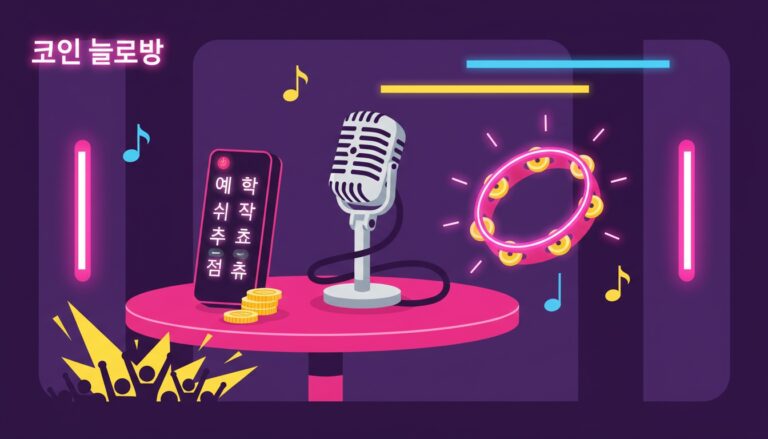
Phase 1: The Vibe check (Immersive Hook)
Hello! I’m your Daily Hangul editor.
You know that scene in every K-Drama? The usually stoic Manager Kim suddenly ties a necktie around his head, grabs a tambourine, and screams into a microphone while disco lights spin wildly. That is the power of the Noraebang (Karaoke).
In Korea, singing isn’t just about hitting the right notes. It’s about releasing stress (or stress-pulgi). If you are invited to a Noraebang, nobody expects you to be Beyoncé or BTS. They expect you to have energy. But what if you don’t know the lyrics? What if the Hangul on the screen is moving too fast?
Don’t panic. You don’t need to sing every word. You just need to know the “hype” phrases. These are the magic words you shout during the instrumental breaks to keep the energy high. Master these three phrases, and you’ll survive—and maybe even become the MVP of the night.
Phase 2: The “Hype” Essentials (Deep Dive)
Here are the three phrases you need when the beat drops.
1. 소리 질러! (Sori jilleo!)
- Pronunciation:
So-ri jill-uh!(Think: “Sorry” + “Jill” + “Uh”) - Meaning:
- Literal: Scream! / Yell!
- Real Vibe: “Make some noise!”
- K-Culture Moment: You will hear this at every K-Pop concert. Right before the chorus drops, the idol points the mic to the crowd and yells “Sori jilleo!”
- Editor’s Insight: Use this when the song is building up. It shows you are leading the vibe. It commands the room.
- Situation Spectrum:
[🚫 Elders/Formal] ———— [⚠️ Mixed Company] ———— [✅ Friends/Party]
(Use with caution with your boss, unless they are already dancing on the table.) - 🤔 Think About It: Why is “screaming” considered a good thing here? In many Western cultures, screaming is for emergencies. In Korea, it’s a tool for collective release.
2. 신난다! (Sinnanda!)
- Pronunciation:
Shin-nan-da! - Meaning:
- Literal: It is exciting!
- Real Vibe: “This is so fun!” / “I’m pumped!”
- K-Culture Moment: Watching a variety show like Running Man, when the cast wins a game or hears good news, they clap and shout this.
- Editor’s Insight: You don’t say this quietly. You shout it while shaking a tambourine. It tells your friends, “I am enjoying your singing!”
- Situation Spectrum:
[🚫 Funeral] ———— [⚠️ Library] ———— [✅ Anywhere else]
(Totally safe to use with anyone, even bosses, to show you are having a good time.)
3. 한 번 더! (Han beon deo!)
- Pronunciation:
Han bun duh! - Meaning:
- Literal: One time more.
- Real Vibe: “Encore!” / “One more time!”
- K-Culture Moment: The song ends, but the mood is too good to stop. Someone (usually the one who paid) yells this to keep the party going.
- Editor’s Insight: Use this when a really popular song ends, or if someone made a mistake and wants to restart. It’s encouraging.
- Situation Spectrum:
[🚫 Tired People] ———— [⚠️ Late Night] ———— [✅ Peak Party]
Phase 3: Textbook vs. Real Life
Let’s be honest. Nobody speaks like a textbook in a dark room with flashing lights.
| Situation | 📖 Textbook Korean | 🗣️ Real “Noraebang” Korean | 💡 The Difference |
|---|---|---|---|
| Cheering | 노래를 잘 하시네요. (You sing well.) | 대박! (Daebak! – Awesome!) | Textbook is polite but kills the vibe. “Daebak” is instant praise. |
| Starting | 시작합시다. (Let’s start.) | 가자! (Gaja! – Let’s go!) | “Gaja” is aggressive, energetic, and sets the momentum. |
| Ending | 이제 그만할까요? (Shall we stop now?) | 막곡? (Mak-gok? – Last song?) | “Mak-gok” is the efficient slang for “Is this the final track?” |
Bottom Note: If you are with very senior executives, stick to the textbook or just clap. But with friends? Use the Real Korean column.
Phase 4: Cultural Deep Dive — The Art of “Heung” (흥)
4-1. Non-verbal: The Tambourine Technique
In a Korean Noraebang, sitting still is a crime. If you aren’t singing, your job is to be the “Tambourine Manager.”
* The Rule: Don’t just shake it randomly. Hit it on the beat.
* The Nunchi (Eye-measure): If a ballad is playing, put the tambourine down. If it’s “Gangnam Style,” you better be shaking that thing like your life depends on it.
4-2. Why do Koreans love dance songs?
Korea is a high-pressure society. Long work hours, intense study schedules. The Noraebang is a sacred space where the hierarchy dissolves slightly. The concept of Heung (흥) refers to a collective joy and energy. When you sing a dance song, you aren’t just singing; you are trying to awaken the “Heung” in everyone else. It’s not about the pitch; it’s about the passion.
Phase 5: Immersive Roleplay
Setting: It is Friday night, 9 PM. You are at a Coin Noraebang (Co-No) in Hongdae with two Korean friends, Min-ji and Jun-ho. The room is tiny, purple lights are flashing, and BLACKPINK’s “How You Like That” just started.
Characters:
* YOU: An enthusiastic beginner in Korean.
* Min-ji: The K-Pop expert who booked the room.
Dialogue:
Min-ji: 야, 이 노래 알아? 내가 제일 좋아하는 거야! 🎤
(Ya, i norae ara? Naega jeil joahaneun geoya!)
(Hey, do you know this song? It’s my favorite!)
YOU: (Nodding enthusiasticallly)
Start! I know the chorus!
(🎭 Stage Direction: The beat drops. Min-ji starts rapping.)
Min-ji: (Rapping perfectly)
Look at you, now look at me…
🔀 Decision Point: The chorus is coming. Min-ji looks at you. What do you shout?
- A) “잘한다!” (Jalhanda! – You’re doing well!)
- B) “소리 질러!” (Sori jilleo! – Make some noise!)
- C) “안녕하세요!” (Annyeonghaseyo! – Hello!)
✅ Best Choice: B) “소리 질러!”
Why? This is the peak of the song. Option A is okay, but a bit like a parent cheering for a child. Option B matches the energy of a dance track. Option C… please don’t say hello in the middle of a song.
Min-ji: (Laughs and screams) Woooo!
YOU: 신난다!
(Sinnanda!)
(This is exciting!)
Phase 6: 10-Second Shadowing Drill
Don’t just read it. Feel it. Say this while imagining loud bass music.
- Emotion: 😤 Hype / Energetic
- Drill:
다 같이 / 소리 질러!
(Da gachi / so-ri jill-uh!)
Everyone together / make some noise!
Phase 7: K-Culture Mini Glossary
| Korean | Romanization | English | Context |
|---|---|---|---|
| 코노 | Ko-no | Coin Karaoke | A cheap, small karaoke booth where you pay by the song (usually 2 songs for 1,000 won). Perfect for solo practice. |
| 서비스 | Service | Free Service | If you go to a regular (big) Noraebang, the owner might give you 10-20 minutes of extra time for free. That is “Service.” |
| 18번 | Ship-pal-beon | Song #18 | It means your “Go-to song” or favorite song to sing. “What is your 18-beon?” |
Phase 8: Traveler’s Survival Kit (Noraebang Edition)
You are in the room. You have the remote control. It is enormous and covered in Korean buttons. Help.
🆘 Survival Buttons (The Remote)
* 취소 (Chwi-so): Cancel. Push this if you picked the wrong song or the intro is too long.
* 시작 (Si-jak): Start.
* 예약 (Ye-yak): Reserve. This queues a song so it plays next.
* 우선예약 (Useon-yeyak): Priority Reserve. It cuts the line and plays your song immediately. (⚠️ Use carefully! Your friends might hate you.)📌 Editor’s Travel Note:
Most machines have a button/search function for “POP” (English songs). You don’t have to sing in Korean! But throwing in one K-Pop chorus makes you a legend.
Phase 9: Think Deeper — “Why so loud?”
Language & Release:
Have you noticed that Korean has many short, explosive phrases like “Gaja!” (Let’s go), “Jjang!” (The best), and “Daebak!”? In a culture that emphasizes politeness and hierarchy (bowing, honorifics) during the day, the language of the night—specifically in a Noraebang—becomes short, direct, and emotive. It is a linguistic venting valve. When you shout “Sori jilleo,” you aren’t just translating “scream”; you are participating in a cultural ritual of shedding the day’s burden.
Phase 10: FAQ & Troubleshooting
Q: Can I sing a ballad when everyone is dancing?
A: Read the room (Nunchi). If everyone is sweating and jumping, playing a sad breakup song is a “mood killer” (Gip-min-nam). Wait for a break in the energy.
Q: Do I have to sing if I’m bad?
A: Yes. Nobody cares if you are bad. They care if you are boring. Just pick a song with a lot of English or an easy beat, and shout “Sinnanda!” a lot.
❌ Common Mistake #1: Not clapping when others sing.
✅ Fix: Even if you are on your phone looking for your next song, keep one hand tapping the table or clapping. It’s basic etiquette.
Phase 11: Wrap-up
One-Liner:
In a Korean Noraebang, energy is more important than ability—just shout “Sori jilleo!”
Action Mission:
* 🥉 Bronze: Say “Sori jilleo!” loudly in your room when nobody is home.
* 🥈 Silver: Find a “Karaoke Version” of a K-Pop song on YouTube and practice shouting “Sinnanda” during the dance break.
* 🥇 Gold: Go to a Coin Noraebang (or any Karaoke) and use the remote control buttons (Start/Cancel) correctly.
K-Culture Mission:
Next time you watch a K-Pop performance video, count how many times they shout or hype the crowd. It’s part of the song!
Phase 12: Quiz
- Situation: The music stops, but you want to sing one more song. What do you shout?
- a) Daebak!
- b) Han beon deo!
- c) Annyeong!
- True or False: You should always sit quietly and listen politely when someone sings a fast dance song in a Noraebang.
- (True / False)
- Button Check: Which button cancels the current song?
- a) 시작 (Si-jak)
- b) 예약 (Ye-yak)
- c) 취소 (Chwi-so)
Answers: 1. (b), 2. False (Shake that tambourine!), 3. (c)
Frequently Asked Questions (FAQ)
Q: What does "소리 질러! (Sori jilleo!)" mean in Korean and how do you pronounce it?
A: In Korean, "소리 질러! (Sori jilleo!)" is pronounced [So-ri jill-uh! (Think: "Sorry" + "Jill" + "Uh"] and means: Literal: Scream! / Yell!
Q: What does "신난다! (Sinnanda!)" mean in Korean and how do you pronounce it?
A: In Korean, "신난다! (Sinnanda!)" is pronounced [Shin-nan-da!] and means: Literal: It is exciting!
Q: What does "한 번 더! (Han beon deo!)" mean in Korean and how do you pronounce it?
A: In Korean, "한 번 더! (Han beon deo!)" is pronounced [Han bun duh!] and means: Literal: One time more.







