

Phase 1: The “Perfect Score” Obsession
Hello, Daily Hangul family. It’s your editor here.
Let’s talk about numbers. You’re watching a music show, and your favorite idol group wins first place by a margin of 12 points. The fans go wild. But then, a post appears on a community forum: “The broadcast score looks suspicious.” Suddenly, Excel sheets are flying, standard deviations are calculated, and the fandom is at war.
Or maybe you’re in Myeongdong. A cosmetic shop claims to be “No. 1 in Customer Satisfaction.” You walk in, and it’s empty. Just crickets and a very bored staff member.
Korea is a society driven by data—rankings, sales figures, viewership ratings (sicheong-ryul). But because numbers hold so much power here, the temptation to tweak them is massive. If you accept every statistic at face value in Korea, you might end up buying a “best-selling” cream that breaks you out or investing in a “booming” stock that’s about to crash.
Today, we aren’t just learning vocabulary; we are learning how to be a smart skeptic in Korean. We’re upgrading your lens from “Tourist” to “Analyst.”
Phase 2: Deep Dive into Deception
Here are three expressions to help you call out the bluff. These are C2-level gems that mix metaphor with sharp critique.
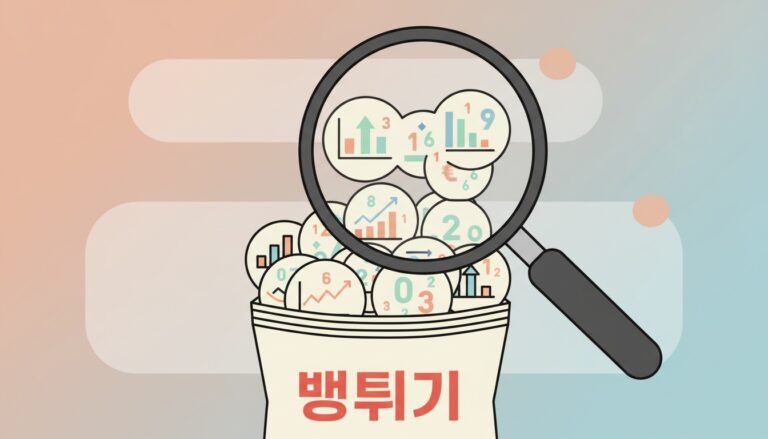
1. 뻥튀기하다 (Ppeong-twigi-hada)
- Pronunciation: [Ppung-twi-gi-ha-da] (Think of a popping sound, like popcorn)
- Meaning: To inflate (data/numbers) drastically.
- Literal: To make puffed rice snacks.
- Nuance: Just as a small handful of corn expands into a huge bag of popcorn, the data has been puffed up with hot air. It implies the core substance is small, but the volume looks impressive.
- K-Culture Moment: You see this in company “specs” or movie promotion. “Cumulative audience of 10 million!” (…if you count the trailers watched online).
- Editor’s Insight: This is more visceral than simply saying “exaggerate” (과장하다). It mocks the hollowness of the data. It suggests that if you poke it, it will crumble.
- Situation Spectrum:
[🚫 Formal Reports] ———— [⚠️ Meeting/Debate] ———— [✅ Casual/Semi-formal] - 🤔 Think About It: Why does Korean culture use a food metaphor for lying about numbers? Perhaps because “뻥튀기” is cheap, abundant, and mostly air—just like bad data.
2. 주작 (Jujak)
- Pronunciation: [Ju-jak]
- Meaning: Fabrication / Rigging / Staged.
- Origin: Originally from the word 조작 (Jojak – manipulation), but morphed in internet slang (gaming culture) to evade censorship filters, now widely used to describe anything fake.
- K-Culture Moment: If a reality dating show feels scripted, or an idol’s “live” vocal sounds too perfect, the comments section will be flooded with “이거 주작 아냐?” (Isn’t this rigged?).
- Editor’s Insight: This word carries a heavy cynical tone. If you use this, you aren’t just doubting; you are accusing someone of orchestrating a lie.
- Situation Spectrum:
[🚫 Business Email] ———— [⚠️ Private Critique] ———— [✅ Internet/Friends] - 🤔 Think About It: In an era of “Deep Fakes,” how does a slang word like Jujak protect people from being fooled?
3. 통계의 마사지 (Tong-gye-ui Massage)
- Pronunciation: [Tong-gye-ui Ma-sa-ji]
- Meaning: Data massaging / Fudging the numbers.
- K-Culture Moment: Used in corporate dramas like Misaeng. A team leader might tell a subordinate to “massage the data” before the executive presentation to make the sales drop look like a “strategic adjustment.”
- Editor’s Insight: It sounds softer than “manipulation.” It implies the data isn’t technically a lie, just… rubbed and pressed until it looks prettier. It’s the polite face of dishonesty.
- Situation Spectrum:
[🚫 Courtroom] ———— [⚠️ Internal Strategy Meeting] ———— [✅ Industry Talk]
Phase 3: Textbook vs. Real Life
How to express skepticism without sounding like a robot.
| Situation | 📖 Textbook Korean | 🗣️ Real Korean (C2 Level) | 💡 Why the difference? |
|---|---|---|---|
| Questioning data validity | 이 통계는 정확합니까? (Is this statistic accurate?) | 이거 수치가 좀 튀는데? (These numbers are jumping/sticking out a bit?) | “튀다” implies an anomaly or outlier that feels unnatural. |
| Suspecting fake reviews | 거짓 리뷰가 많은 것 같습니다. (There seem to be many fake reviews.) | 알바 쓴 냄새가 나요. (It smells like they hired part-timers.) | “Alba” (part-timers) are often hired to write fake comments. “Smell” creates a visceral suspicion. |
| Pointing out a bubble | 가격이 실제 가치보다 높습니다. (The price is higher than actual value.) | 거품이 너무 꼈어요. (There’s too much foam/bubble trapped in it.) | Refers to beer foam or soap bubbles—looks full, but disappears quickly. |
💡 Bottom Note: In high-level Korean, metaphors (smell, foam, popping) are often stronger than literal adjectives (incorrect, high, fake).
Phase 4: Cultural Deep Dive — The “Sajaegi” Scandal
Let’s talk about the dark side of K-Pop charts: 음원 사재기 (Digital Chart Manipulation / Hoarding).
In Korea, ranking is everything. Being #1 on the Melon Chart isn’t just about pride; it’s about event fees and CF contracts. This pressure birthed “Sajaegi”—agencies buying thousands of IDs or using bot farms to stream their own artist’s songs 24/7.
When a ballad by an unknown singer suddenly beats BTS at 3 AM (when idol fandoms are usually asleep), the public gets suspicious. They call this “기계 픽” (Pick by the Machine) versus “대중 픽” (Pick by the Public).
Connecting to Skepticism:
Koreans have developed a “hawk eye” for graphs. If a graph line goes up vertically (called a “wall”), people immediately scream “Jujak!” (Rigged!). The culture of intense competition has paradoxically created a culture of intense verification.
Phase 5: Immersive Roleplay — The Marketing Review
Setting: A tense meeting room in Gangnam. End of Q3. The marketing agency is presenting “amazing” viral results to you, the client.
Characters:
* YOU (Client): A sharp-eyed brand manager who knows standard engagement rates.
* Director Kim (Agency): Trying to hide the fact that he bought fake views.
Dialogue:
Director Kim: 이번 바이럴 영상 반응이 폭발적입니다! 조회수가 벌써 100만을 넘겼습니다.
(Ibeon baireol yeongsang baneung-i pokbaljeok-imnida! Johoesu-ga beolsseo baekman-eul neomgyeot-seumnida.)
(Translation: The reaction to this viral video is explosive! Views have already passed 1 million.)
YOU: 100만이요? 그런데 댓글은 왜 10개밖에 없죠?
(Baekman-iyo? Geureonde daetgeul-eun wae yeol-gae-bakke eopjjo?)
(Translation: 1 million? But why are there only 10 comments?)
Director Kim: (땀을 닦으며) 아, 그게… 공유가 많이 돼서 그렇습니다.
((Wiping sweat) Ah, that’s… it’s because it was shared a lot.)
🔀 Decision Point! How do you grill him?
- A) “거짓말하지 마세요.” (Stop lying.)
- B) “데이터 뻥튀기 하신 거 아니에요? 전환율 좀 봅시다.” (Didn’t you inflate the data? Let’s see the conversion rate.)
- C) “아, 그렇군요. 대단하네요.” (Ah, I see. That’s amazing.)
✅ Best Choice: B. Option A is too aggressive and breaks face instantly. Option B uses the specific vocabulary (뻥튀기) to show you know exactly what’s happening, demanding hard proof (conversion rate) instead of vanity metrics.
Phase 6: 10-Second Shadowing Drill
Practice the tone of skepticism. Raise your eyebrow for full effect.
- 🤔 Suspicious: 이 그래프 / 뭔가 좀 / 이상하지 않아요?
(I geu-rae-peu / meon-ga jom / i-sang-ha-ji a-na-yo?)
Isn’t this graph… a little bit strange? -
😤 Accusatory: 이거 완전 / 눈속임이잖아요!
(I-geo wan-jeon / nun-so-gim-i-ja-na-yo!)
This is completely / visual trickery!
Phase 7: K-Culture Mini Dictionary (The Skeptic’s Edition)
| Korean | Romanization | Meaning | Context |
|---|---|---|---|
| 언플 (언론플레이) | Un-peul | Media Play | Manipulating public opinion through paid news articles. |
| 역주행 | Yeok-ju-haeng | Driving in reverse (Climbing charts) | When a song rises up the charts months after release. Usually good, but sometimes suspicious if too fast. |
| 팩트폭행 (팩폭) | Paek-teu-pok-haeng | Fact Assault | Hitting someone with facts so hard it hurts. “Truth bomb.” |
| 내돈내산 | Nae-don-nae-san | My money, my purchase | A disclaimer used by influencers to prove it’s NOT a sponsored ad. Essential for trust. |
Phase 8: Traveler’s Survival Kit — Spotting Fake Reviews
Even if you aren’t analyzing corporate data, you need to eat. Here is how to navigate Naver Maps or KakaoMap like a skeptic.
🆘 Survival Tip: Filter by “Yeong-su-jeung Review” (Receipt Review)
In Korea, to leave a verified review on Naver, you often have to scan the physical receipt. This system was built to fight data manipulation.
- Look for: “영수증 인증” (Receipt Verified)
- Avoid: Blogs that end with “This product was provided by…” (소정의 원고료를 지원받아…)
- Skeptic’s Phrase: “광고 거르고 찐맛집 찾자.” (Let’s filter out the ads and find the real tasty place.)
Phase 9: Think Deeper — High Context vs. Hard Data
Trust in a High-Context Society
Historically, Korean society relied heavily on “Nunchi” (reading the air) and relationships rather than cold, hard contracts. However, as the economy exploded, this reliance on “implied trust” became a vulnerability for fraud (scams, fake academic credentials, rigged votes).
Now, we see a clash. On one hand, people still trust “Power Bloggers” and “Influencers” because they feel like friends (emotional connection). On the other hand, the younger generation, burned by rigged auditions (like the Produce 101 scandal) and housing bubbles, is becoming hyper-obsessed with “Fairness” and “Raw Data.” Using words like “Pack-teu” (Fact) has become a weapon for the younger generation to challenge the authority of the older generation who might just say, “Trust me.”
💬 Your Turn: In your country, do people trust an influencer’s recommendation more, or a statistic on a website? Why?
Phase 10: FAQ & Troubleshooting
Q: Is it rude to ask for “evidence” (증거) from an elder or superior?
A: Yes, if you ask directly like “Show me the evidence!” (증거 대보세요!). That’s fighting words. Instead, frame it as your own lack of understanding.
* Say this: “제가 잘 이해가 안 가서 그러는데, 구체적인 데이터를 좀 더 볼 수 있을까요?” (I’m not understanding it well, could I see some more concrete data?)
Q: What is “Gook-ppong” (국뽕) related to statistics?
A: It refers to an excessive national pride, often fueled by cherry-picked statistics (e.g., “Korea is #1 in the world for X”). It’s similar to “drinking the Kool-Aid” of nationalism. A skeptic might say, “That sounds like too much Gook-ppong.”
Phase 11: Wrap-up & Action Items
Summary: Today we learned that in Korea, popcorn (뻥튀기) is for inflated data, massage (마사지) is for tweaking numbers, and receipt reviews (영수증 리뷰) are your best friends.
Action Missions:
* 🥉 Bronze: Read a K-Pop music video comment section and look for the word “주작” or “Views.”
* 🥈 Silver: Go to a Korean restaurant review site. Can you spot a review that looks like an ad? (Too many polished photos, generic praise).
* 🥇 Gold: Use the phrase “거품이 좀 있는 것 같아요” (I think there’s a bit of a bubble/hype) when discussing a popular movie or trend with a friend.
Phase 12: Quiz — The Skeptic’s Test
- Situation: Your friend says an idol group sold 1 million albums, but you see stacks of them thrown away on the street (fans buying for lottery tickets). What word describes this inflation?
- a) 팩트폭행
- b) 뻥튀기
- c) 내돈내산
- True or False: “역주행” (Reversing up the charts) is always a sign of manipulation.
- ( ) True / ( ) False
- Fill in the Blank: “Reviewers who actually bought the food write ______ reviews.”
- [ 영 _ _ 리 _ ]
Answers:
1. b) 뻥튀기. (It implies the volume is high, but the substance—actual listeners—is low.)
2. False. Sometimes it’s genuine viral success (like Brave Girls’ “Rollin'”). But skeptics will always check!
3. 영수증 리뷰 (Receipt Review).
Frequently Asked Questions (FAQ)
Q: What does "뻥튀기하다 (Ppeong-twigi-hada)" mean in Korean and how do you pronounce it?
A: In Korean, "뻥튀기하다 (Ppeong-twigi-hada)" is pronounced [Ppung-twi-gi-ha-da] and means: To inflate (data/numbers) drastically.
Q: What does "주작 (Jujak)" mean in Korean and how do you pronounce it?
A: In Korean, "주작 (Jujak)" is pronounced [Ju-jak] and means: Fabrication / Rigging / Staged.
Q: What does "통계의 마사지 (Tong-gye-ui Massage)" mean in Korean and how do you pronounce it?
A: In Korean, "통계의 마사지 (Tong-gye-ui Massage)" is pronounced [Tong-gye-ui Ma-sa-ji] and means: Data massaging / Fudging the numbers.






