

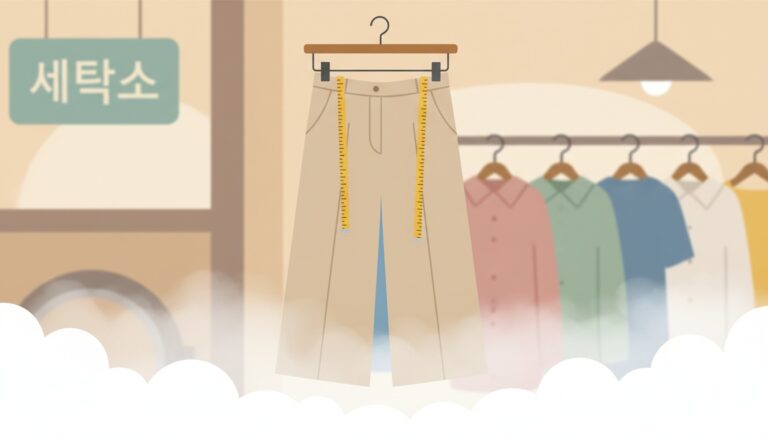
Phase 1: The “K-Fashion” Reality Check
Hello! Daily Hangul editor here.
Let’s be real for a second. Have you ever bought a pair of wide-leg slacks in Hongdae or denim in Gangnam because you wanted that effortless “K-Pop Idol airport fashion” look? You try them on, look in the mirror, and realize… the hem is dragging on the floor like a wedding dress.
Don’t panic. You haven’t shrunk. This is a universal experience in Korea. Why? Because many Korean brands sell pants with extra-long lengths specifically so you can tailor them to your exact height and shoe choice.
In many Western countries, going to a tailor is a special, expensive errand. In Korea? It’s as common as grabbing a coffee. Every neighborhood has a Setakso (세탁소 – Dry Cleaner/Laundry Shop) or a Suseon-jip (수선집 – Alteration Shop) on nearly every block.
Today, we’re going to fix your fit. No more rolling up your jeans three times. Let’s make you look sharp.
Phase 2: The Magic Phrases (Deep Dive)
Here are the only three phrases you really need to survive in a Korean alteration shop.
1. 기장 좀 줄여주세요 (Gi-jang jom jul-yeo-ju-se-yo)
- Pronunciation:
Gi-jang(sounds like ‘key’ + ‘jang’) +jom(rhymes with ‘home’) +jul-yeo-ju-se-yo. - Meaning: “Please shorten the length a little.”
- Literal: Length (Gi-jang) + a little/please (jom) + shorten-give-please (jul-yeo-ju-se-yo).
- K-Culture Moment: You know those makeover scenes in K-Dramas where the protagonist walks out in a perfectly fitted suit? This is the invisible step that happened before that scene.
- Editor’s Insight: The word ‘Jom’ (좀) is magic. Literally, it means “a little,” but in Korea, it acts as a softener. Without it, you sound like a robot issuing a command. With it, you sound polite and local.
- Situation Spectrum:
[🚫 To Boss] ———— [⚠️ Caution] ———— [✅ To Shop Owner]- (You wouldn’t say this to a boss, but it is the correct polite phrase to use with a service provider.)
2. 여기까지 해주세요 (Yeo-gi-kka-ji hae-ju-se-yo)
- Pronunciation:
Yeo-gi-kka-ji+hae-ju-se-yo - Meaning: “Please do it up to here.”
- The Move: You usually don’t just say this. You wear the pants, fold the fabric to the desired length in front of the mirror, and point.
- 🤔 Think About It: Why is physical context so huge in Korean? We love efficiency (Ppal-li Ppal-li). Instead of explaining “3 centimeters,” showing them visually eliminates all errors instantly.
3. 언제 찾으러 올까요? (Eon-je chaj-eu-reo ol-kka-yo?)
- Pronunciation:
Eon-je(When) +chaj-eu-reo(to find/pick up) +ol-kka-yo(shall I come?) - Meaning: “When should I come back to pick it up?”
- Editor’s Insight: In the US or Europe, hemming might take a week. In Korea? The answer might shock you: “Come back in 30 minutes.” Seriously.
Phase 3: Textbook vs. Real Life
| Situation | 📖 Textbook Korean | 🗣️ Real Street Korean | 💡 Why different? |
|---|---|---|---|
| Asking for repair | 바지 수선을 원합니다. (I want pants alteration.) | 이거 기장 좀 줄여주세요. (Please shorten the length of this.) | “수선” is too formal/abstract. “줄이다” (shorten) is the specific action needed. |
| Asking price | 수선비는 얼마입니까? (What is the alteration fee?) | 얼마예요? (How much is it?) | Simple is best. No need for complex nouns like “fee.” |
| Payment | 신용카드로 계산하겠습니다. (I will calculate with a credit card.) | 카드 돼요? (Card okay?) | “Does card work?” is the universal question in small shops. |
Note: Many small Suseon-jip (alteration shops) are run by older generations. Using “Real Street Korean” here isn’t rude; it’s just much more natural.
Phase 4: Cultural Context — The “Ah-jeos-si” Aesthetic
4-1. The Vibe of the Shop
Walking into a local Setakso is a sensory experience. It usually smells like hot steam and dry cleaning chemicals. There are clothes hanging everywhere on automatic conveyors. The owner is often an Ah-jeos-si (middle-aged man) or Ah-jum-ma (middle-aged woman) working swiftly with a sewing machine.
4-2. Ppal-li Ppal-li (Hurry Hurry)
Korean alterations are fast. Because living spaces in Seoul are small and people care deeply about appearance (Che-myeon or face), the infrastructure to maintain clothes is incredibly efficient. You drop off pants, grab a coffee, and they are done. It’s K-Speed at its finest.
Phase 5: Immersive Roleplay
Setting: A small neighborhood laundry shop (Setakso). A TV is playing a news channel in the corner. Steam is rising from an ironing board.
Characters:
* YOU: A foreign student who just bought long jeans.
* Owner: An efficient Korean man in his 50s, wearing an apron.
Dialogue:
YOU: (Entering holding pants) 안녕하세요! 이거 기장 좀 줄여주세요.
(An-nyeong-ha-se-yo! I-geo gi-jang jom jul-yeo-ju-se-yo.)
“Hello! Please shorten the length on this.”
Owner: (Nods) 입어보세요. 어디까지?
(Ib-eo-bo-se-yo. Eo-di-kka-ji?)
“Try them on. Up to where?”
(🎭 Stage Direction: You go behind the curtain, put them on, and come out.)
YOU: (Folding the pant leg) 음… 여기까지 해주세요.
(Eum… yeo-gi-kka-ji hae-ju-se-yo.)
“Hmm… please do it up to here.”
Owner: (Pins it quickly) 알겠어요. 3,000원.
(Al-gess-eo-yo. Sam-cheon-won.)
“Okay. 3,000 won.”
🔀 Decision Point: How do you pay?
- A) Pull out your Credit Card. “Card okay?”
- B) Pull out Cash. “Here you go.”
- C) Try to bargain. “2,000 won please?”
✅ Best Choice: B (Cash)
* Why? For small amounts like 3,000~5,000 KRW (approx $2-4), cash is king in these small shops. They might accept cards, but they love cash. It’s good manners.
⚠️ Choice C Analysis: Do not bargain for alterations. The price is already very low for skilled labor. Bargaining here is considered rude.
Phase 6: 10-Second Shadowing Drill
Repeat after me. Focus on the emotion!
- Polite & Soft:
기장 좀 / 줄여주세요.
(Gi-jang jom / jul-yeo-ju-se-yo)
(Imagine asking for a favor gently.) -
Clear & Direct:
여기까지 / 해주세요.
(Yeo-gi-kka-ji / hae-ju-se-yo)
(Point confidently at your ankle!) -
Curious:
언제 / 찾으러 / 올까요?
(Eon-je / chaj-eu-reo / ol-kka-yo?)
(Looking at the owner, expecting an answer.)
Phase 7: K-Culture Mini Glossary
| Korean | Romanization | English | Context |
|---|---|---|---|
| 세탁소 | Setakso | Dry Cleaner / Laundry Shop | The general place for cleaning AND alterations. |
| 수선 | Suseon | Alteration / Repair | You will see this word on signs. “명품 수선” means Luxury Goods Repair. |
| 현금 | Hyeon-geum | Cash | The preferred payment method for small repairs (under 5,000 won). |
| 깔끔하다 | Kkal-kkum-ha-da | Neat / Tidy | The highest compliment for how you look. Not just “cool,” but “clean and fitted.” |
Phase 8: Traveler’s Survival Kit
Topic: Fixing Clothes on a Trip
🆘 Survival Phrases (Alterations)
* 🇰🇷 “카드 돼요?” (Ka-deu dwae-yo?)
* Meaning: “Do you take card?”
* Use this before you hand over your pants if you have no cash!
* 🇰🇷 “지금 돼요?” (Ji-geum dwae-yo?)
* Meaning: “Can you do it right now?”
* Use this if you are in a rush.📌 Editor’s Pro Tip
* Location: Look for signs that say 수선 (Suseon). Often, they are tiny booths near subway stations or inside large supermarkets (Homeplus, E-Mart, Lotte Mart) near the checkout area.
* Timing: Supermarket alteration corners are usually open late and on weekends!
Phase 9: Think Deeper — “Fit” Culture
Why is “Fit” (핏) so important in Korea?
In Korea, wearing clothes that are too long or baggy (unintentionally) can be seen as “clumsy” or lacking Seong-ui (sincerity). Taking the time to visit a Setakso to hem your pants for $3 shows that you care about presenting a “prepared” version of yourself to the world. It’s part of the communal value of respecting others by looking your best. In your culture, is a perfect fit considered essential, or is comfort more important?
Phase 10: FAQ & Troubleshooting
- Q: Can I ask them to wash my clothes too?
- A: If it’s a Setakso (세탁소), yes! They do dry cleaning and ironing. If it’s a tiny booth that only says Suseon (수선), they only do repairs/alterations.
- Q: Do I tip?
- A: No. Tipping is not part of Korean culture, even for skilled labor like tailoring. The price is the price.
- ❌ Common Mistake: Waiting inside the shop.
- The Fix: These shops are usually tiny (sometimes 2 meters wide). Unless they tell you to wait, it’s better to leave and come back at the appointed time.
Phase 11: Wrap-up & Missions
One-Liner: Altering pants in Korea is cheap, fast, and the secret to looking like a local.
Your Mission:
* 🥉 Bronze: Say “Gi-jang jom jul-yeo-ju-se-yo” aloud 3 times.
* 🥈 Silver: Find a “수선” (Suseon) sign on Google Maps Street View in Seoul.
* 🥇 Gold: Take a pair of pants to a local tailor (even in your country) and try to explain the length using the pointing gesture and confident attitude!
Phase 12: Interactive Quiz
1. You are at a Setakso. The owner asks “Eodi-kkaji?” (Up to where?). What do you do?
* [ ] A. Say “Yes.”
* [ ] B. Wear the pants and point to your ankle.
* [ ] C. Hand him a credit card.
2. True or False?
* “In Korea, you should always bargain (haggle) for the price of hemming pants.”
* (True / False)
Answers:
1. B. It’s a visual question asking for the length.
2. False. The price is fixed and cheap. Haggling is rude here.
Frequently Asked Questions (FAQ)
Q: What does "기장 좀 줄여주세요 (Gi-jang jom jul-yeo-ju-se-yo)" mean in Korean and how do you pronounce it?
A: In Korean, "기장 좀 줄여주세요 (Gi-jang jom jul-yeo-ju-se-yo)" is pronounced [Gi-jang (sounds like 'key' + 'jang'] and means: "Please shorten the length a little."
Q: What does "여기까지 해주세요 (Yeo-gi-kka-ji hae-ju-se-yo)" mean in Korean and how do you pronounce it?
A: In Korean, "여기까지 해주세요 (Yeo-gi-kka-ji hae-ju-se-yo)" is pronounced [Yeo-gi-kka-ji + hae-ju-se-yo] and means: "Please do it up to here."
Q: What does "언제 찾으러 올까요? (Eon-je chaj-eu-reo ol-kka-yo?)" mean in Korean and how do you pronounce it?
A: In Korean, "언제 찾으러 올까요? (Eon-je chaj-eu-reo ol-kka-yo?)" is pronounced [Eon-je (When] and means: "When should I come back to pick it up?"







