

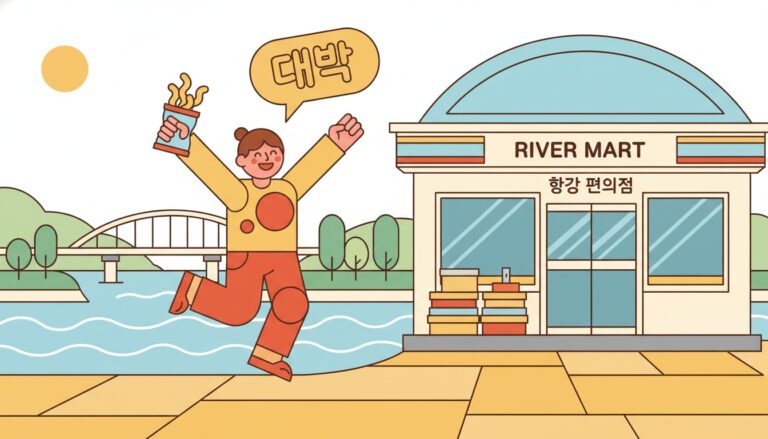
Phase 1: The Immersive Hook
Hello! Daily Hangul Editor here. 👋
Picture this: You’re watching your favorite K-Drama. The main character just passed that impossible job interview. Do they calmly say, “I am happy”?
No way. They probably jump in the air, scream at the sky, or grab their friend by the collar and shake them while yelling something that sounds like “DAE-BAK!”
Or maybe you’re at a K-Pop concert in Seoul. The lights go down, your bias walks out, and the person next to you grabs your arm (even though you’re strangers) and screams, “Michyeosseo!” (Crazy!).
In Korea, expressing happiness isn’t just about stating a fact; it’s about sharing energy. If you only know the textbook phrase “Jeoneun haengbok-hamnida” (I am happy), you might sound like a robot reading a news report. Today, we’re going to learn how to express joy like a real local—whether you just found 10,000 won in your pocket or your food finally arrived.
Phase 2: Deep Dive — 3 Key Expressions
1. 기분이 좋아요 (Gibun-i joayo)
- Pronunciation: [Gi-bun-ee jo-ah-yo]
Sound-alike: ‘Gi’ like Give + ‘bun’ like Bun + ‘jo-ah-yo’- Meaning: I feel good / I’m in a good mood.
- K-Culture Moment: You wake up, the weather is perfect, and you’re walking along the Han River. This is the standard, sunny-day phrase.
- Editor’s Insight: Gibun means “mood” or “atmosphere.” It’s the most neutral and safe way to say you are happy. It’s not an explosion of joy, but a pleasant hum.
- Situation Spectrum:
[🚫 Formal(Boss)] ———— [✅ Semi-formal(Coworker)] ———— [✅ Casual(Friend)]- 🤔 Think About It: In English, we say “I am happy.” In Korean, we say “The mood is good.” Why do you think Korean focuses on the state or atmosphere rather than just the I?
2. 신나요 (Sinnayo)
- Pronunciation: [Shin-na-yo]
Sound-alike: ‘Shin’ like Shin (leg) + ‘na-yo’- Meaning: I’m excited / I’m pumped.
- K-Culture Moment: You’re at a karaoke (Noraebang) and your favorite upbeat song starts playing. You don’t just feel good; you want to dance.
- Editor’s Insight: Use this when your heart is beating fast from excitement. It implies high energy.
- Situation Spectrum:
[⚠️ Formal(Boss)] ———— [✅ Semi-formal(Coworker)] ———— [✅ Casual(Friend)]- 🤔 Think About It: This comes from a word meaning “spirit” rising up. Have you ever felt your spirit actually lifting?
3. 대박 (Daebak)
- Pronunciation: [Dae-bak]
Sound-alike: ‘Dae’ like Dad + ‘bak’ like Back- Meaning: Awesome / Big hit / Wow.
- K-Culture Moment: Literally everywhere. A waiter brings you extra service (free food)? Daebak. Your friend looks amazing? Daebak. BTS releases a new MV? Daebak.
- Editor’s Insight: This is the Swiss Army Knife of Korean exclamations. It originally meant “a big fortune,” but now it’s just “Wow.”
- Situation Spectrum:
[🚫 Formal(Boss)] ———— [⚠️ Semi-formal(Coworker)] ———— [✅ Casual(Friend)]- 🤔 Think About It: “Daebak” is slang that became standard. Is there a slang word in your language that everyone, even grandmas, uses now?
Phase 3: Textbook vs. Real Life
| Situation | 📖 Textbook Korean | 🗣️ Real Korean | 💡 Why the difference? |
|---|---|---|---|
| Winning a game | 기쁩니다 (Gippeumnida) | 아싸! (Assa!) | Gippeumnida sounds like a speech. Assa is a pure sound of victory like “Yesss!” |
| Eating delicious food | 맛이 있습니다 (Masi issseumnida) | 와, 미쳤다 (Wa, michyeotda) | Michyeotda means “Crazy.” Modern Koreans use “crazy” to mean “crazy good.” |
| Meeting a friend | 반갑습니다 (Bangapseumnida) | 완전 오랜만! (Wanjeon oraenman) | Textbooks focus on politeness; friends focus on the length of time apart. |
Bottom Note: For beginners, “Daebak” and “Jinjja joayo” (Really good) will get you through 90% of situations!
Phase 4: Cultural Deep Dive
4-1. Non-verbal: The “Seal Clap” (물개박수)
When Koreans find something really funny or delightful, they don’t just smile. They often clap their hands fast and loud, like a seal.
- Tip: If you laugh while clapping your hands, you look 100% more like a local. It shows you are engaged and loving the vibe.
4-2. K-Food Connection: “Service” (서비스)
If you are at a restaurant and the owner gives you a free bottle of cola or a side of steamed egg, they will say “Service imnida” (It’s service).
- Your Reaction: This is the perfect time to use “Uwa! Daebak! Gamsahamnida!”
- Why? In Korea, giving small freebies is a way to build Jeong (affection/connection) with the customer. Reacting happily ensures they remember you next time!
Phase 5: Immersive Roleplay
Scenario: It’s Friday night. You are at a Convenience Store (Pyeoneijeom) near the Han River. You are buying snacks with your Korean friend, Min-su.
Characters:
* YOU: Hungry student.
* Min-su: Your energetic Korean friend.
Dialogue:
Min-su: 야, 이거 봐! 맥주 4개에 만 원이야! 🍺
(Ya, igeo bwa! Maekju ne-gae-e man-won-iya!)
[Hey, look at this! 4 beers for 10,000 won!]
YOU: (Looking at the price tag)
Wait, really? That’s cheap!
Min-su: 오늘 날씨도 좋은데 한강 갈까?
(Oneul nalssi-do joeunde hangang galkka?)
[The weather is good today too, shall we go to the Han River?]
🔀 YOUR TURN! How do you respond?
- A) “네, 기분이 좋습니다.” (Yes, the mood is good.)
- B) “와, 대박! 좋아!” (Wow, Daebak! Good!)
- C) “감사합니다.” (Thank you.)
✅ Best Choice: B
* Why? You are with a friend, and the news is exciting. Daebak matches Min-su’s energy. Choice A is too robotic, and C doesn’t make sense here.
Min-su: (Grabbing the beers) 아싸! 가자! (Assa! Let’s go!)
Phase 6: 10-Second Shadowing Drill
Let’s practice the rhythm. Don’t speak flatly—add a little bounce to your voice! 😊
- 😊 Brightly:
오늘 / 기분이 / 정~~~말 / 좋아요!
(O-neul / gi-bun-i / jeong~~~mal / jo-ah-yo!)
[Today / my mood / is rea~~~lly / good!] -
😤 With energy (Punch the air):
와 / 대박! / 신난다!
(Wa / dae-bak! / shin-nan-da!)
[Wow / Daebak! / It’s exciting!]
Phase 7: K-Culture Mini Glossary
| Korean | Romanization | Meaning | Context |
|---|---|---|---|
| 텐션 | Ten-shyeon | High Energy/Vibe | Used like “High Tension.” Means the energy is high and exciting. |
| 꿀잼 | Kkul-jaem | Honey fun (Very fun) | Slang. Kkul (Honey) + Jaem (Fun). Use it for movies or games. |
| 소확행 | So-hwak-haeng | Small but certain happiness | Buying a coffee, petting a cat. The little joys in life. |
| 불금 | Bul-geum | Fire Friday | TGIF. The excitement of Friday night. |
Phase 8: Traveler’s Survival Kit
When you are traveling, you’ll often get help from strangers or receive good service. Expressing joy is the best way to say thank you.
🆘 Survival Phrase #1
* 🇰🇷 “진짜요? 감사합니다!” (Jinjja-yo? Gamsahamnida!)
* 🗣️ Pronunciation: [Jin-jja-yo? Gam-sa-ham-ni-da!]
* Where to use: When someone gives you a discount, an upgrade, or directions.
* Why: “Jinjja-yo?” (Really?) shows you are pleasantly surprised.📌 Editor’s Travel Note
* Tipping: If you are happy with the service, do not tip. It can be seen as rude or pity. Instead, say “Jal meogeosseumnida” (I ate well) loudly as you leave. That makes the owner happiest.
Phase 9: Think Deeper — “Why so modest?”
Thinking about Language & Culture:
In Western cultures, happiness is often loud and individualistic (“I am the champion!”). In traditional Korean culture, expressing too much personal happiness was sometimes seen as risking jealousy from spirits or others.
Even today, you might notice that when Koreans receive a huge compliment, they often wave their hands in front of their face (the “No, no” gesture) while smiling. It’s a mix of happiness and humility.
🧠 Think Deeper:
Does your culture encourage showing happiness loudly, or keeping it quiet to be humble? How does that change the words you use?
Phase 10: FAQ & Troubleshooting
- Q: Can I say “Saranghae” (I love you) to a barista if I love the coffee?
- A: No! 🙅♂️ That is for romantic love. Use “Neomu joayo” (I like it so much) or “Choego-yeyo” (It’s the best).
- Q: Is “Daebak” rude to older people?
- A: Yes. Do not say “Daebak” to a taxi driver who is 60 years old. Instead, say “Wa, jeongmal-yo?” (Wow, really?).
❌ Common Mistake: confusing Fun and Funny.
* Jaemi-isseoyo covers both “It is fun” (Rollercoaster) and “It is funny” (Joke). Context is key!
Phase 11: Wrap-up & Action Mission
One-Liner: Happiness in Korean is about sharing the “Mood” (Gibun) and energy (Tension), not just stating a fact.
🚀 Action Missions:
- 🥉 Bronze: Look in the mirror, clap like a seal, and say “Wa! Daebak!” three times.
- 🥈 Silver: Watch a K-Pop reaction video on YouTube. Count how many times they say “Daebak” or “Michyeotda.”
- 🥇 Gold: Next time you eat something delicious, say “Wa, jinjja mas-iss-eo-yo!” (Wow, really tasty) to the cook or your friend.
💬 Your Turn: What is the “slang word for awesome” in your language? Share it in the comments!
Phase 12: Interactive Quiz
- Situation: You found a seat on a crowded subway. What do you whisper to yourself?
- A) Saranghae (I love you)
- B) Assa! (Yes/Lucky!)
- C) Mianhae (I’m sorry)
- True or False: You should tip the waiter if you are really happy with the food.
- (True / False)
- Fill in the blank: Your friend shows you a picture of their new puppy. You say: “Wa,
______! Gwi-yeo-wo!” (Wow, ______! Cute!)- A) Daebak
- B) Annyeong
Answers:
1. B (Assa is used for small lucky wins)
2. False (Compliments > Money in Korea)
3. A (Daebak is perfect for surprises)
Frequently Asked Questions (FAQ)
Q: What does "기분이 좋아요 (Gibun-i joayo)" mean in Korean and how do you pronounce it?
A: In Korean, "기분이 좋아요 (Gibun-i joayo)" is pronounced [Gi-bun-ee jo-ah-yo] and means: I feel good / I'm in a good mood.
Q: What does "신나요 (Sinnayo)" mean in Korean and how do you pronounce it?
A: In Korean, "신나요 (Sinnayo)" is pronounced [Shin-na-yo] and means: I'm excited / I'm pumped.
Q: What does "대박 (Daebak)" mean in Korean and how do you pronounce it?
A: In Korean, "대박 (Daebak)" is pronounced [Dae-bak] and means: Awesome / Big hit / Wow.







