

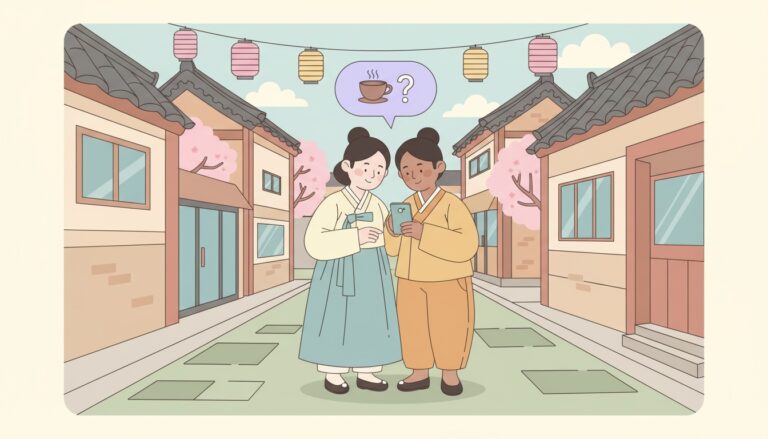
Phase 1: The “Main Character” Moment
Hello! This is your Daily Hangul editor.
Picture this: You are the protagonist in a K-Drama. It’s a breezy Friday evening in Seoul. You’ve just finished work or school, and you spot that cool Korean friend you’ve been dying to hang out with. The background music swells. You want to ask them to grab some Chimaek (Chicken & Beer), but your brain freezes.
Do you say, “Do you desire to consume poultry with me?” (Please, no.)
Or do you just stand there awkwardly until they wave goodbye? Today, we are fixing this. Asking someone out—whether it’s for coffee, a movie, or just hanging out—is the fastest way to make real local friends. But in Korea, it’s not just about the words; it’s about the vibe.
Forget the stiff textbook dialogues. I’m going to teach you how to slide into plans so naturally that they’ll think you’ve lived here for years.
Phase 2: Core Expressions Deep Dive
Here are the three tools you need in your inventory.
1. 시간 있어요? (Sigan isseoyo?)
- Pronunciation: [See-gan e-ssuh-yo?]
- Tip: ‘Si’ sounds like the ‘Sea’, and ‘gan’ rhymes with ‘Khan’.
- Meaning: “Do you have time?” (Literal) / “Are you free?” (Real nuance)
- K-Culture Moment: In almost every romance drama, before the confession scene, the lead character asks this with a shaky voice. It’s the universal opener.
- Editor’s Insight: This is the safest, most polite way to check availability without being pushy. If you drop the ‘yo’ (Sigan isseo?), you are suddenly very casual. Be careful!
- Situation Spectrum:
[🚫 Boss] ———— [⚠️ Colleague] ———— [✅ Friend/Acquaintance]- 🤔 Think About It: Why do Koreans ask about “time” rather than asking “Do you want to hang out?” directly? It gives the other person an easy way out (“Oh, I don’t have time”) to avoid saying a harsh “No.”
2. 같이 갈래요? (Gachi gallae-yo?)
- Pronunciation: [Ga-chee gal-lae-yo?]
- Tip: ‘Gachi’ sounds like ‘Got-cheese’ without the ‘s’.
- Meaning: “Shall we go together?” / “Wanna go with me?”
- K-Culture Moment: Think of variety shows like Running Man. When they form teams, you hear this “-llae-yo?” ending constantly. It’s soft, friendly, and inviting.
- Editor’s Insight: The ending -(u)llae-yo? is magical. It asks for the listener’s preference gently. It’s much softer than “Let’s go” (Gapsida).
- Situation Spectrum:
[🚫 CEO] ———— [⚠️ Senior] ———— [✅ Friend/Date]- 🤔 Think About It: This grammar structure focuses on the listener’s will. It’s not a command; it’s an offer. How does this compare to “Let’s” in English?
3. 저기요… (Jeogiyo…)
- Pronunciation: [Juh-gee-yo]
- Meaning: “Excuse me…” or “Hey there…”
- K-Culture Moment: You usually hear this in restaurants to call a waiter. BUT, in a social context, used softly with a hesitation, it’s the perfect “hesitation noise” before asking someone out.
- Editor’s Insight: You can’t just walk up and demand time. You need a buffer. Start with “Jeogiyo…” to get their attention gently.
- Situation Spectrum:
[✅ Everyone]
Phase 3: Textbook vs. Real Life
Let’s be real. If you talk like a textbook in Hongdae, people might think you are a time traveler from the Joseon Dynasty.
| Situation | 📖 Textbook Korean | 🗣️ Real Korean | 💡 Why is it different? |
|---|---|---|---|
| Asking for dinner | 식사 하셨습니까? (Siksa hasyeosseumnikka?) | 밥 먹으러 갈래? (Bap meogeureo gallae?) | The textbook version sounds like a waiter or a soldier. “Bap” (Rice/Meal) is the heart of Korean bonding. |
| Checking schedule | 시간이 있으십니까? (Sigani isseuseumnikka?) | 오늘 바빠? (Oneul bappa?) | “Busy today?” is faster and less burdensome than asking about their abstract existence of time. |
| Suggesting coffee | 커피를 마십시다. (Keopireul masipsida.) | 커피 콜? (Coffee Call?) | Slang alert! “Call?” comes from poker terminology (Call/Fold). It means “Are you in?” |
Bottom Note: Use “Coffee Call?” only with close friends. Stick to “Gachi gallae-yo?” for people you want to impress.
Phase 4: Cultural Context — The Art of “Empty Promises”
4-1. The “Let’s Eat Sometime” Trap
If a Korean says, “Eonje bap hanbeon meogoyo” (Let’s eat a meal sometime), do not—I repeat, DO NOT—pull out your calendar immediately.
In Korean culture, this is often just a warm way of saying “Goodbye” or “It was nice seeing you.” It’s a social lubricant. If they don’t suggest a specific date or time, just smile and say “Ne, joayo!” (Yes, good!). If you push for a date right then, you might panic them. Wait for them to follow up, or suggest a specific date yourself later via text.
4-2. K-Food Connection: “N bread” (Dutch Pay)
When inviting a friend, who pays? Traditionally, the person who invites pays (especially if they are older). However, among Gen Z and Millennials, “N-bbang” (splitting 1/N) is very common for casual hangouts.
But here is a Pro Tip: If you invited them because you needed a favor or you were lonely, offering to pay (“Naega ssol-ge!” – I’ll shoot/treat!) makes you an instant legend.
Phase 5: Immersive Roleplay
Setting: It is Tuesday afternoon. You and your Korean friend, Min-su, are packing up books after a language exchange meetup. You are hungry, and there is a famous Tteokbokki (spicy rice cake) place nearby.
Characters:
* YOU: Craving spicy food, wants to hang out.
* Min-su: Nice guy, but looks a bit tired.
The Dialogue:
YOU: 민수 씨, 오늘 수업 끝났죠? 시간 있어요?
(Min-su ssi, oneul sueop kkeunnajjyo? Sigan isseoyo?)
(Min-su, class is over, right? Do you have time?)
Min-su: 네, 딱히 약속은 없어요. 왜요?
(Ne, ttaki yaksogeun eopseoyo. Waeyo?)
(Yeah, no specific plans. Why?)
YOU: 저기… 근처에 맛집이 있는데, 떡볶이 먹으러 갈래요?
(Jeogi… geuncheoe matjibi inneunde, tteokbokki meogeureo gallae-yo?)
(So… there’s a famous place nearby, wanna go eat Tteokbokki?)
Min-su: 오, 떡볶이요? 좋죠! 매운 거 잘 먹어요?
(Oh, Tteokbokki? Good! Can you eat spicy food well?)
🔀 Decision Point! How do you respond?
- Option A: “Yes, I eat it well!” (Ne, jal meogeoyo!)
- Option B: “No, I hate it.” (Aniyo, sireoyo.)
- Option C: “A little bit? Together!” (Jogeumyo? Gachi!)
✅ Best Choice: Option A. Koreans love hearing foreigners say they can eat spicy food. It’s a bonding moment.
⚠️ Analysis of B: If you hate it, why did you suggest Tteokbokki? Min-su will be confused.
Min-su: 그래요? 그럼 가요! 제가 쏠게요!
(Geuraeyo? Geureom gayo! Jega ssolgeyo!)
(Really? Then let’s go! It’s my treat!)
Phase 6: 10-Second Shadowing Drill
Don’t just read it. Feel it.
Context: You are asking a friend to see a movie this weekend. You are hopeful but polite.
😊 이번 주말에 / 시간 / 어때요?
(I-beon ju-ma-re / si-gan / eo-ttae-yo?)
How is your time this weekend?
Context: You are suggesting to grab a beer casually.
🍺 오늘 저녁에 / 맥주 / 한잔 / 할래요?
(O-neul jeo-nyeo-ge / maek-ju / han-jan / hal-lae-yo?)
Wanna have a glass of beer this evening?
Phase 7: K-Culture Glossary
| Korean | Romanization | Meaning | Context |
|---|---|---|---|
| 약속 | Yaksok | Appointment/Promise | Used for both “I promise” and “I have plans/appointment.” |
| 불금 | Bul-geum | Fire Friday | TGIF. The best time to invite friends out. |
| 맛집 | Mat-jip | Flavor House | A delicious restaurant. Suggesting a “Mat-jip” ensures a “Yes.” |
| 1차 / 2차 | Il-cha / I-cha | Round 1 / Round 2 | Hangouts rarely end at one place. Dinner (1-cha) is followed by cafe/bar (2-cha). |
Phase 8: Traveler’s Survival Kit
Even if you aren’t inviting a Korean friend, you will need “appointment” words to survive restaurants.
🆘 Survival Expression: Getting a Table
* 🇰🇷 “두 명이에요.” (Du myeong-i-e-yo)
* 🗣️ Sound: [Doo myung-e-ae-yo]
* 📍 Where: At the entrance of any restaurant.
* 💡 Pro Tip: Hold up two fingers. Verbal + Non-verbal = Success.📌 Editor’s Travel Note
* Reservations: Famous “Mat-jip” often require waiting. Look for a machine near the door to input your phone number. If you don’t have a Korean number, catch the staff’s eye immediately!
Phase 9: Think Deeper — “Have you eaten?”
In many Western cultures, asking “Have you eaten?” is a logistical question. You want to know if we need to get food.
In Korea, “Bap meogeosseoyo?” (Have you eaten?) is a greeting, like “How are you?”
Historically, Korea suffered from war and poverty, so asking if someone had a meal was a genuine check on their well-being. Today, food is still the language of care. When you invite a friend to eat, you aren’t just filling their stomach; you are maintaining the relationship (Jeong).
💬 Your Turn: Does your culture use food as a greeting? Or maybe the weather? Let me know in the comments!
Phase 10: FAQ & Troubleshooting
Q: Can I use “Gachi gallae-yo?” to my boss?
A: Technically, the grammar is polite (-yo), but the nuance is too friendly. For a boss, it’s better to wait for them to invite you, or use very formal honorifics (which we will cover in the Business Module). Stick to “gallae-yo” for peers.
Q: Is it okay to invite someone I just met?
A: Koreans can be shy. It’s better to establish some rapport first. Maybe after the second or third time meeting in a group context, invite them for something casual like coffee, not a full 3-course dinner.
❌ Common Mistake: Asking “Do you have time?” without a plan.
✅ Fix: Always follow up immediately with why you are asking. “Do you have time? I want to go to this cafe.” Otherwise, it sounds like you are going to ask to borrow money!
Phase 11: Wrap-up & Action Items
So, don’t be afraid of the awkward silence. A simple “Coffee call?” or “Gachi gallae-yo?” can start a lifelong friendship.
🚀 Your Mission:
* 🥉 Bronze: Look in the mirror and practice saying “Sigan isseoyo?” with a smile, not a scary stare.
* 🥈 Silver: Find a Korean restaurant in your area and practice saying “Du myeong-i-e-yo” (Two people) when you enter.
* 🥇 Gold: Message a friend (Korean or not) right now and ask, “Gachi bap meogeullae?” (Want to eat together?)
K-Culture Mission: Watch a scene from Hospital Playlist or Reply 1988. Count how many times they say “Bap meokja” (Let’s eat). It’s practically 50% of the script!
Phase 12: Interactive Quiz
- Situation: You want to ask a classmate to study together politely.
- A. 공부 해! (Gongbu hae!)
- B. 같이 공부할래요? (Gachi gongbu-hallae-yo?)
- C. 시간 없어. (Sigan eopseo.)
- True or False?
- If a Korean says “Let’s eat sometime” without a date, you should immediately open your calendar and pick a time.
- Fill in the blank:
- To agree to a suggestion casually (Slang): “Coffee “”””””?” (Hint: Poker term)
(Scroll down for answers)
.
.
.
Answers:
1. B (A is a command, C means “I have no time”)
2. False (It’s likely just a polite closing)
3. Call (Coffee Call?)
Frequently Asked Questions (FAQ)
Q: What does "시간 있어요? (Sigan isseoyo?)" mean in Korean and how do you pronounce it?
A: In Korean, "시간 있어요? (Sigan isseoyo?)" is pronounced [See-gan e-ssuh-yo?] and means: a key conversational Korean expression covered in this lesson.
Q: What does "같이 갈래요? (Gachi gallae-yo?)" mean in Korean and how do you pronounce it?
A: In Korean, "같이 갈래요? (Gachi gallae-yo?)" is pronounced [Ga-chee gal-lae-yo?] and means: a key conversational Korean expression covered in this lesson.
Q: What does "저기요... (Jeogiyo...)" mean in Korean and how do you pronounce it?
A: In Korean, "저기요... (Jeogiyo...)" is pronounced [Juh-gee-yo] and means: "Excuse me..." or "Hey there..."






