

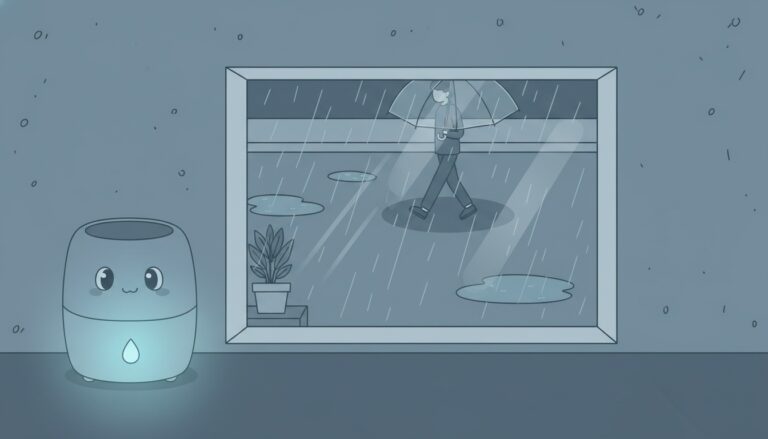
Phase 1: The ‘Parasite’ Reality Check
Hello! It’s your editor from Daily Hangul.
Remember that scene in the movie Parasite? The one where the Kim family leaves their windows open during fumigation, or worse, when the heavy rain floods their entire home? That is the dramatic, Oscar-winning version of Banjiha (Semi-basement) life.
But if you are living in Seoul on a budget, you might actually find yourself in a banjiha. You won’t be fighting floodwaters daily, but you will fight a silent, invisible enemy: Humidity (Seupgi / 습기).
In summer, your wallpaper feels damp. Your clothes don’t dry. And if you aren’t careful, you’ll meet the villain of today’s lesson: Mold. Let’s learn how to complain about this like a local, so you can ask your landlord for help or at least vent to your friends at the pocha.
Phase 2: Core Expressions (Deep Dive)
1. 방이 너무 습해요.
(Bangi neomu seuphaeyo)
- Pronunciation: [Bang-ee neomu seup-hae-yo]
- Sound Analogy: Seup sounds like you’re taking a quick, sharp breath in because something is sticky.
- Meaning: “The room is too humid/damp.”
- K-Culture Moment: You’ll hear idols on V-Live during the rainy season saying, “Aigoo, oneul neomu seup-haeyo” (Oh, it’s so humid today) while fanning themselves.
- Editor’s Insight: This isn’t just about temperature. It’s that heavy, sticky feeling where the air feels like soup.
- Situation Spectrum:
[✅ Casual] ———— [✅ Semi-formal] ———— [✅ Formal]- 🤔 Think About It: Koreans distinguish heavily between “hot” (deowo) and “humid” (seup-hae). Why? Because Korean summers are like a sauna, not a dry desert. Usually, seup-hae is the one that makes people angry.
2. 곰팡이가 피었어요.
(Gompang-iga pieosseoyo)
- Pronunciation: [Gom-pang-ee-ga pee-oss-eo-yo]
- Meaning: “Mold has bloomed (grown).”
- Editor’s Insight: Here is the linguistic irony. The verb 피다 (pida) is usually used for beautiful things like flowers (kkot). But we also use it for mold. It’s a poetic way to describe a disgusting problem.
- Situation Spectrum:
[✅ Casual] ———— [✅ Semi-formal] ———— [✅ Formal]- 🤔 Think About It: Why use the verb “bloom” for mold? Perhaps because it spreads in spots like flowers opening up? Next time you see a flower blooming in a K-Drama, remember… mold does the same thing in a basement.
3. 제습기 좀 틀어줘.
(Jeseupgi jom teureojwo)
- Pronunciation: [Je-seup-gi jom teu-reo-jwo]
- Meaning: “Please turn on the dehumidifier.”
- K-Culture Moment: In Korean variety shows showing celebrities living alone (like I Live Alone), you will see them emptying a tank of water from a machine. That machine is their best friend, the Jeseupgi.
- Editor’s Insight: In many Western countries, you might use a dryer for clothes. In a Korean one-room or banjiha, the Jeseupgi dries your clothes, your room, and your tears.
Phase 3: Textbook vs. Real Life
| Situation | 📖 Textbook Korean | 🗣️ Real Korean (Insa Style) | 💡 Why? |
|---|---|---|---|
| Complaining about dampness | 습도가 높습니다. (The humidity is high.) | 아, 찝찝해. (Ah, it feels gross/sticky.) | “Seupdo” is scientific. Jjip-jjip-hae describes the feeling on your skin. |
| Laundry won’t dry | 빨래가 안 말라요. (The laundry isn’t drying.) | 빨래에서 냄새나… (The laundry smells…) | The real problem isn’t wetness; it’s the sour smell (swin-nae) that comes with it. |
| Suggesting a solution | 창문을 여세요. (Open the window.) | 물먹는 하마 사야돼. (Gotta buy a ‘Thirsty Hippo’.) | Opening a window in a banjiha just lets in street dust. The “Hippo” is a specific moisture absorber brand. |
💡 Bottom Note: Use “Jjip-jjip-hae” (찝찝해) when you feel sticky from sweat or humidity. It’s the ultimate summer complaint.
Phase 4: Cultural Deep Dive — The ‘Banjiha’ Smell
4-1. The Smell of Poverty?
In Parasite, the wealthy father mentions a “smell” crossing the line. That specific smell often comes from the mix of humidity, old concrete, and lack of sunlight found in semi-basements. Koreans are extremely sensitive to smells (naemsae). If you live in a semi-basement, managing humidity isn’t just about comfort; it’s about social dignity.
4-2. The Survival Item: ‘Mulmeokneun Hama’
If you go to a Korean supermarket, you will see pink plastic tubs with a hippo character. This is 물먹는 하마 (Water-eating Hippo). It’s a disposable moisture absorber. Every Korean who has lived in a dorm or studio apartment knows this hippo. Buying one is a rite of passage for living in Korea.
Phase 5: Roleplay — The Visit
Setting: It is July, the rainy season (Jangma). You moved into a cheaper semi-basement to save money. Your Korean friend, Minji, is visiting for the first time. The air is heavy.
Characters:
– YOU: Dealing with the dampness.
– Minji: Your honest Korean friend.
Dialogue:
Minji: 와, 여기 들어오니까 확 다르네. 좀 습하지 않아? 🌧️
(Wa, yeogi deureoonikka hwak dareune. Jom seuphaji ana?)
(Whoa, it feels totally different coming in here. Isn’t it a bit humid?)
(🎭 Minji rubs her arms as if sticky)
YOU: 응, 장마철이라 어쩔 수 없어.
(Eung, jangmacheorira eojjeol su eopseo.)
(Yeah, it’s rainy season, so it can’t be helped.)
Minji: 야, 벽지에 곰팡이 피겠다. 환기 좀 시켜!
(Ya, byeokjie gompangi pigetda. Hwangi jom sikyeo!)
(Hey, mold is going to bloom on the wallpaper. Air it out!)
🔀 Your Turn! How do you respond?
- A) “창문 열면 매연 들어와.” (If I open the window, exhaust fumes come in.)
- B) “제습기 하나 살까 고민 중이야.” (I’m thinking about buying a dehumidifier.)
- C) “괜찮아, 곰팡이랑 친구 할 거야.” (It’s okay, I’ll make friends with the mold.)
✅ Best Choice: B. This shows you are looking for a practical solution. Minji will likely agree enthusiastically.
⚠️ Choice C Analysis: Funny, but Minji might actually get worried about your health and drag you to Daiso immediately.
Phase 6: 10-Second Shadowing Drill
Let’s practice complaining about the weather properly.
😩 Annoyed: 아… / 빨래가 / 안 말라서 / 냄새나.
(Ah… / ppallega / an mallaseo / naemsaena.)
“Ah… the laundry won’t dry so it smells.”
Phase 7: K-Culture Mini Dictionary
| Korean | Romanization | English | Context |
|---|---|---|---|
| 반지하 | Banjiha | Semi-basement | The housing type made famous by Parasite. Half underground, half above. |
| 장마 | Jangma | Rainy Season | Usually late June to late July. Weeks of non-stop rain. |
| 환기 | Hwangi | Ventilation | The act of airing out a room. Crucial for fighting mold. |
| 빨래방 | Ppallaebang | Laundromat | Where banjiha residents go to dry their clothes in heavy duty dryers. |
Phase 8: Traveler’s & Resident’s Survival Kit
If you are staying in an Airbnb or guesthouse that feels damp:
🆘 Survival Phrase
– 🇰🇷 “혹시 제습기 있어요?” (Hoksi jeseupgi isseoyo?)
– 🗣️ Meaning: “Do you happen to have a dehumidifier?”
– 📍 Where: Guesthouses, Airbnbs, older motels.
– 💡 Pro Tip: If they say no, ask for ” 에어컨 리모컨” (AC remote). Use the ‘Dry’ mode (look for the💧icon) on the AC. It helps!
Phase 9: Think Deeper — Language & Space
Have you noticed how Korean words for “room conditions” are very specific? Seup-hae (humid), Guep-guep-hae (muggy/unpleasant), Jjip-jjip-hae (feeling sticky/gross).
Korea is a small country with high population density. Many people live in small spaces like Goshiwons or Banjihas. Because personal space is tight and climate is distinct, the vocabulary to describe physical discomfort in that space is highly developed. In your language, do you have different words for “outside humidity” vs. “inside dampness”?
Phase 10: FAQ & Troubleshooting
Q: My landlord saw mold. Can I ask him to clean it?
A: It depends. If the mold is from a leak (structural), say: “누수 때문에 곰팡이가 생겼어요” (Mold appeared because of a leak). The landlord must fix this. If it’s because you didn’t ventilate (hwangi), it might be your responsibility.
❌ Common Mistake: Saying “The room is wet” (Bangi jeojeosseoyo).
✅ Fix: Jeojeosseoyo means you spilled water on the floor. Use “Seup-hae-yo” for the air quality.
Phase 11: Wrap-up & Mission
One-Liner: When the air feels like soup, don’t just suffer—turn on the Jeseupgi!
🔥 Action Mission:
– 🥉 Bronze: Look at your AC remote. Find the button that says 제습 (Dehumidify) or has a water drop icon 💧.
– 🥈 Silver: Go to a convenience store or Daiso in Korea and find the “Mulmeokneun Hama” (moisture absorber). Snap a picture!
– 🥇 Gold: If you are in Korea during rain, say “Ah, neomu seup-hae” to a Korean friend. Watch them nod in violent agreement.
Phase 12: Interactive Quiz
Q1. You are sweating and the air feels sticky. What is the most natural sound effect word to use?
– A) Siwonhae (Refreshing)
– B) Jjip-jjip-hae (Gross/Sticky)
– C) Dalkomhae (Sweet)
Q2. True or False?
– In Korean, you use the same verb for “Flowers blooming” and “Mold growing.”
Answers:
1. B (Jjip-jjip-hae is the feeling of sweat and humidity mixing.)
2. True (Both use the verb pida.)
Frequently Asked Questions (FAQ)
Q: What does "피다" mean in Korean and how do you pronounce it?
A: In Korean, "피다" is pronounced [pida] and means: is usually used for beautiful things like flowers (
Q: What does "물먹는 하마" mean in Korean and how do you pronounce it?
A: In Korean, "물먹는 하마" is pronounced [Water-eating Hippo] and means: . It’s a disposable moisture absorber. Every Korean who has lived in a dorm or studio apartment knows this hippo. Buying one is a rite of passage for living in Korea.







