

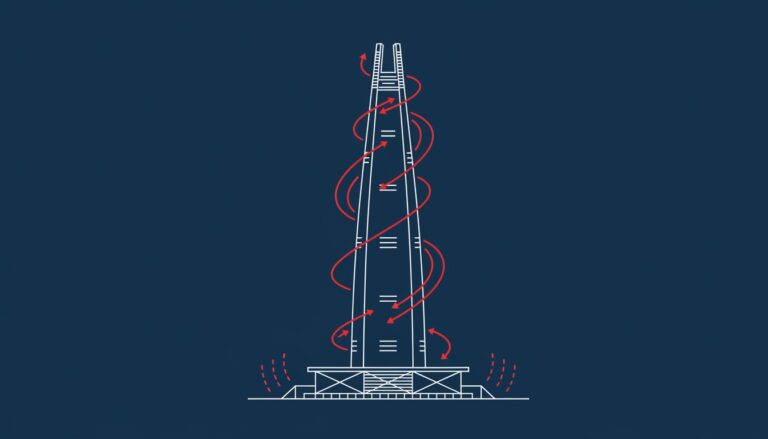
Phase 1: The Hook — More Than Just Concrete
Hello! Daily Hangul Editor here.
Have you ever stood at the base of the Lotte World Tower in Jamsil, craned your neck until it hurt, and thought, “How on earth does this thing stay upright during a typhoon?”
If you watch K-Dramas like My Mister (나의 아저씨), you know that structural engineering in Korea isn’t just about math; it’s about emotional weight. Buildings in Korea carry history, trauma, and immense pride. When a character in a drama creates a structural report, they aren’t just checking numbers—they are checking the conscience of the company.
Today, we aren’t just learning words for “cement” or “steel.” We are looking at the vocabulary of resilience. We’re talking about how Korea, a peninsula hit by summer typhoons and historically anxious about safety (for good reason), engineers its skyline to bend without breaking.
This is C2-level Korean. We are moving beyond “It is big” to “It is aerodynamically optimized to mitigate vortex shedding.” Let’s get technical.
Phase 2: Deep Dive — The Language of Resilience
1. 내진 설계 (Naejin seolge)
- Pronunciation: [Nae-jin seol-gye] (Sounds like ‘Nae’ as in nay, ‘jin’ as in gin, ‘seol-gye’ sharp and quick)
- Meaning: Seismic Design (Literal: Endure-Quake Design)
- The Nuance: While jijin means earthquake, naejin implies the active capacity to withstand it. In a professional setting, you don’t ask if a building is strong; you ask if the naejin seolge is grade 1 or special grade.
- K-Culture Context: Since the 2016 Gyeongju earthquakes, this word has moved from blueprints to real estate brochures. If you are renting a high-end office, asking about this proves you aren’t just a foreigner—you’re a shrewd investor.
- Spectrum:
[Casual] 🚫 — [Professional] ✅ - 🤔 Think About It: Why does Korean use the character ‘Nae’ (Endure) rather than ‘Bang’ (Defend)? It suggests we live with the vibration, not block it entirely.
2. 안전불감증 (Anjeon bulgamjeung)
- Pronunciation: [An-jeon bul-gam-jeung]
- Meaning: Safety Insensitivity / Lack of safety awareness
- The Nuance: This is a heavy hitter. It refers to the societal tendency to ignore safety protocols for the sake of convenience or speed. It’s the critical term used when analyzing accidents in news editorials or debates.
- Editor’s Insight: If you use this in a debate about infrastructure, Koreans will look at you with slight fear and massive respect. It cuts to the core of modern Korean industrial history.
- Situation Spectrum:
[Casual] ✅ — [Formal] ✅(Use carefully; it’s critical)
3. 풍동 실험 (Pungdong silheom)
- Pronunciation: [Pung-dong sil-heom]
- Meaning: Wind Tunnel Test
- The Context: Essential for skyscrapers. Korea has strong seasonal winds. You might hear this in engineering documentaries or when visiting construction expos.
- 🤔 Think About It: In Korean architecture, the wind isn’t just a force to resist; it’s part of Pungsu (Feng Shui). Modern engineering clashes with and complements this ancient view.
Phase 3: Textbook vs. Real Life
| Situation | 📖 Textbook Korean | 🗣️ Real Korean (Field/Site) | 💡 Why the difference? |
|---|---|---|---|
| Asking if it’s safe | 이 건물은 안전합니까? (Is this building safe?) | 이거 끄떡없어요? (Will this not budge?) | “끄떡없다” emphasizes unshakeable durability, often used by confident field managers. |
| Discussing shaking | 건물이 흔들립니다. (The building is shaking.) | 진동이 좀 먹히네요. (The vibration is being ‘eaten’/absorbed.) | Passive voice vs. Active engineering slang. “Eating vibration” means the dampers are working. |
| Complaining about rigid rules | 규정을 준수해야 합니다. (We must follow regulations.) | FM대로 합시다, FM. (Let’s do it ‘FM’.) | ‘FM’ comes from military slang (Field Manual), meaning “by the book.” |
💡 Bottom Note: In the Korean engineering field (or army), doing something “FM” is a huge compliment or a huge annoyance, depending on who you ask.
Phase 4: Cultural Context — The “Sampoong” Shadow
To understand why Koreans are obsessed with specific safety certifications today, you have to know about the Sampoong Department Store collapse (1995). It is the trauma that defines modern Korean construction ethics.
When you discuss gonghak (engineering) in Korea, there is always a subtext: “Ppalli-ppalli” (Hurry, hurry) vs. “Anjeon” (Safety).
The K-Drama Trope:
In dramas involving construction (like Vincenzo or Giant), the villain is often the one cutting corners on materials to save money. The hero is the engineer who refuses to sign the gamni (supervision) papers. When you use words like 부실 공사 (busil gongsa – shoddy construction), you aren’t just describing a wall; you are invoking a moral failure.
Phase 5: Immersive Roleplay — The Site Inspection
Setting: A construction site office in Seoul. You are a Senior Consultant reviewing the final specs for a new skyscraper. Mr. Park (45, Site Manager) is trying to convince you the timeline is fine.
Mr. Park: (Pointing at the blueprint) 이번 태풍 매미급으로 와도 문제없게 설계했습니다. 믿으시죠?
(Ibeon taepung Maemi-geubeuro wado munje-eopge seolgehaetsseumnida. Mideusijyo?)
(Translation: We designed it to handle a typhoon even at the level of ‘Maemi’. You trust us, right?)
YOU (Select your response):
- Option A: 네, 믿습니다. 수고하셨어요. (Yes, I trust you. Good job.)
- Option B: 내진 설계는 알겠는데, 풍동 실험 데이터는 어디 있죠? 데이터로 말씀하시죠. (I get the seismic design, but where is the wind tunnel data? Let’s speak with data.)
- Option C: 아, 진짜요? 대박 튼튼하네요! (Oh really? It’s super strong!)
🔀 Decision Point:
* Option A: Too soft. In a high-stakes engineering environment, blind trust is dangerous.
* Option B (🏆 Best): This is C2. You acknowledge the technical term (Naejin) but pivot to evidence (Data). The phrase “Let’s speak with data” is a power move in Korean corporate culture.
* Option C: Too casual. You sound like a tourist, not a consultant.
Mr. Park: (Sweating slightly, shuffling papers) 아, 그게… 데이터는 본사에서 아직 컨펌 중이라…
(Ah, geuge… deiteoneun bonsa-eseo ajik keompeom jung-ira…)
(Translation: Ah, well… the data is still being confirmed by HQ…)
YOU: 안전불감증이라는 말 듣기 싫으시면, 오늘까지 가져오세요.
(Anjeon bulgamjeung-iraneun mal deutgi sireusimyeon, oneulkkaji gajyeo-oseyo.)
(Translation: If you don’t want to be accused of safety insensitivity, bring it by today.)
Phase 6: 10-Second Shadowing Drill
Let’s practice a sentence you can use when explaining the concept of flexibility to a Korean colleague.
😤 Confident & Professional:
초고층 빌딩은 / 바람을 막는 게 아니라 / 바람을 타고 흘려보내야 합니다.
(Chogocheung building-eun / baram-eul makneun ge anira / baram-eul tago heullyeobonaeya hamnida.)Meaning: Skyscrapers shouldn’t block the wind, but ride it and let it flow past.
Phase 7: K-Culture Mini Glossary (Engineering Edition)
| Korean | Romanization | English | Context |
|---|---|---|---|
| 감리 | Gamni | Supervision/Audit | The act of inspecting a construction site. The person doing this has immense power. |
| 골조 | Goljo | Framework/Skeleton | Used metaphorically too: “The framework of your argument is weak.” |
| 부실 공사 | Busil gongsa | Shoddy construction | A critical term for work done poorly or with cheap materials. |
| 코어 | Core | Core | Loanword. Refers to the central pillar of a building, but also used in Pilates/fitness. |
| 야근 | Yageun | Overtime work | The unfortunate reality of many engineering firms in Korea. |
Phase 8: Traveler’s Survival Kit (Observatory Edition)
Even if you aren’t an engineer, you might visit the Seoul Sky Observatory (555m high). Here is how to sound smart, not scared.
🆘 Survival Expression
* 🇰🇷 “이거 흔들림이 정상 범위인가요?” (Igeo heundeullim-i jeongsang beomwi-ingayo?)
* 🗣️ Meaning: Is this amount of swaying within the normal range?
* 📍 Use it: When the floor feels like it’s moving and your friend is panicking.
* 💡 Pro Tip: Lotte World Tower is designed to sway slightly. Use this phrase to calm your friends down (or freak them out more by sounding so technical).
Phase 9: Think Deeper — Speed vs. Stability
Think Deeper:
Korea built the “Miracle on the Han River” on the back of speed (Ppalli-ppalli). Buildings went up in months, not years. But the 1990s (Sampoong collapse, Seongsu Bridge collapse) forced a painful national reckoning.
Today’s Korean engineering is a dialogue between that old habit of speed and a new, rigid obsession with safety standards. When you see a construction site in Seoul today, you are looking at a society trying to prove to the world (and itself) that it has grown up. Does your country have a similar conflict between rapid development and safety?
Phase 10: FAQ & Troubleshooting
Q: Can I use the word ‘노가다 (Nogada)’ for construction work?
A: No. Or rather, be very careful. Nogada comes from the Japanese Dokata and is a slang term for manual labor. If you say this to a professional engineer or even a skilled site worker, it is derogatory. Stick to 현장직 (Hyeonjang-jik – Field work) or 건설업 (Geonseol-eop – Construction industry).
Q: Why do Koreans say “fighting” at work sites?
A: It’s encouragement! In a high-stress environment like engineering, “Fighting!” (Hwaiting) isn’t about combat; it’s about endurance.
❌ Common Mistake: Confusing 공사 (Gongsa – Construction) with 공시 (Gongsi – Public Exam).
* “저 공사 준비해요” = I’m preparing for construction.
* “저 공시 준비해요” = I’m studying to be a civil servant.
* (One builds the office, the other works inside it!)
Phase 11: Wrap-up & Mission
Summary: Today we learned how to talk about seismic design (Naejin seolge), criticized safety insensitivity (Anjeon bulgamjeung), and learned to demand data like a boss.
Action Mission:
* 🥉 Bronze: Stand in front of a mirror and practice the “Is this safe?” face while saying “Anjeon bulgamjeung.”
* 🥈 Silver: Go to a high building’s observatory. Look at the view and whisper, “Pungdong silheom passed.”
* 🥇 Gold: Watch the movie The Tunnel (터널) or the drama Life (라이프). Spot the word ‘감리 (Gamni)’ or ‘부실 (Busil)’ in the subtitles.
💬 Question: How does your language express “shoddy work”? Is there a specific word for it like Busil? Let me know in the comments!
Frequently Asked Questions (FAQ)
Q: What does "내진 설계 (Naejin seolge)" mean in Korean and how do you pronounce it?
A: In Korean, "내진 설계 (Naejin seolge)" is pronounced [Nae-jin seol-gye] and means: Seismic Design (Literal: Endure-Quake Design)
Q: What does "안전불감증 (Anjeon bulgamjeung)" mean in Korean and how do you pronounce it?
A: In Korean, "안전불감증 (Anjeon bulgamjeung)" is pronounced [An-jeon bul-gam-jeung] and means: Safety Insensitivity / Lack of safety awareness
Q: What does "풍동 실험 (Pungdong silheom)" mean in Korean and how do you pronounce it?
A: In Korean, "풍동 실험 (Pungdong silheom)" is pronounced [Pung-dong sil-heom] and means: Wind Tunnel Test







