

Help! It Doesn’t Fit! 😱 Surviving Returns & Exchanges in Korea
Phase 1: The “Unboxing” Reality Check
Hello! Your Daily Hangul editor here.
Picture this: You’ve just finished a K-Drama marathon, and you were so inspired by the lead actor’s coat that you impulsively bought a similar one on a Korean shopping app. The delivery was lightning fast—typical Korea. The box is at your door. You tear it open, put it on, look in the mirror, and…
Oh no.
Instead of looking like a sleek Seoulite, you look like a walking sleeping bag. The sleeves are too long, or worse, that famous Korean “Free Size” is definitely not free for everyone.
Now comes the part most foreigners dread: The Return (Banpum) and Exchange (Gyohwan).
In many countries, returning an item involves driving to a post office and standing in line. But in Korea? It’s a whole different ball game involving automated requests and door-front pickups. If you don’t know the specific vocabulary, you might end up paying extra shipping fees or stuck with a coat you’ll never wear.
Today, we aren’t just learning words; we are saving your wallet and your fashion reputation. Let’s dive in.
Phase 2: Deep Dive into Key Expressions
Here are the three heavy hitters you need when the clothes don’t fit.
1. 사이즈가 안 맞아요 (Saijeuga an majayo)
- Pronunciation: [Sai-jeuh-ga an ma-ja-yo]
- Meaning: The size doesn’t fit.
- K-Culture Moment: You’ll hear variations of this in makeover scenes in dramas, where the stylist scolds the protagonist. Or in K-Pop behind-the-scenes when idols are doing fittings.
- Editor’s Insight: This is your “Reason for Return.” In Korean apps, you usually have to select a reason. Being honest here is key because it determines who pays the shipping fee.
- Situation Spectrum:
[🚫 Boss] ———— [⚠️ CS Agent] ———— [✅ Friends]
(Wait, actually, this phrase is neutral! You can use it with anyone, just add ‘yo’ at the end for politeness.)
2. 단순 변심 (Dan-sun byeon-sim)
- Pronunciation: [Dan-soon byeon-shim]
- Meaning: Simple change of mind.
- Literal: Simple (Dan-sun) + Change of heart (Byeon-sim).
- Editor’s Insight: Memorize this. If you return an item because you just don’t like the color or style, it falls under Dansun byeonsim. In Korea, if the return is due to your change of mind, you pay the round-trip shipping fee (usually 5,000–6,000 KRW). If the item is defective, the seller pays.
- 🤔 Think About It: Why does Korean law specify “Change of Mind” so clearly? It protects sellers from fickle buyers in a country where delivery is incredibly fast and cheap.
3. 반품 vs. 교환 (Banpum vs. Gyohwan)
- Pronunciation: [Ban-poom] vs. [Gyo-hwan]
- Meaning: Return (Refund) vs. Exchange.
- Usage:
- Banpum (Return): “I want my money back.”
- Gyohwan (Exchange): “I want a different size/color.”
- Editor’s Insight: Be careful not to mix these up on the app. If you click Banpum when you wanted Gyohwan, you’ll get a refund and have to order again (often losing your discount coupon!).
Phase 3: Textbook vs. Real Life
How does a language learner sound versus a Seoul local?
| Situation | 📖 Textbook Korean | 🗣️ Real Korean (Online/Chat) | 💡 Why the difference? |
|---|---|---|---|
| Requesting a return | 저는 이것을 반품하고 싶습니다. (I would like to return this.) | 반품 신청할게요. (I’ll apply for a return.) | “Apply” (Sincheong) is the standard verb for app-based processes. |
| Asking who pays shipping | 배송비는 누가 냅니까? (Who pays the shipping fee?) | 반품비 제가 내야 하나요? (Do I have to pay the return fee?) | We focus on obligation (Do I have to?) rather than just who. |
| Complaining about a defect | 이 물건은 불량품입니다. (This item is defective.) | 여기 올이 풀려 있어요. (There is a loose thread here.) | Koreans tend to be specific about the defect rather than using the broad term “defective.” |
Note: In chat consultations, using shorter sentences is better. K-CS agents are handling multiple chats at once!
Phase 4: Cultural Deep Dive — The “Doorstep” Trust
4-1. The Magic of “Mun-ap” (In front of the door)
In most Western countries, leaving a return package on your porch is an invitation for theft. In Korea, it is the standard procedure.
When you request a return:
1. You pack the item back up.
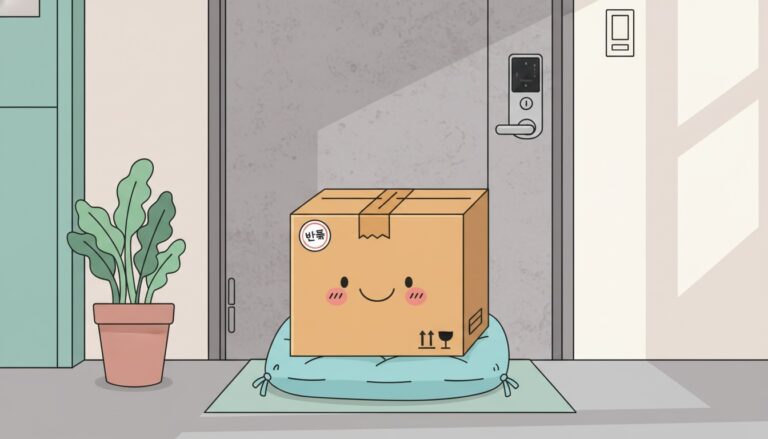
2. You write “반품” (Return) on the box.
3. You leave it in front of your door (문 앞).
The courier picks it up silently, often without even ringing the bell. This system relies on two things: CCTV everywhere and a high-trust society.
4-2. K-Drama Trope Alert 📺
Ever notice in dramas like Crash Landing on You or Her Private Life, packages are stacked high in front of apartments? That’s real life. If you are living in a “Officetel” or apartment, do not stress about handing the package to a person. Just leave it out.
Critical Thinking: How does this “contactless” culture influence the speed of Korean life (Ppalli-ppalli)? It removes the need for scheduling specific meetup times, making the logistics incredibly efficient.
Phase 5: Immersive Roleplay — The CS Chat Bot
Setting: You bought a pair of trendy wide pants, but they are way too long. You are using the store’s “1:1 Chat Consultation” (1:1 채팅 상담) function.
Characters:
– YOU: An international student who wants to exchange the size.
– Agent (CS): Professional customer service representative.
Start Dialogue:
Agent: 안녕하세요. 무엇을 도와드릴까요?
(Annyeonghaseyo. Mueoseul dowadeurilkkayo?)
(Hello. How may I help you?)
YOU: 안녕하세요. 어제 받은 바지 사이즈를 교환하고 싶어요.
(Annyeonghaseyo. Eoje badeun baji saijeureul gyohwanhago sipeoyo.)
(Hello. I want to exchange the size of the pants I received yesterday.)
Agent: 네, 고객님. 사이즈가 안 맞으신가요? 단순 변심의 경우 왕복 배송비 6,000원이 발생합니다.
(Ne, gogaeknim. Saijeuga an majeusingayo? Dansun byeonsimui gyeongu wangbok baesongbi 6,000woni balsaenghamnida.)
(I see. Does the size not fit? In case of a simple change of mind, a round-trip shipping fee of 6,000 won will occur.)
🔀 Decision Point: How do you react?
- A) “네, 알겠습니다. 어떻게 결제하면 되나요?” (Accept it coolly)
- B) “아니요! 이거 불량이에요!” (Lie to save money – Risky!)
- C) “너무 비싸요. 깎아주세요.” (Try to bargain)
✅ Best Choice: A.
“Okay, I understand. How should I pay?”
Why? You cannot bargain (Option C) with a fixed policy in online shopping. Option B requires photo proof; if you lie, they will charge you double later.
YOU: 네, 알겠습니다. 배송비는 박스에 동봉하면 되나요?
(Ne, algesseumnida. Baesongbineun bakseue dongbonghamyeon doenayo?)
(Okay. Should I enclose the shipping fee in the box?)
Agent: 분실 위험이 있어서 앱에서 결제 부탁드립니다.
(Bunsil wiheomi isseoseo abeseo gyeolje butakdeurimnida.)
(There is a risk of loss, so please pay via the app.)
Phase 6: 10-Second Shadowing Drill
Let’s practice the sentence you will use most often. Imagine looking at a shirt that is way too small. Say it with a mix of sadness and determination.
Emotion: 😢 Disappointed but clear.
사이즈가 / 생각보다 작아서 / 교환하고 싶어요.
(Saijeuga / saenggakboda jagaseo / gyohwanhago sipeoyo.)
“The size is / smaller than I thought / so I want to exchange it.”
Tip: Elongate the “ga” (가) and “seo” (서) slightly to sound softer and more natural.
Phase 7: K-Culture Glossary (Shopping Edition)
| Korean | Romanization | Meaning | Context |
|---|---|---|---|
| 택배 | Taekbae | Parcel Service | The lifeblood of Korean commerce. Fast, cheap, and everywhere. |
| 왕복 배송비 | Wangbok baesongbi | Round-trip shipping fee | The fee you pay for exchanges (Seller -> You -> Seller). |
| 품절 | Pumjeol | Sold Out | The saddest word in K-Shopping. Usually in red text. |
| 착불 | Chakbul | Cash on Delivery (Shipping) | The receiver pays the shipping fee upon arrival. |
| 프리 사이즈 | Peuri saijeu | Free Size | Usually fits a Korean size 55-66 (S/M). Rarely fits L/XL. |
Phase 8: Traveler’s Survival Kit
Even if you are just visiting Korea, you might order something to your Airbnb or hotel.
🆘 Survival Expression #1
– 🇰🇷 “문 앞에 놔주세요.” (Mun ape nwajuseyo.)
– 🗣️ Meaning: Please leave it in front of the door.
– 📍 Use: When the delivery driver calls you, or in the “Delivery Request” (배송 요청사항) box on the app.🆘 Survival Expression #2
– 🇰🇷 “경비실에 맡겨주세요.” (Gyeongbisire matgyeojuseyo.)
– 🗣️ Meaning: Please leave it at the security office.
– 📍 Use: If you are staying in a nice apartment or hotel and won’t be home.📌 Editor’s Pro Tip:
If you are returning something from a hotel, ask the Concierge. They often have a service to handle “Taekbae” returns for guests!
Phase 9: Think Deeper — The Hidden Cost of Convenience
Perspective: The “Ppalli-ppalli” (Hurry-Hurry) Culture vs. Labor
Korea’s delivery system is a marvel of the world. Order at 11 PM, arrive by 7 AM. But when we talk about Banpum (Returns), have you considered the person picking it up?
“Taekbae” drivers in Korea are notoriously overworked. When you request a return, a driver has to deviate from their route to come to your specific door to pick up one box. This is why the ‘Change of Mind’ fee exists—it’s not just a penalty; it’s a labor cost.
🧠 Think Deeper: In your country, is the burden of return on the customer (driving to the store/post office) or the system (pickup)? How does this reflect the value of time vs. labor?
Phase 10: FAQ & Troubleshooting
Q: Can I return an item if I cut the tag off?
A: Absolutely NO. In Korea, once the tag (Taek) is removed, it is considered “used” (sayong). Even if you only wore it for 10 seconds. Do not cut the tag until you are 100% sure!
Q: I bought clothes at a subway station underground mall. Can I return them?
A: Often No. Offline budget shops (especially in Gangnam/Express Bus Terminal underground malls) often have a “No Refund, Exchange Only” policy, or sometimes “No Refund/Exchange on White Items.” Always ask “Hwanbul doeyo?” (Is refund possible?) before you pay.
Q: How do I say “It looked different in the picture”?
A: “Sajinhago dallayo” (It’s different from the photo). This is a valid reason for return!
Phase 11: Wrap-up & Mission
Summary: Today we learned that Gyohwan is exchange, Banpum is return, and being honest about Dansun byeonsim (change of mind) saves you trouble, even if it costs you shipping fees.
🚀 Your Action Mission:
- 🥉 Bronze: Practice saying “Saijeuga an majayo” three times while looking at a piece of clothing you own.
- 🥈 Silver: Open a Korean shopping site (like Gmarket or Coupang) and find the “Return/Exchange” button in the menu (usually looks like ‘취소/반품/교환’). Don’t click it, just find it!
- 🥇 Gold: Next time you buy anything (even coffee), ask the clerk, “Hwanbul doeyo?” just to practice the intonation!
💬 Editor’s Question: Have you ever bought “Free Size” clothing in Korea? Did it fit? Tell me your horror (or success) stories in the comments!
Phase 12: Interactive Quiz
1. Situation Judgment:
You ordered a t-shirt, but you just realized you don’t like the shade of blue. You want to return it. What is the correct reason to select?
– A) 상품 불량 (Item defect)
– B) 오배송 (Wrong delivery)
– C) 단순 변심 (Simple change of mind)
2. True or False:
In Korea, it is rude/unsafe to leave a return package in front of your apartment door.
– (True / False)
3. Fill in the Blank:
“This skirt is too small. I want to [ ] it for a larger size.”
– Korean: 이 치마가 너무 작아요. 더 큰 사이즈로 [ ]하고 싶어요.
Answers:
1. C (If you choose A, the seller will check and reject it, charging you double shipping!)
2. False (It is the standard and culturally accepted method!)
3. 교환 (Gyohwan)
Frequently Asked Questions (FAQ)
Q: What does "사이즈가 안 맞아요 (Saijeuga an majayo)" mean in Korean and how do you pronounce it?
A: In Korean, "사이즈가 안 맞아요 (Saijeuga an majayo)" is pronounced [Sai-jeuh-ga an ma-ja-yo] and means: The size doesn't fit.
Q: What does "단순 변심 (Dan-sun byeon-sim)" mean in Korean and how do you pronounce it?
A: In Korean, "단순 변심 (Dan-sun byeon-sim)" is pronounced [Dan-soon byeon-shim] and means: Simple change of mind.
Q: What does "반품 vs. 교환 (Banpum vs. Gyohwan)" mean in Korean and how do you pronounce it?
A: In Korean, "반품 vs. 교환 (Banpum vs. Gyohwan)" is pronounced [Ban-poom] and means: Return (Refund) vs. Exchange.







