

Hi there! Daily Hangul Editor here.
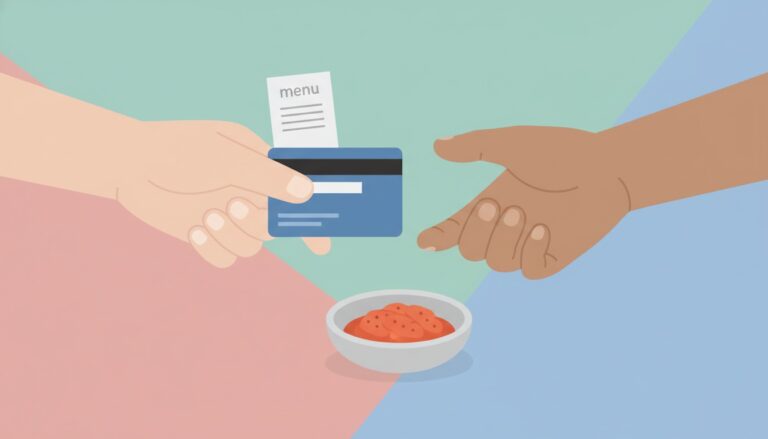
Imagine this: You’ve just finished the most amazing Samgyeopsal (pork belly) of your life. The grill is sizzling, your stomach is full, and the chaotic energy of the restaurant is buzzing around you. Now comes the moment of truth. You need to leave.
In K-Dramas, this is usually where the rich CEO slams a black card on the counter, or a couple has a cute tug-of-war over who gets to pay. But in real life? You’re standing there, wallet in hand, wondering if you should wave, shout, or walk to the counter.
I’ve seen students freeze up here. They know “Hello” and “Thank you,” but paying? That’s where the panic sets in. Today, we’re fixing that. No more awkward staring contests with the cashier.
Phase 2: The Core Expressions (Deep Dive)
Let’s keep it to the three phrases that actually matter.
1. 얼마예요? (Eolmayeyo?)
- Pronunciation: [Eol-ma-ye-yo?]
- Sounds a bit like saying “All – My – Yey – Yo”.
- Meaning: How much is it?
- K-Culture Moment: You’ll hear this everywhere—street markets (sijang), taxis, and convenience stores. In variety shows, you often see foreigners asking this while pointing at literally everything.
- Editor’s Insight: Honestly? In a sit-down restaurant with a bill on the table, you don’t even need to ask this. The price is right there. You mostly use this at street food stalls (Pocha) or if the menu price isn’t clear.
- Situation Spectrum:
[🚫 Formal Boss] ———— [✅ Everyone Else]
(It’s polite enough for almost anyone.)- 🤔 Think About It: In many Western countries, asking the price is just a transaction. In Korea, asking “How much?” at a market often leads to a conversation about discount (service). Why do you think bargaining is such a social activity here?
2. 계산해 주세요 (Gyesanhae juseyo)
- Pronunciation: [Gye-san-hae ju-se-yo]
- Gye-san (Calculation) + Hae juseyo (Please do).
- Meaning: Please check me out / The bill, please.
- Editor’s Insight: This is your bread and butter. You walk to the counter (or raise your hand if it’s table service) and say this. It sounds professional but friendly.
- Situation Spectrum:
[✅ Everywhere]3. 잘 먹었습니다 (Jal meogeotsseumnida)
- Pronunciation: [Jal meo-geot-sseum-ni-da]
- Sounds complex, but break it down: Jal (Well) + Meogeot (Ate) + Sseumnida (Formal ending).
- Meaning: I ate well / Thank you for the meal.
- K-Culture Moment: Every Korean reality show involving food ends with this phrase. It’s not just “thanks”; it’s acknowledging the effort that went into the food.
- Editor’s Insight: Saying this as you leave the restaurant makes you look like a total local. The “auntie” (Imo) at the register will love you.
Phase 3: Textbook vs. Real Life
Textbooks are great, but the streets of Hongdae are different. Here is what happens in the wild.
| Situation | 📖 Textbook Korean | 🗣️ Real Korean | 💡 Why different? |
|---|---|---|---|
| Asking for the bill | “계산서 좀 갖다 주시겠어요?” (Could you bring the bill?) | “여기요! 계산이요!” (Here! Calculation!) | Koreans value speed (Palli-palli culture). Short and clear wins. |
| Checking out | “얼마입니까?” (How much is it?) | (Just handing over the card) | The amount is on the screen. Words are optional if you have a card. |
| Leaving | “안녕히 계세요.” (Stay in peace.) | “수고하세요~” (Work hard / Take care) | “수고하세요” acknowledges their hard work, which is valued more than just a goodbye. |
Bottom Note: If you are A1 level, stick to “계산해 주세요.” It never fails. The slang can wait until you’ve had your first Soju.
Phase 4: Cultural Context — The “Nunchi” of Paying
1. The Two-Handed Pass
When you hand over your credit card, don’t just toss it or use one hand casually. Support your right elbow with your left hand, or use both hands.
– Why? It shows respect. It’s a small gesture, but locals notice.
2. K-Drama Trope: The Battle for the Bill
Have you seen those scenes where two people are physically fighting to give their card to the cashier?
– “I’m paying!”
– “No, put that away! I’m paying!”
This isn’t anger; it’s affection. In Korea, buying food for someone is a huge sign of caring (Jeong). If an older Korean tries to pay for you, let them. It’s their way of taking care of you. Fighting back too hard can actually be rude!
Phase 5: Immersive Roleplay
Setting: A busy Friday night at a BBQ place in Gangnam. You are with Min-su (your Korean friend).
Min-su: (Looking at his wallet) 야, 내가 낼게! (Hey, I’ll pay!)
(Ya, naega naelge!)
YOU (Select your response):
🔀 Decision Point:
– A) “Okay, thanks!” (Cool, free food.)
– B) “Aiyo, no! I will pay!” (Participate in the culture.)
– C) “Let’s split it exactly 50/50.” (Logical, but…)
Analyis:
– If you chose A: It’s fine, but say “Thank you” sincerely.
– If you chose B: ✅ Best Choice! Even if Min-su eventually pays, the act of offering makes him feel good. It shows you aren’t just using him for free ribs.
– If you chose C: ⚠️ Careful. “Dutch Pay” is common among young students, but with older friends or colleagues, exact splitting can feel cold and distant.
Phase 6: 10-Second Shadowing Drill
Don’t just read it. Say it. Feel the emotion.
- Polite & Standard:
😊 여기 / 계산해 / 주세요!
(Yeogi / gyesanhae / juseyo!)
“Here / calculate / please!” -
Happy Ending:
😋 잘 / 먹었습니다~
(Jal / meogeotsseumnida~)
“Well / (I) ate~”
Phase 8: Traveler’s Survival Kit
Going to Korea soon? Screenshot this section.
🆘 Survival Card: Payment
– 🇰🇷 “Card okay?” = “카드 돼요?” (Kadeu dwaeyo?)
– 🇰🇷 “Receipt please.” = “영수증 주세요.” (Yeongsujeung juseyo.)
– 📍 Where to use: Restaurants, Cafes, Convenience Stores.
– 💡 Pro Tip: Tipping is NOT a thing in Korea. If you leave money on the table, the waiter will chase you down the street thinking you forgot it. Seriously.
Phase 9: Think Deeper — Money & Love
Food and Identity:
In many Western cultures, paying for yourself is a sign of independence. In Korea, paying for others is a sign of capacity and relationship. When a senior (Sunbae) buys lunch for a junior (Hubae), it validates their relationship. It says, “I am responsible for you, and we are a team.”
🧠 Think Deeper:
Does paying for someone in your culture imply power, or just kindness? How does it feel when someone refuses to let you pay?
Phase 10: Troubleshooting & FAQ
Q: Do I really need to bow when I pay?
A: Not a full 90-degree bow! Just a slight nod of the head as you take your card back and say “Thank you” is perfect.
Q: Can I split the bill on separate cards?
A: In big franchises? Yes. In a busy, family-run lunch spot with a line out the door? It’s stressful for the owner. Ideally, one person pays, and you transfer money to them later.
❌ Common Mistake:
Thinking you must tip for good service.
✅ Fix: Just say “Thank you” loudly and clearly. That is the best tip.
Phase 11: Wrap-up & Mission
Summary: Don’t panic. Say “Gyesanhae juseyo,” use two hands for your card, and don’t tip!
🔥 Your Mission:
– Bronze: Say “잘 먹었습니다” after your own dinner tonight (even if you cooked it).
– Gold: Go to a Korean restaurant in your city. When you pay, use two hands and try saying, “Gamsahamnida” (Thank you).
K-Culture Mission: Watch a K-Drama scene where they eat. Count how many times they say something involving money or paying. It’s more often than you think!
Got a funny payment story? Share it in the comments!
Frequently Asked Questions (FAQ)
Q: What does "얼마예요? (Eolmayeyo?)" mean in Korean and how do you pronounce it?
A: In Korean, "얼마예요? (Eolmayeyo?)" is pronounced [Eol-ma-ye-yo?] and means: a key conversational Korean expression covered in this lesson.
Q: What does "계산해 주세요 (Gyesanhae juseyo)" mean in Korean and how do you pronounce it?
A: In Korean, "계산해 주세요 (Gyesanhae juseyo)" is pronounced [Gye-san-hae ju-se-yo] and means: a key conversational Korean expression covered in this lesson.
Q: What does "잘 먹었습니다 (Jal meogeotsseumnida)" mean in Korean and how do you pronounce it?
A: In Korean, "잘 먹었습니다 (Jal meogeotsseumnida)" is pronounced [Jal meo-geot-sseum-ni-da] and means: a key conversational Korean expression covered in this lesson.







