

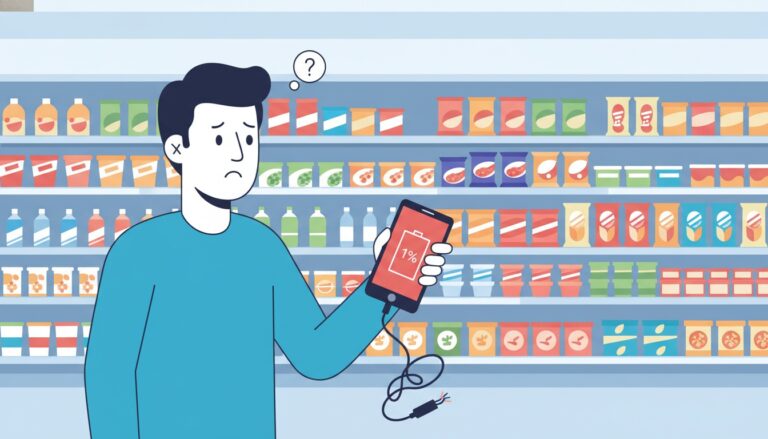
Phase 1: The “1% Battery” Panic
Hello! This is your Daily Hangul editor. 👋
Picture this: You are exploring the hip streets of Seongsu-dong. You just found the perfect aesthetic cafe to upload to your Instagram story. You pull out your phone, and… 1%. The screen goes black.
It’s a classic K-Drama trope, isn’t it? The protagonist is about to receive a life-changing call from their long-lost love, and the phone dies. Dramatic music plays. In reality, there is no dramatic music, just you standing there, unable to check Naver Map to get back to your hotel.
In Korea, a dead phone is a genuine emergency. We do everything on our phones—payments, subway navigation, translation. If your charger breaks or you left it at the hotel, you need a replacement, fast.
Today, I’m going to teach you how to survive this tech crisis without resorting to awkward hand gestures.
Phase 2: Core Expressions (Deep Dive)
1. 충전기가 고장 났어요 (Chungjeon-gi-ga gojang nasseoyo)
- Pronunciation: [chung-jeon-gi-ga / go-jang / na-sseo-yo]
- Sound Analogy: ‘Go-jang’ sounds a bit like ‘Go jam’—like something is jammed and not working.
- Meaning: “My charger broke.”
- Editor’s Insight:
Foreigners often confuse gojang nada (malfunction/break down) with buseojida (physically shatter/break into pieces). Unless you smashed your charger with a hammer, use gojang nada. It means the function has stopped working. - Situation Spectrum:
[🚫 To Boss] ———— [⚠️ To Store Clerk] ———— [✅ To Friends]
(Wait! You can use this with anyone to explain why you are late or unreachable. It’s a universal excuse!) - 🤔 Think About It: Why does Korean distinguish between “functionally broken” (gojang) and “physically broken” (buseojida)? English just says “broken” for both.
2. C타입 충전기 있어요? (C-type chungjeon-gi isseoyo?)
- Pronunciation: [C-type / chung-jeon-gi / i-sseo-yo?]
- Meaning: “Do you have a C-type charger?”
- K-Culture Moment:
Walk into any pyeon-ui-jeom (convenience store like CU, GS25, 7-Eleven). They are lifesavers. They have a whole shelf dedicated to digital accessories. You don’t need an electronics store. - Editor’s Insight:
Koreans use the English alphabets for cable types.- C타입 (C-type) = USB-C
- 8핀 ( Pal-pin) = Lightning (iPhone legacy)
- Situation Spectrum: ✅ Safe to use everywhere.
3. 급속 충전 돼요? (Geupsok chungjeon dwaeyo?)
- Pronunciation: [geup-sok / chung-jeon / dwae-yo?]
- Meaning: “Does it support fast charging?”
- Editor’s Insight:
‘Geupsok’ means ‘rapid speed.’ In the land of Palli-Palli (Hurry-Hurry), nobody wants to wait 3 hours for a phone to charge. If you ask this, the clerk will know you aren’t a tourist who settles for slow speeds.
Phase 3: Textbook vs. Real Life
| Situation | 📖 Textbook Korean | 🗣️ Real Korean | 💡 Why the difference? |
|---|---|---|---|
| Asking for a charger | 충전기를 사고 싶습니다. (I would like to buy a charger.) | 충전기 파나요? (Do you sell chargers?) | “Sago sipseumnida” sounds like you are declaring a formal wish to a genie. “Panayo?” is practical. |
| Checking compatibility | 이것이 제 핸드폰과 호환됩니까? (Is this compatible with my phone?) | 이거 제 폰에 맞아요? (Does this fit my phone?) | “Hohwan” (compatibility) is too technical. “Matda” (fit/match) is used for clothes, shoes, and cables. |
| Asking if it works | 작동합니까? (Does it operate?) | 이거 돼요? (Does this work/do?) | “Dwaeyo?” is the magic verb in Korean. It covers “Is it okay?”, “Does it work?”, “Is it possible?” |
Bottom Note: If you are B1 level, stop saying “I want to buy~” (sago sipeoyo). Just ask “Is there~?” (isseoyo?) or “Do you sell~?” (panayo?). It’s much more natural.
Phase 4: Cultural Context — The “Pyeon-ui-jeom” Survival
4-1. The Silent Check (Non-verbal)
In a busy Korean convenience store, the part-timer (alba) might be wearing AirPods. You don’t always need to speak in full sentences.
* The Move: Hold up your phone, point to the charging port, and make a questioning face while holding a cable package.
* The Nunchi: If the clerk nods, you’re good. If they shake their head and point to another row, you picked the wrong pin.
4-2. K-Travel Connection: The “Battery Rental” Revolution
Buying a charger is so 2010. Nowadays, in Seoul, you will see machines named “Chinggu” or similar QR-code battery rental stations in subways and convenience stores.
* Survival Tip: You scan a QR code, pay a small fee (via KakaoPay or credit card), take a power bank, charge on the go, and return it to any machine in the network. It’s like a city bike, but for electricity.
Phase 5: Immersive Roleplay
Setting: A GS25 convenience store near Hongdae station. It is 11:30 PM. The music is loud K-Pop. You are desperate because your map app just died.
Characters:
* YOU: A tourist with 2% battery.
* Alba (Part-timer): A university student, looking tired but efficient.
Dialogue:
Alba: (Scanning items without looking up) 어서 오세요.
(Eoseo oseyo.)
[Welcome.]
YOU: 저기요, 혹시 C타입 충전기 있어요?
(Jeogiyo, hoksi C-type chungjeon-gi isseoyo?)
[Excuse me, do you happen to have a C-type charger?]
Alba: (Points to the corner) 저기 3번 매대에 있어요.
(Jeogi sam-beon maedae-e isseoyo.)
[It’s over there on shelf number 3.]
YOU: (Looking at the shelf) 종류가 너무 많은데… 급속 충전 되는 거 뭐예요?
(Jongryu-ga neomu maneunde… geupsok chungjeon doeneun geo mwoyeyo?)
[There are too many types… which one does fast charging?]
Alba: (Walks over) 음… 이거요. 이게 제일 빨라요. 머리도 필요하세요?
(Eum… igeoyo. Ige jeil ppallayo. Meori-do piryohaseyo?)
[Hmm… this one. This is the fastest. Do you need the ‘head’ too?]
🔀 Decision Point! What is a “Head” (Meori)?
* A) A haircut?
* B) The charging adapter brick?
* C) A wig?✅ Best Choice: B. In Korean slang, the adapter plug is often called the “head” (meori) or “body,” and the cable is the “line” (jul/seon).
YOU: 아, 네! 머리랑 선 다 필요해요.
(Ah, ne! Meori-rang seon da piryohaeyo.)
[Ah, yes! I need both the head and the cable.]
Phase 6: 10-Second Shadowing Drill
Let’s practice the excuse you will give your friends when you finally reconnect.
- Emotion: 😰 Apologetic and frustrated
- Sentence: 배터리가 / 다 돼서 / 폰이 / 꺼졌었어!
- Romanization: Battery-ga / da dwaeseo / pon-i / kkeojyeosseosseo!
- Meaning: My battery ran out, so my phone turned off!
Phase 7: K-Culture Mini Glossary
| Korean | Romanization | Meaning | Context |
|---|---|---|---|
| 돼지코 | Dwaejiko | Pig nose | Slang for the 220V outlet adapter because it looks like a pig’s snout! 🐷 |
| 보조 배터리 | Bojo battery | Power bank | Literally “Assistant Battery.” Essential for travel. |
| 콘센트 | Consent | Outlet/Socket | Konglish. If you say “outlet,” people might think of a shopping mall. |
| 풀충 | Pul-chung | Full charge | Slang. “My phone is pul-chung.” |
Phase 8: Traveler’s Survival Kit
Did you forget to buy an adapter for Korea’s 220V outlets? Don’t panic.
🆘 Survival Expression #1: Hotel Front Desk
* 🇰🇷 “돼지코 빌릴 수 있을까요?” (Dwaejiko billil su isseulkkayo?)
* 🗣️ Meaning: Can I borrow a plug adapter?
* 💡 Pro Tip: Most hotels have a box full of these left behind by other guests. Just ask!📌 Editor’s Travel Note
* Cafes are charging stations: In Korea, it is culturally acceptable to sit in a cafe for hours and charge your devices. Look for seats near the walls; they usually have ‘콘센트’ (outlets).
* KTX/Trains: KTX trains have USB ports and outlets under the seat or by the window. Don’t let your battery die on the way to Busan!
Phase 9: Think Deeper — The “Palli-Palli” Charging Culture
Why is “Fast Charging” (급속 충전) so important in Korea?
Korea is famous for its ‘Palli-Palli’ (Hurry-Hurry) culture. This isn’t just about walking fast; it’s about efficiency. We hate ‘dead time.’ Waiting for a phone to charge at 5W speed feels like wasting life.
Also, Korea is a hyper-connected society. If you are offline, you don’t exist. You can’t verify your identity, you can’t pay for the bus, and you can’t order food. A dead phone in Seoul is modern isolation. That’s why you’ll see battery rental stations everywhere and outlets in every cafe. It’s not just convenience; it’s a social necessity.
💬 Your Turn: Does your country have public charging stations, or do you have to bring your own? Tell me in the comments!
Phase 10: FAQ & Troubleshooting
- Q: Can I ask a restaurant to charge my phone?
- A: YES! This is very common. Hand your phone to the staff and say: “충전 좀 부탁드려요” (Chungjeon jom butakdeuryeoyo). They usually have a multi-charger behind the counter. It’s free and safe.
- Q: I bought a charger at Daiso, but it’s slow.
- A: Daiso electronics are cheap (3,000~5,000 KRW), but check the wattage (W). If it says 5W, it’s slow. Look for 15W or 20W for decent speed.
❌ Common Mistake: asking for an “outlet” in English.
✅ Fix: Use the word “Consent” (콘센트). “Outlet” sounds like ‘Premium Outlets’ (shopping).
Phase 11: Wrap-up & Mission
One-Liner: When your phone dies in Korea, find a ‘Pyeon-ui-jeom’ and ask for a ‘C-type’ or ‘8-pin’.
🔥 Action Mission:
* 🥉 Bronze: Look at your current charger. Is it C-type or 8-pin? Say it in Korean: “이건 C타입이에요.”
* 🥈 Silver: Go to a Korean Daiso or Convenience Store and find the electronics section. Just look at the packages and try to read “급속” (Fast).
* 🥇 Gold: Ask a cafe staff member: “콘센트 자리 있어요?” (Do you have a seat with an outlet?) before you sit down.
Phase 12: Quiz — Situation Challenge
Situation: You are at a restaurant. Your battery is dead. You want the owner to charge it for you. What do you say?
- “핸드폰이 고장 났어요.”
- “충전기 사세요?”
- “혹시 충전 좀 해주실 수 있나요?”
Answer:
3. “혹시 충전 좀 해주실 수 있나요?” (Could you possibly charge this for me?)
* Why 1 is wrong: This means “My phone is broken.”
* Why 2 is wrong: This means “Do you buy chargers?” (You are trying to sell one to them!).
Frequently Asked Questions (FAQ)
Q: What does "충전기가 고장 났어요 (Chungjeon-gi-ga gojang nasseoyo)" mean in Korean and how do you pronounce it?
A: In Korean, "충전기가 고장 났어요 (Chungjeon-gi-ga gojang nasseoyo)" is pronounced [chung-jeon-gi-ga / go-jang / na-sseo-yo] and means: a key conversational Korean expression covered in this lesson.
Q: What does "C타입 충전기 있어요? (C-type chungjeon-gi isseoyo?)" mean in Korean and how do you pronounce it?
A: In Korean, "C타입 충전기 있어요? (C-type chungjeon-gi isseoyo?)" is pronounced [C-type / chung-jeon-gi / i-sseo-yo?] and means: "Do you have a C-type charger?"
Q: What does "급속 충전 돼요? (Geupsok chungjeon dwaeyo?)" mean in Korean and how do you pronounce it?
A: In Korean, "급속 충전 돼요? (Geupsok chungjeon dwaeyo?)" is pronounced [geup-sok / chung-jeon / dwae-yo?] and means: "Does it support fast charging?"







