

Phase 1: The Windy Island Hook
Hello! It’s your Daily Hangul editor here.
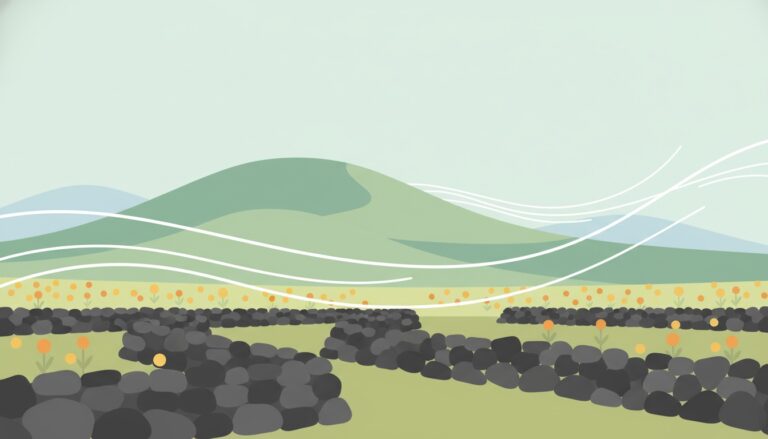
Picture this: You’re watching a K-Drama—maybe Welcome to Samdal-ri or Our Blues. The protagonist, exhausted by city life in Seoul, escapes to an island. The wind is blowing their hair everywhere, there are endless walls of black stone, and they are hiking up a small, grassy hill that looks like a green velvet mound.
They aren’t climbing the massive Hallasan Mountain. They are walking up an “Oreum” (오름).
Jeju Island isn’t just “South Korea’s Hawaii.” It’s a geological museum. To the untrained eye, it’s just pretty scenery. But to a C1-level learner and a true K-Culture fan, knowing the difference between a mountain ($san$) and an Oreum changes how you see the island.
Today, we aren’t just learning words; we are learning how to read the Korean landscape like a local.
Phase 2: Deep Dive into Jeju’s Geology
Here are the three terms that will make you sound like a geology professor (or just a very smart tourist).
1. 오름 (Oreum)
- Pronunciation: [O-reum] (The ‘O’ is short like ‘Oh’, ‘reum’ sounds a bit like ‘room’ but with a flat tongue.)
- Meaning: Literal: A parasitic cone volcano. Real Nuance: A “petite volcano” neighbor. It’s approachable, hike-able, and intimate.
- K-Culture Moment: In Hyori’s Bed & Breakfast, IU and Hyori walk up an Oreum at sunset. It’s not a conquest; it’s a conversation walk.
- Editor’s Insight: Do not call an Oreum a “mountain” ($san$) in front of a Jeju local. Hallasan is the mother; the Oreums are her children. There are over 360 of them!
- Situation Spectrum:
[🚫 Formal/Academic] ———— [⚠️ Travel Guide] ———— [✅ Casual/Local]
(Usage is universal, but the feeling is local pride.)- 🤔 Think About It: Why does Korean distinguish so strictly between the main mountain and the parasitic cones? It reflects a hierarchy, even in nature.
2. 현무암 (Hyeonmuam)
- Pronunciation: [Hyeon-mu-am]
- Meaning: Literal: Basalt. Real Nuance: The “Black Stone” of Jeju.
- K-Culture Moment: Every time you see a Dol Hareubang (Grandfather Stone statue) or those waist-high black stone walls ($batdam$) in a drama, that is Hyeonmuam. It is the skin and bones of the island.
- Editor’s Insight: You can’t take these stones out of Jeju. It’s illegal. If you say “The Hyeonmuam walls are beautiful,” locals will be impressed you know the specific rock name.
- Situation Spectrum:
[🚫 Slang] ———— [⚠️ Conversation] ———— [✅ Descriptive/Academic]- 🤔 Think About It: This stone is porous (full of holes). How did this influence Jeju’s architecture and water culture?
3. 주상절리 (Jusangjeolli)
- Pronunciation: [Ju-sang-jeol-li]
- Meaning: Literal: Columnar Jointing. Real Nuance: Nature’s sculpture park.
- K-Culture Moment: Often featured in travel vlogs or MV backdrops where hexagonal stone pillars rise out of the sea. It looks like Minecraft in real life.
- Editor’s Insight: This is a “show-off” word. Use this when looking at the cliffs near Seogwipo. “Wow, the Jusangjeolli is spectacular today.”
- Situation Spectrum:
[🚫 Slang] ———— [⚠️ Casual] ———— [✅ Sightseeing]
Phase 3: Textbook vs. Real Life
When you are standing on top of an Oreum, catch your breath and say this:
| Situation | 📖 Textbook Korean | 🗣️ Real Korean (Jeju Vibe) | 💡 Why? |
|---|---|---|---|
| Describes the view | 경치가 아름답습니다. (The scenery is beautiful.) |
와, 여기 뷰 미쳤다 / 힐링된다. (Wow, the view is crazy / This is healing.) |
“Beautiful” is too generic. Modern Koreans use “View” (Konglish) or “Healing” for nature. |
| Describing the wind | 바람이 많이 붑니다. (The wind is blowing a lot.) |
바람한테 싸대기 맞는 기분이야. (I feel like the wind is slapping my face.) |
Jeju wind is violent. “Slapping” (ssadaegi) captures the physical intensity. |
| Asking about the hike | 올라가는 데 얼마나 걸려요? (How long to go up?) |
이거 빡세요? (Is this intense/tough?) |
“Bbak-seda” is common slang for physically demanding tasks. |
💡 Bottom Note: Use “Bbak-seda” only with friends. With a guide, stick to “Him-deun-ga-yo?” (Is it hard?)
Phase 4: Cultural Deep Dive — The Island of Three
4-1. Non-verbal: Jeju Time
Seoul is “Pali-pali” (Hurry, hurry). Jeju is… slower. When you visit a cafe near an Oreum, don’t tap your foot waiting for your Hallabong latte. Look out the window at the stone walls. The service pace here is deliberate. Relaxing is part of the “survival” kit here.
4-2. K-Drama Connection: The Dialect Gap
In Our Blues, did you notice the subtitles in Korean when the grandmothers spoke? That’s because Jeju Dialect (Jeju-eo) is distinct enough to be considered a separate language by UNESCO.
– Standard: Eoseo oseyo (Welcome)
– Jeju: Honjeo opseyeo
Critic’s View: Media often romanticizes Jeju as a paradise for Seoulites to “heal.” But for locals, the rocky soil (basalt) made farming incredibly hard historically. That beautiful black stone wall? It was built with back-breaking labor to stop the wind from killing the crops.
Phase 5: Immersive Roleplay
Setting: Late afternoon at Saebyeol Oreum (famous for silver grass). The wind is fierce. You are with Ji-min (29, Korean friend, loves photography).
Ji-min: (Panting) 와, 생각보다 경사가 가파르네. 너 괜찮아?
(Wa, saeng-gak-bo-da gyeong-sa-ga ga-pa-reu-ne. Neo gwaen-chan-a?)
(Wow, the slope is steeper than I thought. Are you okay?)
YOU: (Choose your response)
🔀 Your Turn! How do you reply?
– A) “네, 괜찮습니다. 경치가 아름답네요.” (Textbook robot mode)
– B) “완전 힐링되는데요? 근데 바람이 장난 아니에요!” (Natural & Enthusiastic)
– C) “아, 죽겠어요. 못 가요.” (Too negative, ruins the mood)
✅ Best Choice: B
“Wanjeon healing-doen-de-yo? Geunde baram-i jangnan anieyo!”
(This is total healing! But the wind is no joke!)
Why? You acknowledge the “healing” vibe of Jeju while using the common idiomatic phrase “Jangnan anida” (it’s no joke) to describe the famous Jeju wind.
Ji-min: (Laughs, holding her hair) 맞아, 제주도 바람한테 싸대기 맞는 중이야. 저기 봐, 현무암 돌담 예쁘지 않아?
(Right, I’m getting slapped by the Jeju wind. Look there, isn’t the basalt stone wall pretty?)
YOU:
(Using the word we learned!)
“진짜 멋있어요. 검은색 돌이 제주도만의 매력인 것 같아요.”
(It’s really cool. The black stone seems to be Jeju’s unique charm.)
Phase 6: 10-Second Shadowing Drill
Let’s practice describing the unique geological landscape. Keep your tone amazed and slightly breathless (you just hiked!).
“제주도는 / 어딜 가나 / 오름이 보여서 / 신기해요.”
Pronunciation: Jejudoneun / eodil gana / oreumi boyeoseo / singihaeyo.
Emotion: 😊 Fascinated
Meaning: It’s fascinating that you can see Oreums wherever you go in Jeju.
Phase 7: K-Culture Glossary (Jeju Edition)
| Term | Romanization | Context |
|---|---|---|
| 삼다도 | Samdado | Nickname for Jeju. Island of Three Abundances: Wind, Stones, and Women. |
| 해녀 | Haenyeo | Female divers. The living legends of Jeju who dive without oxygen tanks. |
| 한라산 | Hallasan | The shield volcano at the center of the island. The “Mother” of all Oreums. |
| 유채꽃 | Yuchaekkot | Canola flowers. Yellow flowers that bloom in spring near Sanbangsan. |
Phase 8: Traveler’s Survival Kit (Geology Edition)
Jeju’s geography dictates your travel logistics.
🆘 Survival Tip #1: Shoes matter
– Why? Many tourist spots involve walking on uneven Hyeonmuam (basalt) or climbing Oreums.
– Phrase: “편한 신발 있어요?” (Do you have comfortable shoes?)📌 Editor’s Travel Note: Rental Cars
– Jeju is huge. Public transport exists, but to see the specific Gotjawal (forests) or Oreums, a rental car is 99% necessary.
– Navigation: Don’t use Google Maps. It doesn’t work well for walking/driving directions in Korea. Use Naver Map or Kakao Map.
Phase 9: Think Deeper — Tourism vs. Nature
The Cost of a Selfie:
Jeju’s unique geological features—the Oreums and Gotjawal forests—are fragile ecosystems. Recently, “over-tourism” has become a hot topic in Korea. Visitors sometimes trample protected moss in the forests just to get a photo that looks like a K-Drama poster.
🧠 Question: As a visitor who loves Korean culture, how do we balance the desire to “consume” these beautiful landscapes with the need to protect them? Does your country have a similar “Instagram vs. Nature” conflict?
Phase 10: FAQ & Troubleshooting
Q: If I speak standard Korean to a Jeju grandma, will she be offended?
A: No! She knows you are a mainlander ($yukji-saram$) or a foreigner. She will try to speak standard Korean to you, but her accent might be strong. Just smile and listen carefully.
Q: Can I take a piece of basalt (Hyeonmuam) home as a souvenir?
A: Absolutely NOT. It is illegal to take volcanic stones from Jeju, even small pebbles from the beach. You can be fined at the airport. Buy a fake stone statue at the gift shop instead.
Phase 11: Wrap-up & Mission
One-Liner: Jeju isn’t just an island; it’s a collection of 360+ Oreums and black Hyeonmuam stones.
🔥 Your Mission:
– 🥉 Bronze: Say “Oreum” and “Hyeonmuam” out loud three times. Watch your ‘R’ pronunciation.
– 🥈 Silver: Go to Google Images and search for “Yongnuni Oreum”. Look at the curves.
– 🥇 Gold: Watch the first episode of Welcome to Samdal-ri (Netflix) and spot the stone walls and Oreums in the background. Count how many you see!
💬 Comment below: Have you ever hiked a volcano (even a small one)? Tell me about it!
Frequently Asked Questions (FAQ)
Q: What does "오름 (Oreum)" mean in Korean and how do you pronounce it?
A: In Korean, "오름 (Oreum)" is pronounced [O-reum] and means: Literal: A parasitic cone volcano. Real Nuance: A "petite volcano" neighbor. It's approachable, hike-able, and intimate.
Q: What does "현무암 (Hyeonmuam)" mean in Korean and how do you pronounce it?
A: In Korean, "현무암 (Hyeonmuam)" is pronounced [Hyeon-mu-am] and means: Literal: Basalt. Real Nuance: The "Black Stone" of Jeju.
Q: What does "주상절리 (Jusangjeolli)" mean in Korean and how do you pronounce it?
A: In Korean, "주상절리 (Jusangjeolli)" is pronounced [Ju-sang-jeol-li] and means: Literal: Columnar Jointing. Real Nuance: Nature's sculpture park.







