

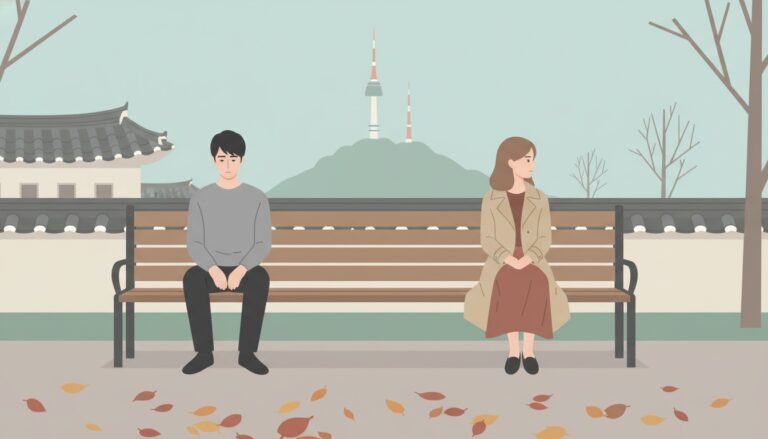
Phase 1: The “We Need to Talk” Moment
Hello! Daily Hangul Editor here.
You know the scene. It’s episode 12 of a K-Drama. The background music slows down to a acoustic piano track. The couple is sitting in a beautifully lit cafe, but they haven’t touched their iced Americanos. The protagonist looks down at the table and sighs. You know what’s coming before the subtitles even load.
The Breakup.
In English, we might say, “I’m dumping you” or “It’s over.” But in Korean, breaking up is an art form of indirectness, heavy pauses, and specific emotional vocabulary. If you’re dating a Korean, or just addicted to K-Dramas, understanding the nuance of how things end is just as important as how they begin.
Today, we aren’t just learning words; we’re learning how to read the air when the temperature drops.
Phase 2: Core Expressions (The Heartbreakers)
1. 우리 그만하자 (Uri geumanhaja)
- Pronunciation: [Uri geumanhaja] Sounds like: “OO-ree geu-man-ha-ja”
- Meaning: Let’s stop. (Real nuance: Let’s break up.)
- K-Culture Moment: This is the ultimate K-Drama line. It’s rarely screamed; it’s usually whispered with tears in eyes. It implies, “We’ve tried, but this is the end of the road.”
- Editor’s Insight: Notice the word 우리 (Uri – Us). Even in separation, Koreans prioritize the collective. It’s not “I am leaving you”; it’s “Let’s end us.” It shares the burden of the breakup.
- Situation Spectrum:
[🚫 Formal/Boss] ———— [⚠️ Semi-formal] ———— [✅ Casual/Dating] - 🤔 Think About It: Why does Korean use “stop” (doing an action) rather than “break” (a bond)? What does that imply about the relationship being an activity or effort?
2. 마음이 식었어 (Maeumi sigeosseo)
- Pronunciation: [Maeumi sigeosseo] Sounds like: “Ma-eum-ee shi-guss-uh”
- Meaning: My heart has cooled down. (Real nuance: I don’t love you anymore.)
- K-Culture Moment: Used when the partner asks “Why?” (왜? 도대체 왜?). It’s the most honest, painful justification. You’ll hear this in sad ballads more often than in spoken conversation because it hurts to admit.
- Editor’s Insight: In English, we “fall out of love.” In Korean, the heart changes temperature. It was hot (passionate), and now it is cold (indifferent).
- Situation Spectrum:
[🚫 Polite Company] ———— [⚠️ Friends] ———— [✅ Lovers]
3. 좋은 친구로 지내자 (Joeun chinguro jinaeja)
- Pronunciation: [Joeun chin-gu-ro ji-nae-ja]
- Meaning: Let’s stay good friends.
- K-Culture Moment: The classic “softener.” In reality—and in dramas—this rarely works out. Usually, the other person cries and says, “How can we be friends?”
- Editor’s Insight: This is often a lie to reduce guilt. If someone says this to you, don’t expect to actually hang out next weekend. It’s a polite way to fade away.
- Situation Spectrum:
[🚫 Strangers] ———— [⚠️ Acquaintances] ———— [✅ Dating]
Phase 3: Textbook vs. Real Life
| Context | 📖 Textbook Korean | 🗣️ Real Korean | 💡 The Vibe Shift |
|---|---|---|---|
| The Notice | 우리 헤어집시다. (Let’s break up – Formal) | 할 말이 있어. (I have something to say.) | “Hal mal i-sseo” is the terrifying trigger phrase that signals doom. |
| The Reason | 성격이 안 맞아요. (Personalities don’t match.) | 너랑 나랑 안 맞는 것 같아. (I don’t think you and I fit.) | Using “match/fit” (맞다) focuses on compatibility rather than fault. |
| Ghosting | 연락을 끊었습니다. (Cut off contact.) | 잠수 탔어. (Rode the submarine.) | Slang for ghosting. You submerged and disappeared like a submarine. |
Bottom Note: Never use “헤어집시다” (Let’s break up – formal) unless you are breaking up with a business partner or in a arranged marriage drama set in the 1900s. Stick to banmal (casual speech) for dating.
Phase 4: Cultural Deep Dive — The Art of “Jeong” and Cutting Ties
4-1. The Difficulty of a Clean Break
Breaking up in Korea is complicated by Jeong (정)—that deep, invisible bond of attachment that forms over time, even if you hate the person. Because of Jeong, Koreans often struggle with clean breaks. You might see exes contacting each other “just to check in” (자니? – Are you sleeping?) more often than you’d expect. It’s not always about wanting to get back together; it’s the lingering Jeong making it hard to detach completely.
4-2. K-Pop Breakup Protocol: The “Ballad” Phase
In Western pop culture, you might listen to an empowering “I don’t need you” anthem. In Korea, the “Moving On” process involves going to a Coin Noraebang (Coin Karaoke) and singing gut-wrenching ballads until you lose your voice. Songs by artists like Park Hyo-shin or IU that detail the pain of separation are essential therapy. It’s socially acceptable to sing and cry in that small booth.
Phase 5: Immersive Roleplay
Setting: A quiet bench at Han River Park (한강공원). It’s windy. You are holding a can of beer, but haven’t opened it.
Characters:
* YOU: Feeling guilty but sure that this needs to end.
* Min-jun (30, your boyfriend): He suspects something is wrong but is trying to act cheerful.
Dialogue:
Min-jun: 오늘따라 왜 이렇게 조용해? 무슨 일 있어? 😟
(Oneulttara wae ireoke joyonghae? Museun il isseo?)
[Why are you so quiet today? Is something wrong?]
(🎭 Min-jun tries to hold your hand)
YOU: 민준아… 나 할 말이 있어. 😔
(Minjun-a… na hal mari isseo.)
[Min-jun… I have something to say.]
Min-jun: …뭔데? 설마 안 좋은 얘기는 아니지?
(…Mwonde? Seolma an joeun yaegineun aniji?)
[…What is it? Don’t tell me it’s bad news?]
🔀 Decision Point: How do you deliver the blow?
- A) “우리 헤어지자. 더 이상 널 사랑하지 않아.” (Direct strike)
- B) “우리… 시간을 좀 갖는 게 좋을 것 같아.” (The cowardly soft exit)
- C) “너 너무 착한 사람인데, 나랑은 안 맞는 것 같아.” (The ‘It’s not you, it’s me’)
✅ Best Choice: C — “You’re a good person, but we don’t fit.” This preserves Min-jun’s face (Chemyon) while being clear. Option A is too brutal for a long-term relationship, and B (taking a break) often gives false hope.
YOU (Option C): 너 너무 좋은 사람인데… 우리 서로 안 맞는 것 같아.
(Neo neomu joeun saraminde… uri seoro an manneun geot gata.)
Min-jun: (Sighs deeply) …결국 이렇게 되는구나.
(…Gyeolguk ireoke doeneunguna.)
[…So it ends like this eventually.]
Phase 6: 10-Second Shadowing Drill
Practice these to master the tone of a breakup. Don’t be robotic; act it out!
- 😔 The Resignation:
우리 / 그만하는 게 / 좋을 것 같아.
(uri / geuman-haneun-ge / joeul-geot-gata.)
[I think it would be best if we stopped.] -
😢 The Regret:
미안해 / 내가 / 부족해서 그래.
(mianhae / naega / bujokaeseo geurae.)
[Sorry / It’s because I’m lacking.]
Note: This is a classic line to take the blame.
Phase 7: K-Culture Mini Glossary
| Korean | Romanization | English | Context |
|---|---|---|---|
| 차다 / 차이다 | chada / chaida | To dump / To get dumped | Literally “to kick.” “I got kicked” means I got dumped. |
| 잠수 타다 | jamsu tada | Ghosting | Literally “to ride a submarine.” Disappearing without a word. |
| 흑역사 | heuk-yeok-sa | Dark History | Embarrassing memories (like drunk texting your ex). |
| 읽씹 | il-ssip | Left on read | Reading a message and ignoring it. The ultimate sign of coldness. |
| 미련 | miryeon | Lingering feelings | What you have when you can’t throw away their hoodie. |
Phase 8: Traveler’s Survival Kit (Heartbreak Edition)
Even if you aren’t breaking up, you might visit a Noraebang (Karaoke) where these emotions are everywhere.
🆘 Survival Phrase #1: Extending time
* 🇰🇷 “여기 서비스 시간 좀 주세요!” (Yeogi seobiseu sigan jom juseyo!)
* 🗣️ Pronunciation: [Yeo-gi service shi-gan jom ju-se-yo]
* Use: At a Noraebang.
* Meaning: “Please give us some service (free) time!”
* Why: If you are singing sad ballads and the owner sees you are really “into it,” they often give 10-20 minutes of free time. It’s Korean Jeong!📌 Editor’s Pro Tip:
If you see people crying at a pojangmacha (street tent bar) with empty soju bottles, do not stare. It is the designated “breakup zone.” Just drink your udon soup and look away. That is manners.
Phase 9: Think Deeper — “Why so vague?”
The Culture of Indirectness:
Notice how Korean breakups rarely say “I hate you” or “You did this wrong.” They say “We don’t match” or “My heart cooled.” Korean culture relies heavily on High-Context Communication. Explicit confrontation is seen as immature or hurtful. The goal of a breakup conversation is often to end the relationship while damaging the other person’s kibun (mood/pride) as little as possible. It feels frustratingly vague to Westerners who value clarity (“Tell me exactly why!”), but in Korea, the vagueness is the kindness.
💬 Your Turn: In your country, is it better to be brutally honest or kindly vague when breaking up?
Phase 10: FAQ & Troubleshooting
- Q: Can I break up via KakaoTalk?
- A: Strong No. Unless you went on one date, breaking up via text is considered extremely rude and cowardly (비매너). It creates “Dark History” (흑역사) for you. Meet in person, or at least call.
- Q: What if they ask “Why?” repeatedly?
- A: Repeat the compatibility line: “너랑 나랑 잘 안 맞는 것 같아” (I don’t think we fit well). Avoid listing their flaws unless you want a fight.
❌ Common Mistake: Saying “I love you, but let’s break up.” (사랑하는데 헤어지자).
Why: In K-Dramas, this is romantic. In real life, it sounds like nonsense and makes the other person angry. Just be clear that feelings have changed.
Phase 11: Wrap-up & Mission
One-Liner: Breaking up in Korean is about “us” stopping, not just “you” leaving, wrapped in enough indirectness to save face.
Action Missions:
* 🥉 Bronze: Stand in front of a mirror, look sad, and say “우리 그만하자” three times.
* 🥈 Silver: Watch a K-Pop music video (try IU’s “Ending Scene”) and spot the word “미안해” (Sorry).
* 🥇 Gold: Go to a Coin Noraebang and sing a sad song. Feel the Han (sorrow)!
Phase 12: Quiz — Do You Have Nunchi?
Situation: You went on 3 dates with someone. You aren’t interested. They text you: “This weekend movie?”
Which reply is the most appropriate ‘Korean Soft Rejection’?
- “No, I don’t like you.”
- (Ignore the text – Ghosting)
- “죄송해요. 제가 요즘 회사 일이 너무 바빠서 시간이 안 날 것 같아요.”
(Sorry. I’m so busy with work these days, I don’t think I’ll have time.)
Correct Answer: 3.
Explanation: Option 1 is too harsh. Option 2 is rude (though common). Option 3 is the standard “polite excuse.” If you say you are busy twice, a Korean with Nunchi will understand it means “No.”
Frequently Asked Questions (FAQ)
Q: What does "우리 그만하자 (Uri geumanhaja)" mean in Korean and how do you pronounce it?
A: In Korean, "우리 그만하자 (Uri geumanhaja)" is pronounced [Uri geumanhaja] and means: Let's stop. (Real nuance: Let's break up.)
Q: What does "마음이 식었어 (Maeumi sigeosseo)" mean in Korean and how do you pronounce it?
A: In Korean, "마음이 식었어 (Maeumi sigeosseo)" is pronounced [Maeumi sigeosseo] and means: My heart has cooled down. (Real nuance: I don't love you anymore.)
Q: What does "좋은 친구로 지내자 (Joeun chinguro jinaeja)" mean in Korean and how do you pronounce it?
A: In Korean, "좋은 친구로 지내자 (Joeun chinguro jinaeja)" is pronounced [Joeun chin-gu-ro ji-nae-ja] and means: Let's stay good friends.







