

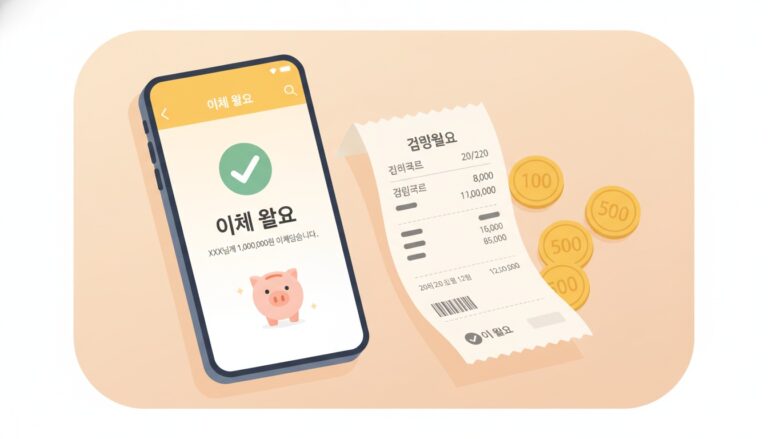
Phase 1: The “Bill Fight” Scene
Hello! I’m your editor at Daily Hangul.
If you’ve watched enough K-Dramas, you know the scene. A group finishes a meal. The check arrives. Suddenly, chaos erupts. One person grabs the bill, another tries to snatch it away, shouting “No, I’m buying!” It looks like a wrestling match, but it’s just polite affection.
But in real life, especially among younger generations or coworkers, we don’t always wrestle. We calculate. We split. And unlike in some countries where you might use Venmo or Cash App, in Korea, we do direct Bank Transfers (Gye-jwa I-che) right at the table.
Whatever you do, don’t just sit there silently while everyone else is pulling out their phones. Today, I’ll teach you the magic phrase to handle the bill without looking like a confused tourist.
This isn’t just about money; it’s about being part of the group.
Phase 2: The Magic Words (Deep Dive)
Here are the three phrases you need to survive a Korean dinner payment.
1. 계좌번호 좀 알려주세요 (Please give me your account number)
- Pronunciation: [Gye-jwa-beon-ho jom al-lyeo-ju-se-yo]
- Sound Analogy:
- Gye sounds like the start of “Guest.”
- Jwa sounds like “Jua” in “Tijuana.”
- Beon-ho sounds like “Bun-ho.”
- Meaning: “Please let me know your account number.”
- K-Culture Moment: Imagine a group of friends leaving a cafe. Everyone has their banking apps open. You’ll hear “Gye-jwa, gye-jwa” (Account, account) muttered everywhere.
- Editor’s Insight: The word “좀 (jom)” literally means “a little,” but here it softens the request. Without it, you sound like a debt collector. Always use “jom”!
- Situation Spectrum:
[🚫 Boss] ———— [⚠️ Coworkers] ———— [✅ Friends/Servers]
(Actually, this is polite enough for almost anyone, except maybe the President.)- 🤔 Think About It: Why do Koreans prefer bank transfers over cash? It’s fast (instant), free (mostly), and we hate carrying coins.
2. 얼마 보내면 돼요? (How much should I send?)
- Pronunciation: [Eol-ma bo-nae-myeon dwae-yo?]
- Meaning: “How much if I send becomes okay?” (Literal) → “How much do I owe you?”
- Editor’s Insight: This puts the math responsibility on the person who paid. You are just the sender.
3. 보냈어요! (I sent it!)
- Pronunciation: [Bo-naes-seo-yo!]
- Meaning: Past tense of “to send.”
- K-Culture Moment: You say this immediately after tapping ‘confirm’ on your phone. The receiver will check their phone and say “Deu-reo-wat-ne” (It came in).
Phase 3: Textbook vs. Real Life
Textbooks make you sound like a news anchor. Let’s fix that.
| Situation | 📖 Textbook Korean | 🗣️ Real Korean | 💡 Why different? |
|---|---|---|---|
| Asking for info | 계좌번호를 말씀해 주시겠습니까? (Could you please speak your account number?) | 계좌 뭐야? (What’s the acc?) | Start with casual speech for friends. Efficiency is key. |
| Confirming | 송금했습니다. (I have remitted the funds.) | 보냈어~ (Sent it~) | “Remitted” sounds too banking-official. |
| Splitting | 비용을 나누죠. (Let us divide the cost.) | N빵 하자! (Let’s do N-bbang!) | N-bbang comes from “1/N”. Slang for splitting evenly. |
Bottom Note: If you are a total beginner (A1), stick to the polite “Bo-naes-seo-yo.” Slang like “N-bbang” is fun to know, but risky to use with your boss.
Phase 4: Cultural Context — The Speed of Trust
4-1. The “8282” Culture
Korea is famous for Pali-Pali (Hurry-Hurry) culture. This applies to banking too. In many countries, a bank transfer takes 1-3 business days. In Korea? It takes 1-3 seconds.
If you say “I sent it,” the other person expects to see the notification immediately. If it doesn’t arrive in 10 seconds, they might ask, “Did you get the number right?”
4-2. K-Food Connection: “I’ll shoot!”
In many Western cultures, “separate checks” is the default. In Korea, usually one person pays the whole bill first at the counter to save time/hassle for the staff. Then, everyone transfers money to that one person. Asking the cashier to split the payment on 5 different cards is technically possible but can make the line behind you very angry.
Phase 5: Roleplay — The Post-Dinner Scramble
Setting: Friday night, 9 PM. A loud fried chicken place in Hongdae. You just finished eating with your Korean friend, Min-ji.
Characters:
* YOU: An expat/traveler trying to be polite.
* Min-ji (28): Your energetic Korean friend who already has her card out.
(Dialogue)
Min-ji: 잘 먹었다! 내가 계산할게. 🍗
(Jal meogeotda! Naega gyesanhalge.)
(I ate well! I’ll calculate/pay.)
(🎭 Stage Direction: She practically runs to the counter.)
YOU: 😯 Wait, Min-ji!
Min-ji: (Coming back with receipt) Done. Let’s go!
YOU: Thank you! But I want to pay my share.
Min-ji: Aww, okay.
YOU: [ 🔀 Your Choice! ]
Option A: “Money give?”
Option B: “Gye-jwa-beon-ho jom al-lyeo-ju-se-yo.”
Option C: (Give her cash)
✅ Best Choice: Option B. Asking for the account number is the standard modern way.
Min-ji: Ah, okay. It’s Kakao Bank, 3333-01…
YOU: (Typing on phone) Eol-ma bo-nae-myeon dwae-yo?
Min-ji: Just send 20,000 won.
YOU: Okay… (Tap tap)… Bo-naes-seo-yo!
Min-ji: Checked! Thanks!
Phase 6: 10-Second Shadowing Drill
Let’s practice the most useful phrase. Don’t be shy—mumble it until your tongue gets used to it.
Emotion: 😊 Polite but quick (you don’t want to hold up the group).
Gye-jwa-beon-ho / jom / al-lyeo-ju-se-yo?
(Account number / please / let me know?)
Phase 7: K-Culture Glossary
| Korean | Romanization | Meaning | Context |
|---|---|---|---|
| N빵 | N-bbang | Dutch Pay / Splitting | Slang. Derived from the variable ‘N’ in math + ‘bbang’ (split/hit). |
| 쏘다 | Ssoda | To treat/pay | Literally “to shoot.” ex: “I’ll shoot!” means “It’s on me!” |
| 더치페이 | Deochi-pay | Dutch Pay | The standard Konglish term for splitting the bill. |
| 카카오페이 | KakaoPay | KakaoPay | The most common mobile payment method integrated into Korea’s main chat app. |
Phase 8: Traveler’s Survival Kit
Wait, do you actually have a Korean bank account?
Most short-term travelers don’t. You usually need an Alien Registration Card (ARC) to open one or use online banking.
So, if a Korean friend pays for you and expects a transfer, you might be stuck.
🆘 Survival Strategy for Tourists
If you cannot transfer money, say this BEFORE they pay:
- 🇰🇷 “현금으로 드려도 돼요?” (Hyeon-geum-eu-ro deu-ryeo-do dwae-yo?)
- 🗣️ Meaning: “Can I give you cash?”
- 💡 Pro Tip: Keep 10,000 won and 50,000 won bills handy. If you owe 18,000 won and only have 50,000, it gets awkward again. Try to carry small bills!
Phase 9: Think Deeper — Money & Relationships
In many Western cultures, talking about money can be taboo or strictly private. In Korea, discussing who pays, how much to send, and the act of “fighting” to pay the bill is a loud, public performance of friendship.
When someone says “I’ll buy,” they aren’t just buying food; they are buying social credit and showing affection (Jeong). When you quickly offer to transfer your share, you are saying, “I respect you, and I don’t want to be a burden.”
💬 Your Turn: In your country, is it polite to split the bill down to the last penny, or does one person usually pay? Tell me in the comments!
Phase 10: Troubleshooting & FAQ
Q: Can I just ask for their email for PayPal?
A: No. PayPal is rarely used for domestic transfers in Korea. It’s all about local bank apps, KakaoPay, or Toss.
Q: I sent the money but used the wrong name. What happens?
A: Korean banking apps show the receiver’s real name before you hit final confirm. Always check the name matches your friend’s name!
❌ Common Mistake:
Sending the exact amount divided by the number of people, resulting in messy numbers like 13,333 won.
✅ Do this instead: Round up. If it’s 13,333, just send 13,500 or 14,000. It looks generous and “cool.”
Phase 11: Wrap-up & Mission
One-Liner: To split the bill in Korea, let one person pay first, then ask “Gye-jwa-beon-ho jom al-lyeo-ju-se-yo” to pay them back instantly.
Action Mission:
- 🥉 Bronze: Say “Gye-jwa-beon-ho” 5 times fast while washing your hands.
- 🥈 Silver: Next time you eat with friends (even non-Koreans), jokingly say “I’ll shoot!” (Naega ssol-ge!).
- 🥇 Gold: If you are in Korea, ask a friend for their account number and successfully transfer your share of lunch!
K-Culture Mission: Watch a K-Drama scene where they are drinking Soju. Watch who pays. Does one person pay? Do they split? Observe the “Wallet War.”
Phase 12: Pop Quiz
- Situation: You ate dinner and want to pay your friend back. What is the best phrase?
- A) Gye-jwa-beon-ho jom al-lyeo-ju-se-yo.
- B) Saranghaeyo.
- C) Eol-ma-ye-yo?
- True or False: In Korea, it is common to ask the cashier to split the bill onto 7 different credit cards during lunch rush hour.
- (True / False)
(Answers: 1-A, 2-False [It’s considered rude to the staff/people waiting. One pays, others transfer.])
Frequently Asked Questions (FAQ)
Q: What does "계좌번호 좀 알려주세요 (Please give me your account number)" mean in Korean and how do you pronounce it?
A: In Korean, "계좌번호 좀 알려주세요 (Please give me your account number)" is pronounced [Gye-jwa-beon-ho jom al-lyeo-ju-se-yo] and means: a key conversational Korean expression covered in this lesson.
Q: What does "얼마 보내면 돼요? (How much should I send?)" mean in Korean and how do you pronounce it?
A: In Korean, "얼마 보내면 돼요? (How much should I send?)" is pronounced [Eol-ma bo-nae-myeon dwae-yo?] and means: "How much if I send becomes okay?" (Literal) → "How much do I owe you?"
Q: What does "보냈어요! (I sent it!)" mean in Korean and how do you pronounce it?
A: In Korean, "보냈어요! (I sent it!)" is pronounced [Bo-naes-seo-yo!] and means: Past tense of "to send."







