

Phase 1: The “Heart-Drop” Moment 😱
Hello! It’s your Daily Hangul editor here.
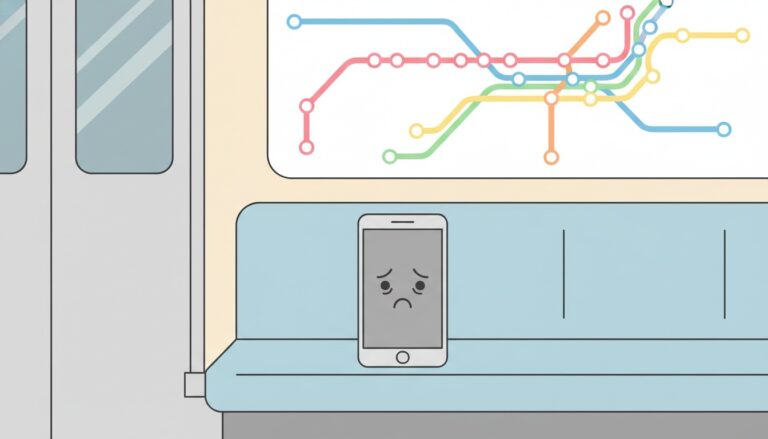
Imagine this: You are riding the subway in Seoul, completely engrossed in the latest Webtoon or maybe scrolling through Instagram photos of the cafe you just visited. You get off at Gangnam Station, walk through the turnstiles, reach into your pocket, and… nothing.
That sinking feeling? It’s universal. But in Korea, losing your smartphone is like losing your wallet, ID, and brain all at once. We do everything on our phones here—from paying for the bus to verifying our identity online.
In K-Dramas, this is usually the start of a romance. The protagonist leaves their phone in a taxi, and a handsome CEO picks it up. In reality? It’s just a panic attack waiting to happen.
But here is the good news: Korea is arguably one of the best places in the world to lose a phone. The chances of getting it back are surprisingly high. Today, we are going to learn how to navigate this crisis with B2-level Korean—moving beyond simple panic to handling insurance and police reports like a local.
Phase 2: Deep Dive into Key Expressions 🧠
Here are the three heavy-hitting expressions you need when the situation gets serious.
1. 분실물 센터 (Bunsilmul senteo)
- Pronunciation: [Bun-sil-mul sen-teo] (Sounds like: Bun + Seal + Mool + Center)
- Meaning: Lost and Found Center
- K-Culture Moment: Every major subway line and department store has one. If you lose something on the subway, don’t just ask “Where is my phone?” You ask for this place first.
- Editor’s Insight: This sounds official, right? It is. If you go to the information desk, just saying this word will make them act faster than trying to explain “I lost my phone” in broken sentences.
- Situation Spectrum:
[🚫 Casual] ———— [✅ Standard] ———— [✅ Formal]- 🤔 Think About It: Why does Korea have such an organized system for lost items? It relates to the high volume of public transit commuters—millions per day!
2. 습득하다 (Seupdeuk-hada)
- Pronunciation: [Seup-deuk-ha-da] (Think of ‘soup’ but shorter + ‘duke’)
- Meaning: To find/pick up (property); to acquire
- Nuance: You won’t say this often, but you will hear it. The police or carrier will ask: “습득 연락이 왔나요?” (Did a contact come in saying it was found/acquired?). It’s much more formal than just ‘chanda’ (to find).
- Editor’s Insight: Knowing this word changes you from a confused tourist to a competent resident. It’s the legal term for “finding something that isn’t yours.”
- Situation Spectrum:
[🚫 Friends] ———— [⚠️ Written/Official] ———— [✅ Police/Insurance]3. 보험 처리를 위해 서류가 필요해요 (Boheom cheorireul wihae seoryuga piryohaeyo)
- Pronunciation: [Bo-heom cheo-ri-reul wi-hae seo-ryu-ga pi-ryo-hae-yo]
- Meaning: I need documents for insurance processing.
- K-Drama Context: It’s not dramatic, but it’s the climax of the “Real Life” genre. After the hope of finding the phone is gone, you must face the bureaucracy.
- Editor’s Insight: Korean logic: No document = It didn’t happen. Even if you have insurance, you must explicitly ask for the ‘police report’ (police confirmation of loss) to get paid.
- Situation Spectrum:
[🚫 Friends] ———— [✅ Customer Service] ———— [✅ Police]
Phase 3: Textbook vs. Real Life 🗣️
Let’s see how a textbook robot speaks versus how a Seoulite speaks in a panic.
| Situation | 📖 Textbook Korean | 🗣️ Real Korean (Seoul Style) | 💡 Why the difference? |
|---|---|---|---|
| Realizing it’s gone | 제 휴대폰을 잃어버렸습니다. (I lost my phone.) | 어? 폰이 없어졌어요… 어떡하지? (Uh? My phone is gone… what do I do?) | “잃어버렸다” is too factual. We focus on the emotion of panic first. |
| Asking a Taxi Driver | 휴대폰을 택시에 두고 내렸습니다. (I left my phone in the taxi.) | 기사님, 혹시 뒷좌석에 핸드폰 떨어져 있나요? (Driver, by any chance, is there a phone dropped in the back seat?) | We use “혹시” (Hoksi – by any chance) and polite questions rather than statements to soften the request. |
| At the Police Station | 분실 신고를 하고 싶습니다. (I want to report a loss.) | 분실 확인증 좀 뗄 수 있을까요? 보험 때문에요. (Can I get a loss confirmation certificate? It’s for insurance.) | We skip straight to the result we need (the document) and the reason (insurance). Efficiency! |
Phase 4: Cultural Deep Dive — The Myth of the “Unstolen Phone” ☕️
4-1. The “Cafe Table” Phenomenon
If you have been to a Korean cafe, you’ve seen it. People leave their $1,000 iPhones on the table to save their seat while they go order. To a Westerner, this looks insane. To a Korean, it’s normal. This is Civic Trust.
However, this does not apply to drunk people on Friday nights. Most lost phones in Korea happen in taxis or subways after hoesik (company dinners). The “safety” rule has exceptions!
4-2. CCTV Heaven (or Hell?)
Korea has one of the highest densities of CCTV in the world. If you lose your phone in a shop or subway, there is footage. K-Dramas aren’t lying when detectives pull up footage from three different angles. This makes finding lost items much easier than in many other countries.
Phase 5: Roleplay — The Subway Station Office 🎬
Setting: It’s 10 PM. Sadang Station (a huge transfer hub). You are frantic. You rush to the “Safety Center” (subway office). An Ajusshi (middle-aged man) is behind the desk, looking tired.
Characters:
* YOU: Desperate expat. Korean level: B2.
* Staff: Practical, slightly indifferent but helpful.
Dialogue:
YOU: (Rushing in) 저기요! 죄송한데 제가 방금 지하철에 핸드폰을 두고 내린 것 같아요!
(Jeogiyo! Joesonghande jega banggeum jihacheol-e haendeupon-eul dugo naerin geot gatayo!)
(Excuse me! I’m sorry, but I think I just left my phone on the subway!)
Staff: (Sighs, picks up a pen) 몇 호선 타셨어요? 그리고 내린 시간이 언제예요?
(Myeot hoseon tasyeosseoyo? Geurigo naerin sigani eonjeyeyo?)
(Which line did you ride? And when did you get off?)
YOU: 2호선이요. 5분 전에 내렸어요. 열차 번호는 못 봤는데…
(2-hoseon-iyo. 5-bun jeone naeryeosseoyo. Yeolcha beonho-neun mot bwanneunde…)
(Line 2. I got off 5 minutes ago. I didn’t see the train number, though…)
Staff: 지금 전화 해봤어요? 신호는 가요?
(Jigeum jeonhwa haebwasseoyo? Sinho-neun gayo?)
(Did you try calling it now? Is it ringing?)
🔀 Decision Point: What is the most effective reply?
- A) “네, 근데 안 받아요.” (Yes, but no answer.)
- B) “아니요, 배터리가 없어서 꺼졌을 거예요.” (No, the battery was dead so it’s probably off.)
- C) “제 친구가 전화하고 있어요. 위치 추적 해주세요!” (My friend is calling. Please track the location!)
✅ Best Choice: A. If it rings, the staff will immediately call the train driver of the next train. It’s the fastest solution.
⚠️ Choice B Analysis: This complicates things. Now they have to wait until the train reaches the terminal (depot) to search manually.
🚫 Choice C Analysis: Subway staff cannot do “GPS tracking” like in the movies. Only the police/carrier can handle location data due to privacy laws.
Phase 6: 10-Second Shadowing Drill 🎧
Let’s practice the sentence that explains why you need the paperwork. Say it with a “worried but professional” tone.
“보험 회사에 / 제출해야 해서 / 분실 증명서가 / 필요해요.”
(Boheom hoesa-e / jechul-haeya haeseo / bunsil jeungmyeong-seo-ga / piryohaeyo.)
Emotion: 😟 Worried but clear.
Translation: I need the loss certificate because I have to submit it to the insurance company.
Phase 7: K-Culture Mini Glossary 📖
| Korean | Romanization | Meaning | Context |
|---|---|---|---|
| 파출소 | Pachulso | Police Box | Smaller than a station. Usually the first place to go for lost items in a neighborhood. |
| 유심 | Yusim | SIM Card | Koreans say “USIM,” not SIM. If you lose your phone, you need to suspend your “USIM” first. |
| 사례금 | Sarye-geum | Reward Money | If someone returns your phone, it is polite (and culturally expected) to offer a small cash reward (maybe 30,000~50,000 KRW) for their trouble. |
| CCTV | See-see-tee-vee | CCTV | The magic eye that solves crimes (and finds phones). |
Phase 8: Traveler’s Survival Kit 🧳
Lost your phone while traveling? Don’t panic. Here is your emergency kit.
🆘 Survival Expression #1: Asking a Stranger
* 🇰🇷 “죄송한데, 제 핸드폰으로 전화 한 번만 해주실 수 있나요?”
* (Joesonghande, je haendeupon-euro jeonhwa han beon-man haejusil su innayo?)
* Meaning: I’m sorry, but could you please call my phone just once?
* 📍 Where: Anywhere. Koreans are very helpful with this.📌 Editor’s Travel Note
* Lost112: This is the magic website (www.lost112.go.kr). It is the national police lost and found portal. All police stations upload found items here. Use Google Translate to search it!
* Subway lockers: If someone finds your phone, they might leave it in a subway storage locker (T-Locker) and give you the code. This is very common now.
Phase 9: Think Deeper — “Privacy vs. Safety” 🧠
Let’s step back. Korea’s ability to find lost phones relies heavily on CCTV and Location Tracking. When you report a phone lost, you might be asked to consent to location tracking.
In many Western cultures, the idea of cameras everywhere feels like an invasion of privacy. In Korea, it is viewed as a “Safety Net.” The thought process is: “I gave up a bit of privacy, so now I can find my lost wallet.”
💬 Your Turn: Would you prefer total privacy even if it means lost items are gone forever? Or the Korean system where you are watched, but protected? How does your culture view this?
Phase 10: FAQ & Troubleshooting 🛠️
Q: Can I just buy a new phone if I lose mine?
A: It’s complicated. In Korea, your identity is tied to your phone number. To buy a new phone, you need to verify your identity… often via your phone. You usually need to visit your carrier’s branch (KT, SKT, LG U+) with your Passport/ARC physically to solve this.
Q: Should I speak English or broken Korean to the police?
A: If your Korean is B2, try Korean. Police officers are busy. Showing you can communicate efficiently gets you faster service. Use English only if the situation gets legally complex.
❌ Common Mistake: Shouting “Police!” (경찰!) when you lose a phone.
✅ Do this instead: Go to a “Jigu-dae” (지구대) or “Pachulso” (파출소). These are local community safety centers. The big “Police Station” (경찰서) handles serious crimes.
Phase 11: Wrap-up & Mission 🎁
Summary: Losing a phone is scary, but using words like “분실물 센터” and “분실 확인증” turns you into a pro problem-solver.
🚀 Action Mission:
* 🥉 Bronze: Practice the Shadowing sentence 3 times.
* 🥈 Silver: Open Naver Map/Kakao Map and type “파출소” (Pachulso). Find the one nearest to your home/hotel. Know where it is before you need it!
* 🥇 Gold: If you have a Korean friend, roleplay the “Subway Station” scenario with them. Ask them to be a grumpy staff member!
See you next time! Don’t lose your phone! (But if you do, now you are ready.)
Frequently Asked Questions (FAQ)
Q: What does "분실물 센터 (Bunsilmul senteo)" mean in Korean and how do you pronounce it?
A: In Korean, "분실물 센터 (Bunsilmul senteo)" is pronounced [Bun-sil-mul sen-teo] and means: Lost and Found Center
Q: What does "습득하다 (Seupdeuk-hada)" mean in Korean and how do you pronounce it?
A: In Korean, "습득하다 (Seupdeuk-hada)" is pronounced [Seup-deuk-ha-da] and means: To find/pick up (property); to acquire
Q: What does "보험 처리를 위해 서류가 필요해요 (Boheom cheorireul wihae seoryuga piryohaeyo)" mean in Korean and how do you pronounce it?
A: In Korean, "보험 처리를 위해 서류가 필요해요 (Boheom cheorireul wihae seoryuga piryohaeyo)" is pronounced [Bo-heom cheo-ri-reul wi-hae seo-ryu-ga pi-ryo-hae-yo] and means: I need documents for insurance processing.







