

Phase 1: The ‘Laundry Mountain’ Meditation (Greeting & Hook)
Hello, Daily Hangul family! It’s your editor here.
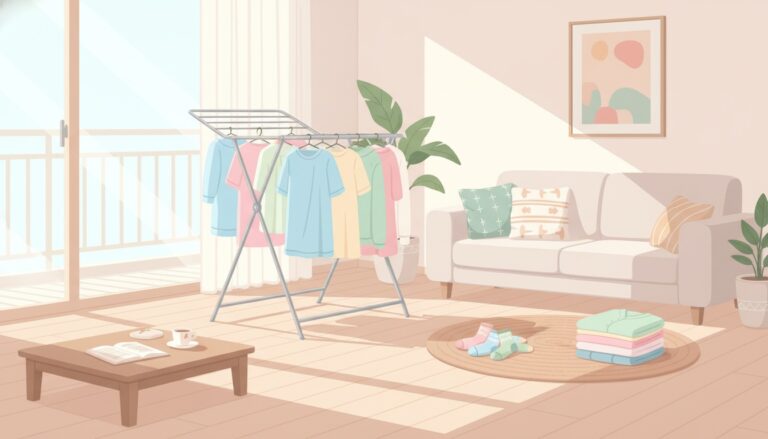
Picture this scene: It’s a Sunday afternoon in Seoul. The TV is playing a variety show (maybe Running Man), you are sitting on the warm floor (thanks to the Ondol heating), and in front of you is a massive mountain of clean clothes.
If you’ve watched enough K-Dramas, you know this scene. It’s usually where the mom character gives the hero some life-changing advice—or nags them about getting married—while furiously folding socks. The aggressive snapping of the towel? That’s part of the language.
Today, we aren’t just learning words for ‘folding’. We are learning the soundtrack of a lazy Korean Sunday. If you ever stay in a Korean guesthouse or live with a roommate, knowing how to talk about this mundane task instantly makes you feel like family rather than a guest. Let’s tackle that laundry mountain!
Phase 2: Deep Dive into Core Expressions
Here are the three phrases you’ll actually hear when the drying rack is full.
1. 빨래를 개다 (Ppal-lae-reul gae-da)
- Pronunciation: [gae-da] — Sounds a bit like ‘Geh’ as in ‘Guest’ + ‘Da’.
- Meaning: To fold the laundry.
- K-Culture Moment: In reality shows like I Live Alone, you often see celebrities sitting on their living room floor mumbling, “아, 빨래 개기 귀찮아” (Ah, folding laundry is annoying).
- Editor’s Insight: English speakers often try to use the word ‘fold’ (접다 / jeop-da) for clothes. While gramatically okay, for laundry specifically, we almost always use 개다. It implies the whole process of folding and organizing.
- Situation Spectrum:
[🚫 Formal Speech] ———— [✅ Casual/Daily]- 🤔 Think About It: Why do we have a specific verb just for folding laundry, separate from folding paper? It shows how much distinct value housework has in the language.
2. 뒤집어 놓다 (Dwi-ji-beo no-ta)
- Pronunciation: [dwi-ji-beo no-ta]
- Meaning: To turn something inside out (or leave it inside out).
- K-Culture Moment: The classic ‘Mom Nagging’ scene. “The socks are inside out again!” (양말 좀 뒤집어 놓지 마!)
- Editor’s Insight: This phrase is usually loaded with mild annoyance. If you are the one doing the laundry, and your roommate leaves their jeans inside out, this is your weapon.
- Situation Spectrum:
[⚠️ Careful with elders] ———— [✅ Roommates/Family]3. 짝이 안 맞아요 (Jjag-i an ma-ja-yo)
- Pronunciation: [jjag-i an ma-ja-yo]
- Meaning: The pair doesn’t match / I can’t find the match.
- K-Culture Moment: Sitting amidst a pile of socks, holding up one striped sock and looking confused. A universal human experience, but very common in Korean dorm life dialogues.
- Editor’s Insight: ‘짝’ (Jjak) means a pair or a mate. You’ll hear this word in dating shows too (finding your soulmate), but here, it’s just about that missing sock.
Phase 3: Textbook vs. Real Life
Let’s be real. Nobody speaks like a textbook in their own living room.
| Situation | 📖 Textbook Korean | 🗣️ Real Korean (Daily Life) | 💡 Why the difference? |
|---|---|---|---|
| Starting the task | 저는 빨래를 개요. (I fold the laundry.) | 아, 빨래 언제 다 개지? (Ah, when will I fold all this?) | Real life is mostly complaining about the workload! |
| Finding inside-out clothes | 옷이 뒤집혀 있습니다. (The clothes are inside out.) | 이거 누가 뒤집어 놨어? (Who left this inside out?) | Passive voice is rare; we look for the culprit immediately. |
| Finished | 다 정리가 되었습니다. (It is all organized.) | 끝! (Done!) | Efficiency is key in casual speech. |
Bottom Note: For A2 learners, simply saying “다 했다!” (Did it all!) is the most natural way to announce you are finished.
Phase 4: Cultural Context — The ‘Geonjodae’ Lifestyle
4-1. The Center of the Living Room: The Drying Rack
In many Western countries, the dryer machine is standard. In Korea? Not so much (though it’s changing). The 빨래 건조대 (Ppal-lae geon-jo-dae / Drying Rack) is an essential piece of furniture. It often sits right in the living room or on the balcony.
- The Vibe: When you visit a Korean friend’s house, you might see their clothes drying in the living room. It’s not ‘messy’; it’s just life. Don’t stare at their underwear!
4-2. K-Drama Connection: The ‘Floor Fold’
Why do drama characters always sit on the floor to fold clothes? It’s the Ondol (floor heating) culture. The floor is the cleanest, warmest place in the house. Folding laundry isn’t a chore done standing up in a utility room; it’s a communal activity done while watching TV together. It turns a chore into bonding time.
Phase 5: Immersive Roleplay
Setting: Sunday afternoon in a small apartment in Hongdae. You live with a Korean roommate, Min-ji.
Characters:
* YOU: A tidy roommate trying to help.
* Min-ji: Your friend who hates housework.
(The drying rack is overflowing with clothes)
YOU: 민지야, 우리 빨래 개자. 너무 많아!
(Min-ji-ya, uri ppal-lae gae-ja. Neo-mu ma-na!)
(Min-ji, let’s fold the laundry. There is too much!)
Min-ji: 아… 조금 이따가 하면 안 돼? 😩
(Ah… jogeum ittaga hamyeon an dwae?)
(Ah… can’t we do it a little later?)
YOU: 안 돼. 내일 입을 옷이 없어. 얼른 와.
(An dwae. Naeil ibeul osi eop-seo. Eolleun wa.)
(No. I have no clothes to wear tomorrow. Come quickly.)
(Min-ji sighs and sits on the floor. She picks up a shirt.)
Min-ji: 야, 너 양말 또 뒤집어 놨지!
(Ya, neo yang-mal tto dwi-ji-beo nwat-ji!)
(Hey, you left your socks inside out again, didn’t you!)
🔀 Decision Point: How do you respond?
- A) “미안, 다음부터는 조심할게.” (Sorry, I’ll be careful next time.)
- B) “아니야! 내 거 아니야!” (No! That’s not mine!)
- C) “원래 그런 거야.” (It’s supposed to be like that.)
✅ Best Choice: A — Even if it wasn’t you, just apologizing mildly ends the nagging fast. It’s the secret to peaceful roommate life.
⚠️ Choice B Analysis: Denying it strongly might lead to a funny “detective” moment where she checks the size of the sock.
Phase 6: 10-Second Shadowing Drill
Let’s practice complaining naturally. Repeat after me!
“Why do socks always have one missing?”
🤔 Emotion: Confused and slightly annoyed.
양말은 / 왜 맨날 / 한 짝이 / 없지?
(Yang-ma-reun / wae maen-nal / han jja-gi / eop-ji?)
Phase 7: K-Culture Mini Glossary
| Korean | Romanization | Meaning | Context |
|---|---|---|---|
| 건조대 | Geon-jo-dae | Drying Rack | The silver metal rack found in every Korean home. |
| 섬유유연제 | Seom-yu-yu-yeon-je | Fabric Softener | Koreans love strong, fresh scents (like Downy/Pigeon). |
| 런드리룸 | Laundry Room | Coin Wash | 24-hour coin laundromats, popular hangouts for single households. |
| 수건 | Su-geon | Towel | Korean towels are often folded in a very specific ‘hotel style’ roll or neat square. |
Phase 8: Traveler’s Survival Kit (Laundromat Edition)
Traveling in Korea longer than a week? You’ll likely visit a Coin Wash (코인 빨래방).
🆘 Survival Phrases
* 🇰🇷 “동전 교환기 어디 있어요?” (Dong-jeon gyo-hwan-gi eo-di i-sseo-yo?)
* “Where is the coin exchange machine?”
* 🇰🇷 “세제는 자동으로 나와요?” (Se-je-neun ja-dong-eu-ro na-wa-yo?)
* “Does the detergent come out automatically?” (Crucial question! Some machines include it, some don’t.)
* 💡 Pro Tip: Many modern Korean laundromats accept credit cards or have a kiosk, but having 500 won coins is always a safe bet.
Phase 9: Think Deeper — “Who does the Housework?”
Let’s talk about the word ‘돕다’ (to help). In the past, Korean men often said, “내가 집안일 도와줄게” (I will help you with housework).
Recently, younger generations are criticizing this phrasing. Why? Because saying “help” implies the work belongs to the woman, and the man is just being kind. Now, the trend is to say “같이 하자” (Let’s do it together) or just doing it without announcing it as a favor. Language shapes how we see responsibility. How do you handle this in your culture?
Phase 10: FAQ & Troubleshooting
- Q: Can I wear shoes while folding laundry?
- A: NO! 🚫 Absolute prohibition. You are sitting on the floor where people sleep and eat. Never wear shoes inside, especially not while handling clean clothes.
- Q: My Korean friend puts clothes on the floor to fold. Is it dirty?
- A: Not in Korea. The floor is wiped daily. It’s considered ‘living space’, not ‘walking space’ like in the West.
- Common Mistake Alert:
- ❌ Don’t say: “빨래를 접어요” (Ppal-lae-reul jeo-beo-yo) – It sounds like you are folding paper.
- ✅ Say: “빨래를 개요” (Ppal-lae-reul gae-yo) – This is the proper term for laundry.
Phase 11: Wrap-up & Mission
One-Liner: ‘Folding laundry’ in Korea is a floor-sitting, TV-watching, bonding activity called 빨래 개기 (Ppal-lae gae-gi).
🎯 Action Mission:
* 🥉 Bronze: Sit on the floor (even if you have a sofa) and fold 3 shirts saying “빨래를 개요”.
* 🥈 Silver: Check your sock drawer. Find a mismatched pair and say “짝이 안 맞아요!”
* 🥇 Gold: Visit a Korean-style coin laundromat (or spot one in a K-Drama) and identify the ‘Bong-tu’ (Bag) vending machine.
Phase 12: Interactive Quiz
1. Which sentence sounds most natural when your roommate asks what you are doing?
* A) 나는 옷을 접고 있어. (I am folding clothes – paper style)
* B) 나 빨래 개고 있어. (I am folding laundry.)
* C) 나 빨래 닫고 있어. (I am closing laundry.)
2. True or False?
* “In Korea, it is common to dry clothes in the living room on a rack.”
Answers:
1. B) ‘개다’ is the correct verb.
2. True. The ‘Geon-jo-dae’ is a staple item.
Frequently Asked Questions (FAQ)
Q: What does "빨래를 개다 (Ppal-lae-reul gae-da)" mean in Korean and how do you pronounce it?
A: In Korean, "빨래를 개다 (Ppal-lae-reul gae-da)" is pronounced [gae-da] and means: To fold the laundry.
Q: What does "뒤집어 놓다 (Dwi-ji-beo no-ta)" mean in Korean and how do you pronounce it?
A: In Korean, "뒤집어 놓다 (Dwi-ji-beo no-ta)" is pronounced [dwi-ji-beo no-ta] and means: To turn something inside out (or leave it inside out).
Q: What does "짝이 안 맞아요 (Jjag-i an ma-ja-yo)" mean in Korean and how do you pronounce it?
A: In Korean, "짝이 안 맞아요 (Jjag-i an ma-ja-yo)" is pronounced [jjag-i an ma-ja-yo] and means: The pair doesn’t match / I can’t find the match.







