

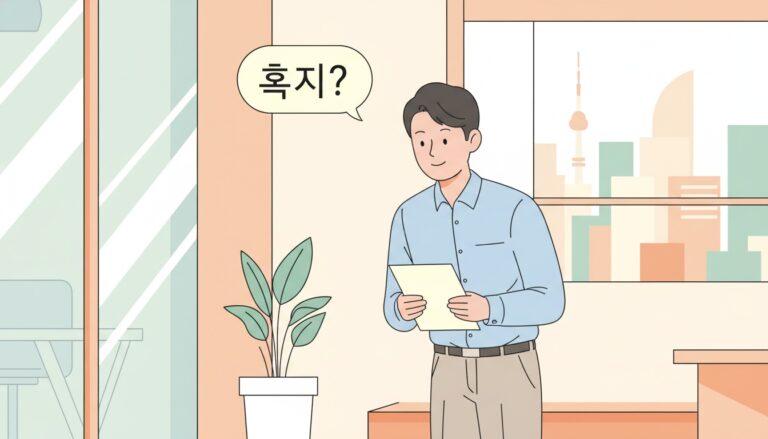
Phase 1: The “Soft” Approach (Immersive Hook)
Hello! This is your Daily Hangul Editor.
Picture this: You are the main character in a K-Drama. You are the hardworking new employee at a marketing firm in Gangnam. It is 6 PM. Everyone is tired. You are staring at a pile of documents you don’t understand, and you need help from Sunbae (senior) Minji, who is furiously typing away at her desk.
In English, you might just say, “Can you help me?”
But if you walk up to Minji and say “도와주세요” (Help me) directly, the background music stops. The camera zooms in on her annoyed face. Why? Because in Korea, asking for help without a “cushion” can sound like a demand, not a request.
Today, we are learning the art of the “Conditional Cushion”—how to use “If” to soften your blow. It is the difference between being the rude foreigner and the charming colleague everyone wants to grab lunch with.
Phase 2: The Magic of “If” (Deep Dive)
Here are the three tools you need to ask for favors without sweating.
1. ~(으)면 [-(eu)myeon]
- Pronunciation: [euh-myeon]
Think of it like: “myeon” sounds like the first syllable of “Meander”.- Meaning: If / When
- The Mechanics: If the verb stem ends in a consonant, add ~으면. If it ends in a vowel, just add ~면.
- K-Culture Moment: Listen closely to K-Pop ballads. You will hear phrases like “niga useumyeon” (If you smile…) or “dasi mannamyeon” (If we meet again…). It sets the condition for the emotion.
- Editor’s Insight: This is your basic LEGO block. By itself, it is neutral. “If you have time” is “시간(이) 있으면” (Sigan-i isseumyeon).
- Situation Spectrum:
[🚫 Boss] ———— [⚠️ Colleague] ———— [✅ Friend]
(It is a bit blunt for a boss. Keep reading for the upgrade!)- 🤔 Think About It: In English, we often put “If” at the end (“Help me if you can”). Korean always puts the condition first. Why? Maybe because setting the context is more important than the action itself?
2. 괜찮으시면 [Gwaenchaneusimyeon]
- Pronunciation: [Gwen-chan-euh-shi-myeon]
- Meaning: If it is okay with you / If you don’t mind
- K-Drama Moment: The polite second male lead always uses this. “Minji-ssi, gwaenchaneusimyeon, dinner tonight?” It gives the listener an easy way out.
- Editor’s Insight: This is the “Gold” standard. It combines 괜찮다 (to be okay) + ~(으)시 (honorific marker) + ~면 (if). Using this instantly raises your “Class” level.
- Situation Spectrum:
[✅ Boss] ———— [✅ Colleague] ———— [✅ Stranger]3. 혹시 [Hoksi]
- Pronunciation: [Hoke-shee]
- Meaning: By any chance / Perhaps
- Editor’s Insight: This is not a grammar point; it is a magic word. Put this at the very beginning of your sentence. It signals: “I am about to ask something, and I am being super careful about it.”
- 🤔 Think About It: “Hoksi” is often translated as “Perhaps,” but its usage is far more common in Korea than “perhaps” is in English. It is a verbal shield.
Phase 3: Textbook vs. Real Life
Let’s look at how a robot speaks versus how a Seoulite speaks.
| Situation | 📖 Textbook Korean | 🗣️ Real Korean | 💡 Why the difference? |
|---|---|---|---|
| Asking a friend for help | 시간 있으면 나 좀 도와줘. (If you have time, help me.) | 야, 혹시 시간 돼? (Hey, does time “work” / become?) | “Helping” is implied. Asking if time “works” is more natural slang. |
| Asking a coworker | 시간이 있으면 이것 좀 봐주세요. (If you have time, look at this.) | 바쁘시겠지만, 시간 괜찮으시면 이것 좀… (You must be busy, but if you’re okay, this…) | We acknowledge their busyness first. We often trail off (…) instead of commanding “Look!” |
Bottom Note: Notice the trailing off in the second example? In Korean, ending a sentence too perfectly can sometimes sound cold. Leaving it slightly open (“…좀”) invites the other person to step in.
Phase 4: Cultural Context (The Art of “Nunchi”)
4-1. The Eyes Have It
Before you even open your mouth to say “Hoksi,” you need to scan the room. This is Nunchi (눈치).
* Is the person walking fast? Don’t ask.
* Do they have earphones in? Don’t ask.
* Are they sighing at their monitor? DEFINITELY don’t ask.
In Korea, asking a conditional question (“If you have time…”) when the person clearly doesn’t have time shows a lack of Nunchi. The verbal condition isn’t enough; the situational awareness must match.
4-2. K-Drama Connection: The “Wrist Grab” Prequel
We all know the dramatic wrist grab scene. But usually, right before that, someone ignored a conditional request.
* Heroine: “If you are uncomfortable, I will leave.” (Condition)
* Hero: (Stays silent)
* Heroine: (Turns to leave)
* Hero: (Grabs wrist) “Don’t go.”
The silence was the answer in the condition. Korean communication relies heavily on what is not said.
Phase 5: Roleplay Scenario (Your Turn!)
Setting: A frantic Monday morning at the office. The printer is jammed. You have a meeting in 10 minutes. Minji (your senior) is drinking coffee nearby.
YOU: (Approaching cautiously) 저기… 민지 선배님?
Minji: (Looks up, slightly tired) 어, 무슨 일이에요?
(Oh, what’s up?)
🔀 Decision Point: How do you ask for help?
A) 프린터가 고장 났어요. 고쳐주세요.
(The printer is broken. Fix it please.)B) 혹시 시간 괜찮으시면, 프린터 좀 봐주실 수 있으세요?
(By any chance, if you are okay with it, could you look at the printer?)C) 시간 있으면 프린터 고쳐줘.
(If you have time, fix the printer.)
Select your answer…
.
.
.
✅ Best Choice: B
* Why: You used the magic trio: Hoksi (softener) + Gwaenchaneusimyeon (polite condition) + Can you? (possibility, not demand). This gives Minji the respect she deserves as a senior.
⚠️ Choice A Analysis: Too direct. You sound like you are giving her an order. She might do it, but she will remember your rudeness.
🚫 Choice C Analysis: You dropped the honorifics (Banmal). Unless Minji is your childhood best friend, this is a disaster waiting to happen.
Phase 6: 10-Second Shadowing Drill
Let’s practice the rhythm. Remember, sound unsure at the start, and grateful at the end.
😟 (Apologetically) / 😊 (Gently)
혹시 / 시간 괜찮으시면 / 저 좀 / 도와주실 수 있나요?
(Hoksi / sigan gwaenchaneusimyeon / jeo jom / dowaju-sil su innayo?)
Meaning: By any chance / if you have time / me a little / could you help?
Phase 7: K-Culture Mini Glossary
| Korean | Romanization | Meaning | Context |
|---|---|---|---|
| 부탁 | Butak | Favor / Request | You often say “Butak-haeyo” (I ask a favor) after someone agrees to help. |
| 선배 | Sunbae | Senior | A person with more experience than you (school/work). Always use polite conditionals with them. |
| 빈말 | Binmal | Empty words | If someone says “Let’s eat sometime if we have time,” it might just be Binmal (politeness), not a real plan. |
Phase 8: Traveler’s Survival Kit
You are lost in Hongdae. You need to ask a stranger for directions. Using “Do you have time?” can be misunderstood as “Are you free to date?” or a cult recruiter pickup line (seriously).
Use this instead:
🆘 Survival Expression #1
– 🇰🇷 “혹시 길 좀 여쭤봐도 될까요?”
(Hoksi gil jom yeojjwo-bwado doelkkayo?)
– 🗣️ Meaning: By any chance, may I ask about the way?
– 💡 Pro Tip: Keep your distance. Don’t touch their arm. Just a slight bow and “Hoksi…” will stop most people.
Phase 9: Think Deeper (Critical Thinking)
Language & Power: The Hierarchy of “If”
Have you noticed that the person with less power uses longer sentences?
- Boss to Employee: “시간 되면 해.” (Do it if you have time. – Short, simple)
- Employee to Boss: “혹시 지금 바쁘지 않으시면, 잠시 시간 내주실 수 있으십니까?” (If you aren’t busy right now, could you possibly spare a moment? – Long, complex)
In Korean, the length of your conditional phrase often equals the amount of respect you are showing. It is inefficient, yes. But that “inefficiency” is the currency of social harmony. Does your language have a similar “length = politeness” rule?
Phase 10: Troubleshooting & FAQ
Q: Can I say “시간 있어요?” (Do you have time?) to a stranger?
A: I wouldn’t recommend it. In areas like Gangnam or Hongdae, “Do you have time?” is almost exclusively used by cult recruiters or pickup artists. Stick to “Hoksi” and state your specific need (directions, photo) immediately.
Q: What if I accidentally use casual language (Banmal) to a senior?
A: Freeze. Apologize immediately. “죄송합니다, 말이 헛나왔어요” (Sorry, the words came out wrong). They usually understand you are a learner, but acknowledging the mistake helps restore the “Face” (Chemyon) of the situation.
❌ Common Mistake: Asking “Can you help?” before checking if they are busy.
✅ Fix: Always use the conditional (“If you aren’t busy…”) as the opener.
Phase 11: Wrap-up & Mission
One-Liner: Asking for help in Korea is 20% vocabulary and 80% “cushioning” the request.
🚀 Your Mission:
- 🥉 Bronze: Stand in front of a mirror and practice the “Hoksi” face (slightly worried eyebrows).
- 🥈 Silver: Text a Korean friend (or language exchange partner): “혹시 내일 시간 괜찮아?” instead of just “Meet tomorrow?”
- 🥇 Gold: Go to a Korean restaurant. When asking for a refill, try: “혹시 김치 좀 더 주실 수 있나요?” (By any chance, can you give me more kimchi?)
K-Culture Bonus: Watch an episode of a workplace drama (like Misaeng). Count how many times the junior employees say “Hoksi” or “Gwaenchaneusimyeon.” Report back in the comments!
Phase 12: Pop Quiz
Situation: You see your favorite K-Pop idol at the airport. They are rushing to the gate. You want an autograph.
1. Which phrase is appropriate?
* A) “야! 사인해줘!” (Hey! Sign this!)
* B) “혹시 사인 좀 해주시겠어요?” (By any chance, would you sign this?)
* C) Don’t ask. They are rushing.
Correct Answer: C (and maybe B if you are lucky).
Recall Phase 4 (Nunchi). If they are rushing, the polite “conditional” doesn’t matter—the situation dictates you shouldn’t ask. But if they are standing still, B is the only acceptable verbal option.
Frequently Asked Questions (FAQ)
Q: What does "~(으)면 [-(eu)myeon]" mean in Korean and how do you pronounce it?
A: In Korean, "~(으)면 [-(eu)myeon]" is pronounced [euh-myeon] and means: If / When
Q: What does "괜찮으시면 [Gwaenchaneusimyeon]" mean in Korean and how do you pronounce it?
A: In Korean, "괜찮으시면 [Gwaenchaneusimyeon]" is pronounced [Gwen-chan-euh-shi-myeon] and means: If it is okay with you / If you don't mind
Q: What does "혹시 [Hoksi]" mean in Korean and how do you pronounce it?
A: In Korean, "혹시 [Hoksi]" is pronounced [Hoke-shee] and means: By any chance / Perhaps







