

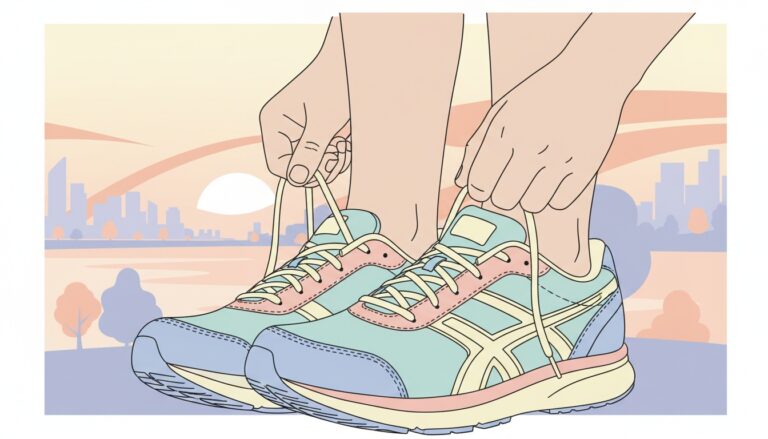
Ties Your Shoelaces, Change Your Mindset: The “It’s Go Time” Moment in Korea
Phase 1: The Hook — That Dramatic Zoom-In
Hello! Your Daily Hangul editor here. 👋
You know that specific scene in almost every action K-Drama or sports movie? The hero has hit rock bottom. The sad ballad music stops. Suddenly, the camera zooms in on their feet. They stomp the ground, crouch down, and yank their shoelaces tight.
Snap.
No words are spoken, but every Korean viewer knows exactly what that means: “Playtime is over. I’m about to get serious.”
Today, we aren’t just talking about safety knots. We are learning the language of determination. Whether you are about to run along the Han River, hike up Bukhansan, or just need to survive a Monday morning meeting, this unit is about the Korean attitude of “tightening up” your mind and body.
Let’s get ready. 꽉 (Kkwak)!
Phase 2: Deep Dive into Determination
Here are the three phrases you need when the training montage music starts playing.
1. 신발 끈 꽉 묶어 (Sinbal kkeun kkwak mukkeo)
- Pronunciation: [Sin-bal kkeun kkwak mu-kkeo] + (“Kkwak” sounds like a duck quacking, but cut short and sharp)
- Meaning:
- Literal: Tie your shoelaces tightly.
- Real Nuance: “Get your head in the game.” / “Prepare for a battle.”
- K-Culture Moment: In variety shows like Running Man, right before a chase starts, you’ll see the members checking their shoes. It’s the universal ritual of preparation.
- Editor’s Insight: The magic word here is 꽉 (kkwak). It’s an adverb that means “tightly,” “fully,” or “squeezed.” You can hold a hand kkwak, hug someone kkwak, or tie a knot kkwak. It implies intensity.
- Situation Spectrum:
[🚫 Boss] ———— [⚠️ Colleague] ———— [✅ Friend/Self]- 🤔 Think About It: Why does a physical action (tying shoes) represent a mental state in Korea? Does your culture have a physical ritual for “getting ready”?
2. 몸 좀 풀어볼까? (Mom jom pureobolkka?)
- Pronunciation: [Mom jom pu-reo-bol-kka?]
- Meaning: “Shall we loosen up (our bodies) a bit?” / “Let’s warm up.”
- Editor’s Insight: Koreans take warming up (junbi undong) very seriously. Even at community pools, everyone stops for 5 minutes every hour to do group stretches. Ignoring this makes you look like a reckless amateur!
- Situation Spectrum:
[🚫 Formal Presentation] ———— [⚠️ Gym Buddy] ———— [✅ Casual]3. 가보자고! (Gabojago!)
- Pronunciation: [Ga-bo-ja-go!]
- Meaning: “Let’s go!” / “Let’s do this!”
- K-Culture Moment: This is huge in the K-Pop fandom and internet slang right now. It’s more energetic than the standard “Gaja” (Let’s go). It has a nuance of “Let’s go and see what happens!” or “Let’s wreck this!”
- Situation Spectrum:
[🚫 Elders] ———— [⚠️ Close Team] ———— [✅ Friends/Social Media]
Phase 3: Textbook vs. Real Life
Let’s be real. Nobody talks like a robot in the gym.
| Situation | 📖 Textbook Korean | 🗣️ Real Korean (In the Gym/Park) | 💡 Why? |
|---|---|---|---|
| Suggesting a break | 휴식합시다. (Hyusik-hapsida.) | 숨 좀 돌리자. (Sum jom dollija.) | “Let’s spin our breath” = catch our breath. Much more vivid. |
| Cheering someone on | 힘내세요! (Himnaeseyo!) | 화이팅! / 아자아자! (Hwaiting! / Aja Aja!) | “Himnaeseyo” can sound like pity. “Hwaiting” is pure energy. |
| Starting the workout | 운동을 시작합시다. (Undong-eul sijak-hapsida.) | 오운완 가자! (Ounwan gaja!) | Ounwan is a hashtag: “Today’s Workout Complete.” It’s goal-oriented slang. |
Note: Ounwan (#오운완) is the #1 hashtag you’ll see on Korean fitness Instagram. Using it instantly makes you look like a local Trend-setter.
Phase 4: Cultural Deep Dive — The “Equipment” Obsession
4-1. The “Full Gear” Phenomenon
If you go hiking in Korea, even on a small neighborhood hill, you will notice something fascinating. Everyone is dressed like they are climbing Mount Everest. High-tech moisture-wicking shirts, professional hiking sticks, expensive backpacks, and gloves.
The Rule: Looking the part is half the battle. In Korea, showing up with the proper equipment (jangbi) is a sign of respect for the activity and determination to do it right. So, tying those shoelaces kkwak isn’t just functional; it’s part of the costume of success.
4-2. The Han River (Hangang) Vibe
The Han River isn’t just a river; it’s Seoul’s gym. There are unspoken rules here:
– Right lane for walking, left for passing.
– Don’t block the path. Koreans walk fast (the Ppalli-Ppalli culture applies to exercise too).
– If you stop to tie your shoes, step off the track completely.
Phase 5: Roleplay — The Night Jog
Setting: Han River Park, Banpo Bridge area. 8:00 PM. The Rainbow Fountain is playing. Cyclists are zooming past.
Characters:
– YOU: Tired after work, but trying to stay fit.
– Minji: Your energetic Korean friend who runs marathons.
(Minji stops stretching and looks at you)
Minji: 야, 너 신발 끈 풀렸다. 그러다 넘어져.
(Ya, neo sinbal kkeun pullyeotda. Geureoda neomeojyeo.)
Hey, your shoelace is untied. You’re gonna trip like that.
YOU (Squatting down to tie it):
(Romanization) A, jinjja? Gomawo.
(English) Ah, really? Thanks.
Minji: 오늘 목표는 동작대교까지야. 준비 됐지?
(Oneul mokpyoneun Dongjak-daegyo-kkajiya. Junbi dwaetji?)
Today’s goal is Dongjak Bridge. You ready?
🔀 Your Turn! How do you respond?
- A) “응, 준비 됐어.” (Standard & Polite)
- B) (Tighten laces firmly) “가보자고!” (Energetic & Trendy)
- C) “너무 힘들어… 집에 가자.” (Complaining)
✅ Best Choice: B
Minji is hype right now. Match her energy! Using “Gabojago” here shows you are mentally locking in. It turns a boring run into a mission.
🎭 Stage Direction: You stand up, stomp your feet once like a drama protagonist, and start running.
Phase 6: 10-Second Shadowing Drill
Let’s practice that determination. Say this as if you are staring at a steep hill you are about to conquer.
😤 Emotion: Determined, slightly aggressive
신발 끈 / 꽉 묶고 / 한번 / 달려보자!
(Sinbal kkeun / kkwak mukko / hanbeon / dallyeoboja!)
Tie the shoelaces / tight / and let’s / run (give it a try)!
Phase 7: K-Culture Mini Glossary
| Korean | Romanization | Meaning | Context |
|---|---|---|---|
| 3대 500 | Sam-dae-o-baek | 500kg in Big 3 | The gold standard for gym bros (Squat+Bench+Deadlift = 500kg). |
| 헬린이 | Hell-rini | Gym Kindergartener | A beginner at the gym (Fitness + Eorini/Child). Cute way to be humble. |
| 작심삼일 | Jak-sim-sam-il | Giving up in 3 days | An idiom for weak determination. “My diet is always Jak-sim-sam-il.” |
| 장비빨 | Jang-bi-ppal | Gear power | Relying on expensive equipment rather than skill. |
Phase 8: Traveler’s Survival Kit (Hiking Edition)
Since hiking is the national sport of Korea, you might find yourself on a mountain.
🆘 Survival Expression #1
– 🇰🇷 “정상까지 얼마나 남았어요?” (Jeongsang-kkaji eolmana namasseoyo?)
– 🗣️ Meaning: How much further to the top?
– 📍 Use: When you are dying of exhaustion on the trail.
– 💡 Pro Tip: Korean hikers will always lie and say “Almost there!” (Da wasseoyo!). Trust the map, not the kind ajusshi.📌 Editor’s Travel Note
– Water: Most mountains have fresh spring water (yaksu), but bring your own bottle.
– Etiquette: If someone is faster than you, step aside and let them pass. Say “Monjeo gaseyo” (Go first).
Phase 9: Think Deeper — The Cult of “Hardship”
Why is everything a “Battle”?
In Korean, you often hear phrases like “fighting a war” against weight, or “conquering” a mountain. Even hobbies are approached with intense discipline (remember the expensive gear?).
This reflects the “Pali-Pali” (Hurry-Hurry) and highly competitive nature of modern Korean society. Relaxation often feels like “wasting time,” so even leisure activities must have a clear goal, tangible results (like a sweaty selfie #Ounwan), and maximum efficiency. When you tie your shoes kkwak, you aren’t just walking; you are performing.
💬 Your Turn: In your country, is exercise seen as “training” or “play”? Do you dress up for the gym?
Phase 10: FAQ & Troubleshooting
Q: Can I say “Hwaiting” to my boss?
A: Generally, yes! It’s positive energy. However, if your boss is struggling with something serious, a quiet “Gosaeng man-euseyo” (You are working hard/suffering) is more empathetic. “Hwaiting” can sometimes feel like toxic positivity if the situation is grim.
Q: Is it rude to sit with my legs stretched out after running?
A: If you are with older people, yes. Showing the soles of your feet or stretching legs toward a senior is considered impolite. Sit cross-legged or turn your body slightly away.
❌ Common Mistake: Saying “I play running.”
In English, we “play” sports. In Korean, we “do” (hada) sports.
– ❌ Running haeyo (I do running) – Okay but awkward.
– ✅ Dalligi haeyo (I do running) – Better.
– ✅ Leoning(Running) haeyo – Most common Konglish/Loanword usage now.
Phase 11: Wrap-up & Mission
Summary: Today we learned that tying your shoes (Sinbal kkeun) is a ritual for determination (Kkwak!) and that saying “Gabojago” makes you the coolest person on the trail.
🏃 Action Mission:
– 🥉 Bronze: Say “Gabojago!” out loud next time you leave your house.
– 🥈 Silver: Post a photo of your sneakers on social media with the caption: “신발 끈 꽉 묶고, 가보자고!”
– 🥇 Gold: Go for a run/walk and use the hashtag #오운완 (#Ounwan) on your story.
Phase 12: Quiz — Are you a Gym Local?
- Situation: Your friend is tired during a hike. You want to energize them. What do you say?
- A) Jogoyeo. (Excuse me.)
- B) Gabojago! Hwaiting! (Let’s do this! Fighting!)
- C) Annyeonghi gyeseyo. (Goodbye.)
- Culture: You see a hiker wearing jeans and loafers on a rocky mountain. What would a Korean likely think?
- A) “Wow, so stylish.”
- B) “He has no ‘Jangbi’ (gear/preparation). Dangerous.”
- True or False: If an Ajusshi on the mountain says “You’re almost there,” it means you are exactly 1 minute away from the peak.
- (True / False)
(Answers: 1-B, 2-B, 3-False – It usually means 30 more minutes!)
Frequently Asked Questions (FAQ)
Q: What does "신발 끈 꽉 묶어 (Sinbal kkeun kkwak mukkeo)" mean in Korean and how do you pronounce it?
A: In Korean, "신발 끈 꽉 묶어 (Sinbal kkeun kkwak mukkeo)" is pronounced [Sin-bal kkeun kkwak mu-kkeo] and means: Literal: Tie your shoelaces tightly.
Q: What does "몸 좀 풀어볼까? (Mom jom pureobolkka?)" mean in Korean and how do you pronounce it?
A: In Korean, "몸 좀 풀어볼까? (Mom jom pureobolkka?)" is pronounced [Mom jom pu-reo-bol-kka?] and means: "Shall we loosen up (our bodies) a bit?" / "Let's warm up."
Q: What does "가보자고! (Gabojago!)" mean in Korean and how do you pronounce it?
A: In Korean, "가보자고! (Gabojago!)" is pronounced [Ga-bo-ja-go!] and means: "Let's go!" / "Let's do this!"







