

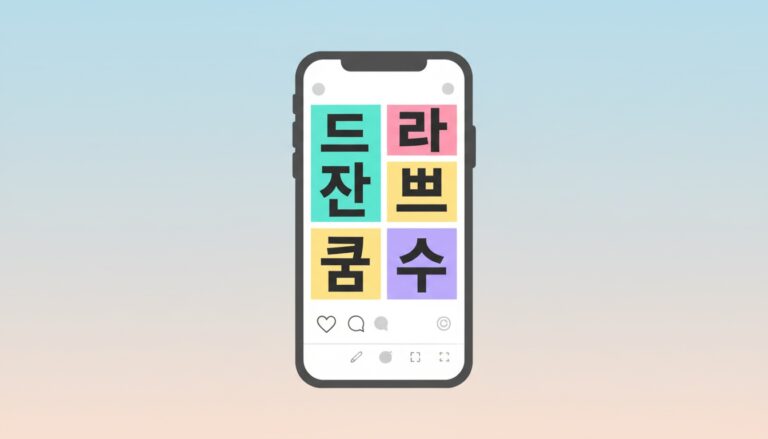
Phase 1: The Scroll-Stopper
Hello, Daily Hangul readers. It’s your editor here.
You’ve mastered the grammar. You can probably write a decent essay on the geopolitical history of the Joseon Dynasty if you really tried. But here is the brutal truth: when you post on Instagram or create a slide deck for your Korean colleagues, people might be scrolling right past your content. Why? Because you are writing prose, not copy.
Think about the subtitles in Korean variety shows like Running Man or I Live Alone. They don’t just transcribe what people say; they visualize the emotion and impact. They use short, punchy, rhythmic text that hits the eye before the brain even processes it.
In the Korean digital landscape, especially in the “Card News” (카드 뉴스) format dominant on Instagram and blogs, brevity isn’t just a stylistic choice—it’s survival. Today, we are moving away from the “correct” Korean of the textbooks and diving into the “clickable” Korean of the marketing world.
Phase 2: The Anatomy of a Hook (Deep Dive)
To write copy that stops the thumb, you need to understand the psychology behind these three C2-level patterns.
1. [N] + 딱 정해드립니다
- Pronunciation: [Ddak jeong-hae-deu-rim-ni-da] + [Sounds like a gavel hitting a desk: Bam!]
- Meaning: “I will decide/define this for you once and for all.” (Literal) → “Here is the definitive answer to your indecision.” (Nuance)
- K-Culture Moment: Koreans often suffer from Gyeoljeong Jang-ae (Decision Paralysis)—hence the invention of “Jjamjjamyun” (half noodles, half spicy seafood noodle). Using this phrase frames you as the expert solving their headache.
- Editor’s Insight: This implies authority. You aren’t suggesting; you are dictating the best option to save their time.
- Situation Spectrum:
[🚫 Boss to CEO] ———— [⚠️ Client Meeting] ———— [✅ Social Media/Blogs]- 🤔 Think About It: Why does Korean marketing value “efficiency of choice” so highly? Is it related to the Pali-pali (Hurry, hurry) culture?
2. ~하는 법 총정리
- Pronunciation: [~haneun beop chong-jeong-ni]
- Meaning: “Total summary of how to…” (Literal) → “The Ultimate Guide / All You Need to Know.”
- K-Culture Moment: Search for any travel destination on Naver Blog. The top hits are always “Danang Travel Chong-jeong-ni.” It promises that reading this ONE post will replace hours of research.
- Editor’s Insight: Chong (Total) adds a sense of completeness. If you just say “정리” (Summary), it sounds weak. Chong-jeong-ni sounds like a encyclopedia.
- Situation Spectrum:
[🚫 Casual Text] ———— [⚠️ Email Subject] ———— [✅ Headlines/Thumbnails]3. 솔직히 나만 알고 싶은 [N]
- Pronunciation: [Soljiki naman algo sipeun…]
- Meaning: “Honestly, [N] that I want to keep to myself.”
- K-Culture Moment: Used extensively for hidden cafes, indie songs, or restaurants. It triggers the FOMO (Fear Of Missing Out) instinct.
- Editor’s Insight: It creates a false sense of intimacy. You are sharing a “secret” with the reader, even though you are broadcasting it to the world.
Phase 3: Textbook vs. Viral Copy
Let’s rewrite boring sentences into thumb-stopping headlines.
| Context | 📖 Textbook Korean | 🗣️ Copywriting Korean | 💡 Why the change? |
|---|---|---|---|
| Travel Tip | 제주도에서 꼭 가봐야 할 카페들을 소개합니다. (Let me introduce cafes you must visit in Jeju.) | 제주도 카페, 여기만 가면 성공! ☕ (Jeju cafes, just go here and you succeed!) | Passive introduction vs. Guarantee of success. “성공” (Success) is a huge keyword in dining/travel. |
| Study Tip | 한국어를 빨리 배우는 방법이 있습니다. (There is a way to learn Korean quickly.) | 한국어, 아직도 이렇게 공부하세요? 😱 (Korean, are you still studying like this?) | Informative vs. Provocative. Questions challenge the user’s current behavior. |
| Sale Info | 여름 옷을 싸게 팝니다. (We are selling summer clothes cheaply.) | 여름 옷, 지금이 기회! 최대 80% (Summer clothes, now is the chance! Up to 80%) | Statement vs. Urgency (“Opportunity”). |
Bottom Note: Notice the use of punctuation. Question marks and exclamation points are part of the grammar in copywriting.
Phase 4: Cultural Context — The “Snack Culture”
4-1. Visual Rhythm (The Webtoon Effect)
Koreans are used to scrolling vertically (Webtoons). Your text needs to have visual rhythm. Don’t write a block of text. Break it up. Use distinct line breaks. In Card News, we follow the “One Slide, One Message” rule.
4-2. The “God-saeng” (갓생) Trend
Much of Korean copywriting appeals to the desire to live a diligent, productive life (God-saeng = God + Life). Phrases like “하루 10분 투자로…” (Invest 10 mins a day…) work because they promise self-improvement with minimal effort. Connect your copy to the reader’s aspiration to be a better version of themselves.
Phase 5: Immersive Roleplay — The Marketing Meeting
Setting: A hip shared office in Seongsu-dong. You are reviewing the draft for a new Instagram campaign with your Korean team leader.
Characters:
* YOU: Marketing Manager (Foreigner).
* Sujin (31): Team Leader. Sharp, trend-sensitive, drinks 3 iced Americanos a day.
Dialogue:
Sujin: (Looking at your screen) 음… 문장이 너무 정직해요. “우리 제품은 아주 빠릅니다.” 이건 임팩트가 없잖아요.
(Eum… munjang-i neomu jeongjikhaeyo. “Uri jepeum-eun aju ppareumnida.” Igeon impekteu-ga eopjannayo.)
(Hmm… the sentence is too honest. “Our product is very fast.” There’s no impact.)
YOU: (Scratches head) 그래요? 그럼 어떻게 바꿔야 할까요?
(Geuraeyo? Geureom eotteoke bakkwoya halkkayo?)
(Really? Then how should I change it?)
Sujin: 소비자가 얻는 이득을 바로 보여줘야죠. “속도”를 강조하지 말고 “시간 절약”을 강조해 봐요.
(Sobija-ga eonneun ideuk-eul baro boyeojwoyajyo. “Sokdo”-reul gangjohaji malgo “sigan jeoryak”-eul gangjohae bwayo.)
(Show the benefit the consumer gets immediately. Don’t emphasize “speed,” emphasize “saving time.”)
🔀 Decision Point: How do you revise the copy?
- A) “빠른 속도로 시간을 아끼세요.” (Save time with fast speed.)
- B) “퇴근 시간이 1시간 빨라지는 기적!” (The miracle of going home 1 hour earlier!)
- C) “시간은 금입니다.” (Time is gold.)
✅ Best Choice: B. It translates the feature (speed) into a tangible, emotional benefit (going home early). “Going home” (Kal-toe) is the ultimate desire of every Korean worker.
Phase 6: 10-Second Shadowing Drill
Let’s practice the rhythm of a viral headline. Pitch your voice slightly higher on the emphasized words.
😤 이거 / 모르면 / 진짜 / 손해입니다! (igeo / moreumyeon / jinjja / sonhae-imnida!)
(If you don’t know this / it’s really / a loss!)
😏 실패 없는 / 데이트 코스 / 딱 / 정해드립니다. (silpae eomneun / deiteu koseu / ddak / jeong-hae-deu-rim-ni-da.)
(Failure-free / date course / I will definitely / decide for you.)
Phase 7: K-Culture Mini Glossary (Marketing Edition)
| Korean | Romanization | Meaning | Context |
|---|---|---|---|
| 어그로 | Aggro | Attention-seeking / Clickbait | Derived from “Aggravation” in gaming. “어그로를 끌다” means to pull attention (often negatively, but used neutrally in marketing). |
| 가독성 | Gadokseong | Readability | The holy grail of card news. If it’s messy, it has “bad readability.” |
| 꿀팁 | Kkultip | Honey Tip | A hack or incredibly useful tip. Put this on any slide and people will save it. |
| 영혼을 갈아넣다 | Yeonghoneul gara-neota | Grinding one’s soul | Putting immense effort into creating content. “Edited with my soul.” |
Phase 8: Digital Nomad Survival Kit
Since you might be posting about your travels in Korea, here is how to caption your photos to get engagement from locals.
🆘 The “Instagrammable” Caption Formula
1. The Hook: Start with an emotional exclamation.
* Ex: “와… 여기 진짜 미쳤다.” (Wow… this place is insane.)
2. The Info: Give the location but keep it mysterious (or helpful).
* Ex: “저장해두고 꼭 가보세요!” (Save this and definitely go!)
3. Hashtags: Use Korean search terms, not just English ones.
* #부산맛집 (Busan Tasty Place) #여행에미치다 (Crazy about Travel – huge community tag)📌 Editor’s Note: When reviewing a place, never say “It was bad.” Instead, say “조금 아쉬웠어요” (It was a little leaving something to be desired). It’s the polite code for “Don’t go here.”
Phase 9: Think Deeper — Language & Attention Economy
The Death of Long Sentences?
Korean is a high-context language, traditionally valuing indirectness and politeness. However, the influence of mobile interfaces is making written Korean shorter, more direct, and more visual. We are seeing a shift from “Reading” (읽기) to “Seeing” (보기). Is this eroding literacy, or is it an evolution toward efficiency? In your native language, do you see a similar divide between “Literature Language” and “Social Media Language”?
💬 Your Turn: Try to describe your favorite movie using only 10 Korean characters (syllables) in the comments!
Phase 10: Troubleshooting & FAQ
- Q: Can I use emojis in formal business writing?
- A: In a contract? Never. In a team Slack channel or internal newsletter? Absolutely. It softens the tone. Without emojis, short Korean sentences can seem angry or cold.
- Q: Should I use honorifics (존댓말) in Card News titles?
- A: It depends on your brand persona. But generally, titles often drop the verb ending for brevity (e.g., “~하는 법” instead of “~하는 방법입니다”). It makes it punchier.
- ❌ Common Mistake: Translating English idioms directly.
- Don’t say: “케이크 한 조각이죠” (It’s a piece of cake).
- Say: “식은 죽 먹기죠” (It’s eating cold porridge) OR just “누워서 떡 먹기” (Eating rice cake while lying down).
Phase 11: Wrap-up & Mission
Summary: Effective Korean copywriting trades textbook grammar for rhythm, urgency, and direct benefits (like “Saving time” or “Avoiding loss”).
🚀 Action Mission:
* 🥉 Bronze: Write a catchy title for your lunch today using “~는 필수” (e.g., “비 오는 날, 파전은 필수”).
* 🥈 Silver: Find a Korean Instagram account (@travelholic_korea is good) and analyze 3 headlines.
* 🥇 Gold: Post a photo on your social media with a caption fully in “Copywriting Style” Korean.
K-Culture Mission: Go to a Korean convenience store (or search online for GS25/CU flyers). Look at the “1+1” or “2+1” tags. Read the small print slogans. That is the essence of Korean micro-copy!
Phase 12: Interactive Quiz
1. Which title is most likely to get clicks on a blog about cleaning?
* A) 청소하는 방법을 알려드립니다. (I will teach you how to clean.)
* B) 청소, 이것만 알면 끝! 꿀팁 대방출. (Cleaning, know this and it’s over! Honey tips released.)
* C) 청소는 매우 중요합니다. (Cleaning is very important.)
2. Fill in the blank:
“부산 여행, 숙소 고민 _______!”
(Busan travel, accommodation worries [I will decide/end for you]!)
(Answers below)
.
.
.
1. B. It promises a definitive end to the problem (“끝”) and offers “Honey Tips.”
2. 딱 정해드립니다 (or 끝, 해결).
Frequently Asked Questions (FAQ)
Q: What does "[N] + 딱 정해드립니다" mean in Korean and how do you pronounce it?
A: In Korean, "[N] + 딱 정해드립니다" is pronounced [Ddak jeong-hae-deu-rim-ni-da] and means: "I will decide/define this for you once and for all." (Literal) → "Here is the definitive answer to your indecision." (Nuance)
Q: What does "~하는 법 총정리" mean in Korean and how do you pronounce it?
A: In Korean, "~하는 법 총정리" is pronounced [~haneun beop chong-jeong-ni] and means: "Total summary of how to..." (Literal) → "The Ultimate Guide / All You Need to Know."
Q: What does "솔직히 나만 알고 싶은 [N]" mean in Korean and how do you pronounce it?
A: In Korean, "솔직히 나만 알고 싶은 [N]" is pronounced [Soljiki naman algo sipeun...] and means: "Honestly, [N] that I want to keep to myself."







