

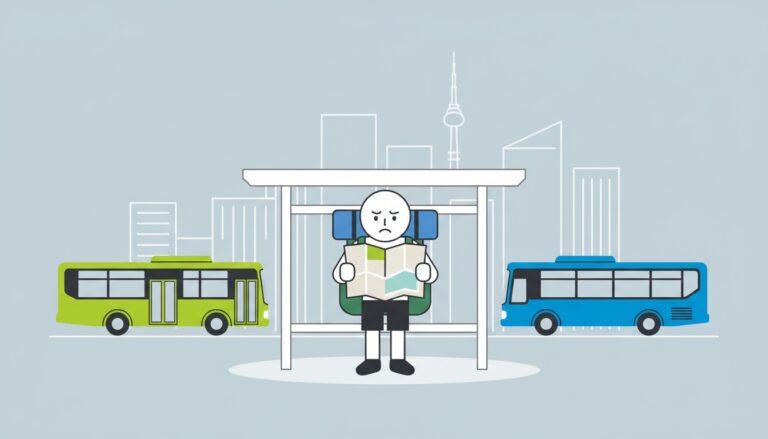
Phase 1: The “Wait, Is This My Bus?” Panic
Hello! This is your Daily Hangul editor.
Picture this: You are standing at a bus stop in Gangnam. It’s rush hour. A massive blue bus pulls up, hissing its air brakes. People are rushing to tap their cards. You look at your map app, then at the bus, then back at the app.
In K-Dramas, this is usually where the protagonist misses the bus, and a handsome stranger pulls up in a car to offer a ride. Spoiler alert: That won’t happen. In real life, the driver will just close the door and zoom off to the next stop while you stand there confused.
Today, we are fixing that. No more missing buses because you were too scared to ask. We are learning the absolute survival phrases to get you on the right set of wheels.
Phase 2: Deep Dive into “Which Bus?”
Here are the three phrases that will save your legs.
1. [Place] 가요?
- Pronunciation: [Place] gayo?
- Sound-alike: “[Place] Ga (like Lady Gaga) – yo?”
- Meaning: Does it go to [Place]?
- Context: You don’t need a full sentence. You have about 3 seconds before the driver gets impatient. Just say the destination and “Gayo?” with a rising intonation.
- Situation Spectrum:
[🚫 Formal] ———— [✅ Standard] ———— [✅ Casual](Works for everyone because it’s polite enough with the ‘yo’)- 🤔 Think About It: Why is the subject (“this bus”) removed? In Korean, if we both know what we are talking about (the giant bus in front of us), we don’t waste breath saying it. Efficiency is key.
2. 몇 번 버스 타요?
- Pronunciation: Myeot beon beoseu tayo?
- Sound-alike: “My-ut (mut) bun (bun) bus ta-yo?”
- Meaning: Which number bus do I take?
- Context: Use this when asking a person on the street, not the driver. You are lost, holding your phone map, looking desperate.
- Editor’s Insight: “Myeot” means “how many/which number.” “Beon” is the counter for numbers.
3. 잠시만요!
- Pronunciation: Jamsimanyo!
- Sound-alike: “Jam-see-man-yo!”
- Meaning: Just a moment! / Hold on!
- K-Culture Moment: The classic K-Drama run. The girl is running toward the bus waving her arms. She screams this.
- Use case: The bus doors are closing, but you are so close. Scream this.
Phase 3: Textbook vs. Real Life
Textbooks often teach you to be a robot. Let’s be human.
| Situation | 📖 Textbook Korean | 🗣️ Real Street Korean | 💡 Why different? |
|---|---|---|---|
| Asking destination | 이 버스는 명동으로 갑니까? (Does this bus go to Myeongdong?) | 명동 가요? (Myeongdong gayo?) | Bus drivers are busy. Long sentences slow everyone down. |
| Asking number | 몇 번 버스를 타야 합니까? (Which bus must I take?) | 몇 번 타요? (Myeot beon tayo?) | Context makes the word “bus” unnecessary. |
| Stopping the bus | 멈추세요! (Stop!) | 잠시만요! (Wait a moment!) | “Stop” sounds like a police order. “Wait” asks for a favor. |
Phase 4: Cultural Context — The “Palli-Palli” Bus
4-1. The Art of the “Eye Contact”
In many Western countries, you might wave your hand to hail a bus. In Korea, we use aggressive body language.
When you see your bus number, step toward the curb. Make eye contact with the driver through the windshield. If you stay sitting on the bench or looking at your phone, the driver assumes you are waiting for a different bus and will drive right past you. This is the Nunchi (눈치) game—you have to signal your intent without saying a word.
4-2. The Color Code (K-Travel)
Seoul buses are color-coded. Knowing this helps you filter the chaos:
* 💙 Blue: Long distance (cross-city).
* 💚 Green: Short distance (connects to subway stations).
* ❤️ Red: Express (goes to satellite cities outside Seoul).
* 💛 Yellow: Loop buses (usually around tourist areas like Namsan).
If you need to go just a few stops, don’t wait for a Red bus—it’s more expensive and might not stop where you want!
Phase 5: Roleplay — The Rainy Night in Seoul
Setting: It’s pouring rain near Hongdae. You want to go to City Hall. A Green Bus #7011 pulls up. The driver looks tired.
Characters:
* YOU: A wet, confused traveler.
* Driver: A middle-aged Korean man (Ajusshi), wearing sunglasses even though it’s raining.
Dialogue:
Driver: (Opens door) 어서 오세요. (Eoseo oseyo / Welcome.)
YOU: (You need to know if this hits City Hall)
🔀 Your Turn! What do you say?
* A) “Excuse me, sir, I was wondering…” (Too slow!)
* B) “City Hall gayo?” (Fast, clear)
* C) “I go City Hall?” (Grammatically weird, but he might understand)
✅ Best Choice: B
YOU: 시청 가요? (Sicheong gayo?)
Driver: (Nods quickly) 네, 타세요. (Ne, taseyo / Yes, get on.)
YOU: 감사합니다! (Taps card) Beep!
Phase 6: 10-Second Shadowing Drill
Practice this before you hit the streets. Focus on the rising intonation at the end.
- Emotion: 😊 Curious & Urgent
- Sentence: 이 버스 / 강남 / 가요?
- Pronunciation: I beoseu / Gangnam / gayo?
- Meaning: Does this bus go to Gangnam?
Phase 7: K-Culture Glossary
| Korean | Romanization | English | Context |
|---|---|---|---|
| 환승 | Hwanseung | Transfer | The magic word. Transferring from bus to subway is free within 30 mins! |
| 교통카드 | Gyotong-card | Transport Card | Usually T-Money. Cash is disappearing from Seoul buses. |
| 벨 | Bel | Bell | The red ‘Stop’ button. You MUST press this before your stop, or the driver won’t stop. |
| 기사님 | Gisanim | Driver (Honific) | Don’t call him “Hey” or “Mister.” Use “Gisanim” to show respect. |
Phase 8: Traveler’s Survival Kit
🆘 Survival Card: The Magic Phrase
* 🇰🇷 [Destination] 가요? ([Destination] gayo?)
* 🗣️ Pronunciation: [Place name] + Ga-yo?
* 📍 Where to use: Every time you board a bus if you aren’t 100% sure.
* 💡 Pro Tip: If you can’t pronounce the destination, just show the Korean text on your phone map to the driver and look confused. It works 100% of the time.
📌 Editor’s Travel Note:
ALWAYS tap your card when you get off the bus. If you forget, you will be charged double the next time you use public transport. The machine will say “Hacha-imnida” (Disembarking) when you tap out.
Phase 9: Think Deeper — “Silence vs. Noise”
Have you noticed how quiet Korean public transport can be? People rarely talk on the phone loudly. Yet, the bus itself is loud—the radio is on, the stop announcements are blaring, and the machine beeps.
🧠 Think About It: In Korea, public space is shared space. My personal noise (talking on the phone) is considered rude, but “official” noise (announcements, safety warnings) is considered helpful information. How does this compare to buses in your country? Do people chat with the driver?
Phase 10: FAQ & Troubleshooting
- Q: Can I pay with cash?
- A: Maybe not. Many buses in Seoul are now “Cashless Buses.” Always have a T-Money card or a loaded NAMANE card. You can buy them at any convenience store (GS25, CU, 7-Eleven).
- Q: Can I drink my coffee on the bus?
- A: NO. This is a strict rule. You cannot bring takeout cups (coffee, bubble tea) onto Seoul buses if they are unsealed. Bottled water with a cap is okay.
- ❌ Common Mistake: Standing up after the bus stops.
- ✅ Fix: In Korea, the “Palli-Palli” (Hurry) culture means you should stand up and move to the door while the bus is slowing down. If you wait until it fully stops, the driver might close the door before you get out!
Phase 11: Wrap-up
Today’s Summary: To ask if a bus goes to your destination, just say “[Place] + Gayo?”
Action Missions:
* 🥉 Bronze: Say “Gangnam gayo?” out loud three times right now.
* 🥈 Silver: Open a map app, find a bus route in Seoul, and read the bus number in Korean (Sino-Korean numbers: Il, I, Sam…).
* 🥇 Gold: Watch a K-Drama scene with a bus. Does the character tag their card when they get off? Spot the mistake if they don’t!
💬 Your Turn: Have you ever taken a bus in a foreign country and ended up in the middle of nowhere? Tell me your horror story in the comments!
Frequently Asked Questions (FAQ)
Q: What does "[Place] 가요?" mean in Korean and how do you pronounce it?
A: In Korean, "[Place] 가요?" is pronounced [Place] and means: Does it go to [Place]?
Q: What does "몇 번 버스 타요?" mean in Korean and how do you pronounce it?
A: In Korean, "몇 번 버스 타요?" is pronounced [Myeot beon beoseu tayo?] and means: Which number bus do I take?
Q: What does "잠시만요!" mean in Korean and how do you pronounce it?
A: In Korean, "잠시만요!" is pronounced [Jamsimanyo!] and means: Just a moment! / Hold on!







