

Phase 1: The “Where Am I?” Panic (Immersive Hook)
Hello, Daily Hangul family! It’s your editor here.
Picture this: You are in the maze-like alleys of Hongdae. Your phone battery is flashing 3% red. You are looking for that one specific vintage shop you saw on TikTok, but Naver Map is spinning in circles. You muster up the courage to ask a passerby. They stop, smile, and start drawing an imaginary map in the air with their hands.
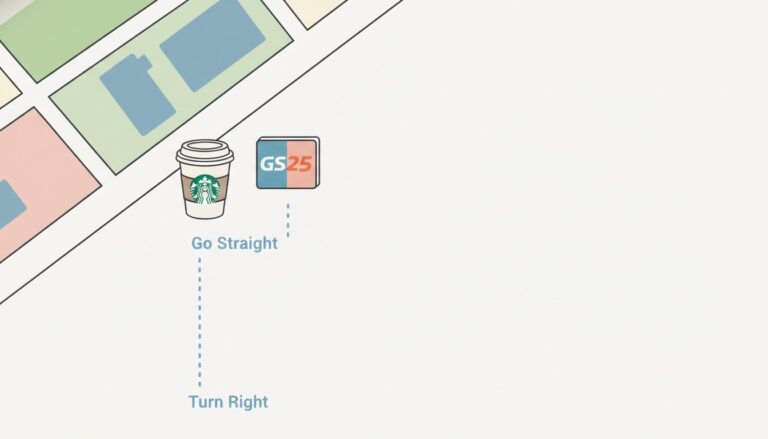
“Here… go jjuk… then see GS25… turn right…”
If you don’t know the keywords, their hand gestures just look like a K-Pop dance move. Today, we are going to learn how to understand these “verbal maps” so you never have to eat your cold convenience store triangle gimbap on a random curb out of frustration.
This guide comes straight from the streets of Seoul—practical, simple, and survival-ready.
Phase 2: The Compass Words (Deep Dive)
Here are the three phrases that make up 90% of directions in Korea.
1. 쭉 가세요 (Jjuk gaseyo)
- Pronunciation: [Jjuk ga-seh-yo] (The ‘Jjuk’ sound is strong and short, like the sound of slurping noodles!)
- Meaning: Go straight.
- K-Culture Moment: You hear this in variety shows like Running Man when members are frantically looking for a mission location. It’s often accompanied by a hand chopping through the air.
- Editor’s Insight: The word “쭉 (jjuk)” implies a continuous, straight line. If someone emphasizes it (“Jju~~~uk!”), it means go straight for a long time.
- Situation Spectrum:
[🚫 Formal Boss] ———— [✅ Everyone Else](Safe for strangers and elders).2. 오른쪽 / 왼쪽으로 도세요 (Oreunjjok / Oenjjok-euro doseyo)
- Pronunciation: [Oh-reun-jjok] (Right) / [Wen-jjok] (Left)
- Meaning: Turn right / Turn left.
- Memory Hack: “O” (Oreunjjok) usually means correct or right. “Right is right.”
- Editor’s Insight: Often, Koreans will drop the “-euro doseyo” part and just say “Geogi-seo oreunjjok” (From there, right). It’s faster.
- 🤔 Think About It: Why do we say “turn”? In Korean, the verb “dol-da” (to turn/spin) is used. It feels more active, like physically rotating your body.
3. ~이/가 보일 거예요 (~i/ga boil geoyeyo)
- Pronunciation: [~boy-il-guh-yeh-yo]
- Meaning: You will see [Landmark].
- K-Travel Tip: This is the most crucial part of drawing a mental map. Koreans rarely use street names. We use landmarks. “You will see a Starbucks” is our version of “Go 100 meters.”
- Situation Spectrum:
[✅ Universal]
Phase 3: Textbook vs. Real Life
Let’s be real. Nobody speaks like a textbook in a busy street.
| Situation | 📖 Textbook Korean | 🗣️ Real Korean | 💡 Why the difference? |
|---|---|---|---|
| Going Straight | 앞으로 100미터 직진하세요. (Go straight 100 meters forward.) | 그냥 쭉~ 가세요. (Just go straaaight.) | We estimate by feeling, not meters. |
| Turning | 저기 사거리에서 우회전하세요. (Turn right at that intersection.) | 저기 편의점 끼고 도세요. (Turn around the corner of that convenience store.) | Visual landmarks are easier to spot than abstract intersections. |
| Arriving | 도착했습니다. (You have arrived.) | 딱 나와요. (It just pops out.) | “딱 (ttak)” emphasizes exactness and visibility. |
Bottom Note: “~끼고 도세요” (Turn wrapping around the corner) is a pro-level expression. If you hear “GS25 kkigo”, it means turn at the corner where the GS25 is.
Phase 4: Cultural Context — The “Landmark” Logic
4-1. The Finger Pointing Rule
When giving directions, do not point with your index finger. In many Western cultures, this is fine. In Korea, pointing with a single finger can seem accusatory or rude, especially to older people. Instead, use an open hand (palm up or to the side) to gesture in the direction. It looks like you are presenting the way, not commanding it.
4-2. The K-Travel Connection: The “Olive Young” Navigation System
Forget street signs. In Seoul, the primary navigation beacons are:
1. Starbucks
2. Olive Young (Beauty store)
3. GS25 / CU (Convenience stores)
4. Paris Baguette (Bakery)
If you ask for directions, expect to hear one of these brand names. “Go to the Olive Young and turn left” is a standard sentence here.
Phase 5: Roleplay — Lost in Hongdae
Setting: A bustling Saturday afternoon in Hongdae. Music is blasting from clothing stores. You are trying to find a famous Tteokbokki place.
Characters:
* YOU: Hungry traveler.
* Student: A helpful college student walking by.
The Scene:
YOU: (Showing phone screen) 저기요, 여기 어디예요?
(Jeogiyo, yeogi eodiyeyo? / Excuse me, where is this?)
Student: 아, 여기요? 저기 스타벅스 보이세요? ☕
(Ah, yeogiyo? Jeogi Starbucks boiseyo?)
(Translation: Ah, here? Do you see that Starbucks over there?)
YOU: 네, 보여요!
(Ne, boyeoyo! / Yes, I see it!)
Student: 저기서 오른쪽으로 도세요. 그럼 바로 있어요.
(Jeogiseo oreunjjok-euro doseyo. Geureom baro isseoyo.)
(Translation: Turn right from there. Then it’s right there.)
🔀 Your Turn! How do you respond?
- A) “Okay, bye.” (Too abrupt!)
- B) “감사합니다! (Gamsahamnida!)” (Perfect standard.)
- C) “아~ 감사합니다! (Ah~ Gamsahamnida!)” + A slight bow. (The most natural local reaction.)
✅ Best Choice: C. The “Ah~” sound shows you understood the information, and the bow shows respect for their time.
Phase 6: 10-Second Shadowing Drill
Practice these until they roll off your tongue.
- 😊 Seeking Confirmation:
편의점이 / 보일 거예요!
(Pyeonie-jeom-i / boil geo-yeyo!)
Translation: You will see a convenience store! -
👮 The Command:
쭉 가다가 / 왼쪽으로 / 도세요.
(Jjuk gadaga / oen-jjok-euro / do-seyo.)
Translation: Go straight and then turn left.
Phase 7: K-Culture Mini Glossary
| Korean | Romanization | Meaning | Context |
|---|---|---|---|
| 사거리 | Sageori | 4-way Intersection | A major reference point for directions. |
| 골목 | Golmok | Alleyway | K-Dramas love these. Where hidden gems (and kisses) happen. |
| 역 | Yeok | Subway Station | The absolute center of gravity for meeting spots (e.g., Gangnam Yeok). |
| 근처 | Geuncheo | Nearby | “Where is it?” “Here nearby (Yeogi geuncheo).” |
Phase 8: Traveler’s Survival Kit
Giving directions is hard, but asking is harder. Here is your cheat sheet.
🆘 Survival Card
* 🇰🇷 “길 좀 물어봐도 될까요?” (Gil jom mureobwado doelkkayo?)
* 🗣️ Meaning: Can I ask for directions?
* 💡 Pro Tip: If this is too long, just show your phone map and say “여기 가고 싶어요” (I want to go here).📌 Editor’s Travel Note
* App Alert: Google Maps is not great in Korea. Download Naver Map or KakaoMap. They have English interfaces now!
* Data: Make sure you have data. “Screenshots” of maps are static; you need the GPS moving blue dot to survive Seoul’s alleyways.
Phase 9: Think Deeper — Street Names vs. Landmarks
Why do Koreans use landmarks instead of street names?
In the US or Europe, you might say “Turn left on Maple Street.” In Korea, we say “Turn left at the Paris Baguette.”
This isn’t just habit. Korea’s street address system was completely overhauled recently, so many locals (especially older generations) still don’t know the new street names. But more importantly, Korean cities change fast. A building might be rebuilt in a month. But big franchises (Landmarks) tend to stay. It’s a navigation system built on visual recognition rather than abstract grids. It reflects a “high-context” culture where reading the immediate environment is key.
💬 Your Turn: How do you give directions in your hometown? By street names or by “that big yellow house”? Tell us in the comments!
Phase 10: FAQ & Troubleshooting
- Q: Can I just point to my phone?
- A: Yes! But saying “Yeogi (Here)” while pointing helps. Don’t just shove the phone in someone’s face silently.
- Q: What if I don’t understand their Korean?
- A: Look at their hands. Hand gestures are universal. If they wave forward, go straight. If they chop sideways, turn.
❌ Common Mistake: Confusing 오른쪽 (Right) and 왼쪽 (Left).
✅ Fix: Remember “L” for Left doesn’t work in Korean sounds. But Right has an R and O-Reun has an R sound. (It’s a stretch, but it helps!)
Phase 11: Wrap-up & Mission
One-Liner: To survive in Korea, follow the “Jjuk” (Straight) and look for the “Starbucks.”
Action Mission:
* 🥉 Bronze: Say “Jjuk gaseyo” while walking down your hallway.
* 🥈 Silver: Open Google Street View for “Gangnam Station,” find a convenience store, and practice giving directions to it.
* 🥇 Gold: Next time you are in a Korean restaurant or town, ask “Hwajangsil (Restroom) eodiyeyo?” and listen for “Jjuk” or “Oenjjok.”
K-Culture Mission: Watch a scene in a K-Drama where someone is running. Shout directions at the screen! “Ani! Oenjjok! (No! Left!)”
Phase 12: Pop Quiz
Situation: Someone tells you: “Starbucks-eseo oreunjjok-euro doseyo.” What do you do?
- Go into Starbucks and order coffee.
- Turn left at Starbucks.
- Turn right at Starbucks.
- Go straight past Starbucks.
(Toggle for Answer: 3. Turn right at Starbucks. Oreunjjok = Right!)
Frequently Asked Questions (FAQ)
Q: What does "쭉 가세요 (Jjuk gaseyo)" mean in Korean and how do you pronounce it?
A: In Korean, "쭉 가세요 (Jjuk gaseyo)" is pronounced [Jjuk ga-seh-yo] and means: Go straight.
Q: What does "오른쪽 / 왼쪽으로 도세요 (Oreunjjok / Oenjjok-euro doseyo)" mean in Korean and how do you pronounce it?
A: In Korean, "오른쪽 / 왼쪽으로 도세요 (Oreunjjok / Oenjjok-euro doseyo)" is pronounced [Oh-reun-jjok] and means: Turn right / Turn left.
Q: What does "~이/가 보일 거예요 (~i/ga boil geoyeyo)" mean in Korean and how do you pronounce it?
A: In Korean, "~이/가 보일 거예요 (~i/ga boil geoyeyo)" is pronounced [~boy-il-guh-yeh-yo] and means: You will see [Landmark].







