

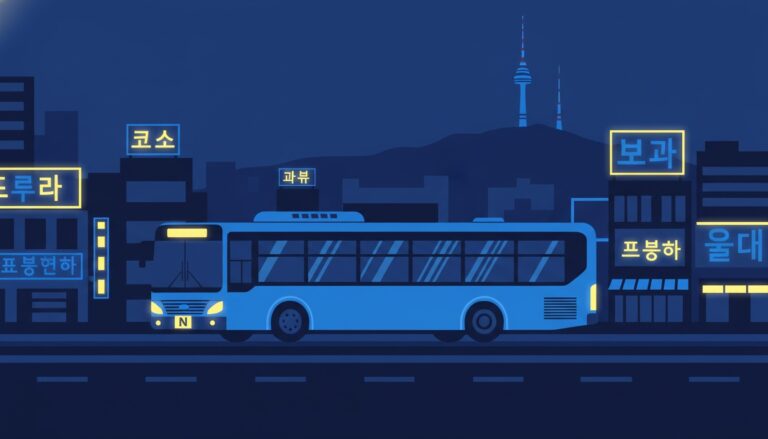
Phase 1: Immersive Hook
Greeting: 안녕하세요! This is your Daily Hangul editor.
Picture this: It’s 2:00 AM on a Friday night in Gangnam. You’ve just stumbled out of a noraebang (karaoke), throat sore from belting out NewJeans songs. The subway gates shut hours ago. You try to hail a taxi, but the “Reserved” (빈차) lights turn off as soon as the drivers see you, or they demand “double fare.”
In K-Dramas, this is usually where the male lead pulls up in a luxury sedan to rescue the protagonist. In reality? You’re freezing on the sidewalk, watching your battery percentage drop to 4%.
But if you know where to look, a savior does appear. It’s huge, it’s blue, and it has a glowing “N” on its forehead. Welcome to the world of the Owl Bus (올빼미 버스)—the lifeline of Seoul’s night owls.
This isn’t just about getting home; it’s about understanding the pulse of a city that refuses to sleep. Today, we look at the language of late-night survival.
Phase 2: Deep Dive into Core Expressions
Here are three high-level expressions you’ll need when the sun goes down.
1. 막차 끊겼어 (Makcha kkeungyeosseo)
- Pronunciation: [mak-cha kkeun-kyeot-seo] (Sounds like: mock-cha + kun-kyot-so)
- Meaning: “The last bus/train is gone.”
- Nuance: Literally, kkeunghida means “to be cut off.” It’s passive. You didn’t miss the bus (which implies a mistake); the service was cut off from you. It’s a statement of fact that often leads to a decision: Taxi? Owl Bus? or jjimjilbang (sauna)?
- K-Culture Moment: Every romance drama ever. “Oh no, the last bus is gone…” implies, “I guess we have to spend more time together.”
- Situation Spectrum:
[🚫 Formal: Avoid] ———— [✅ Friends/Casual: Perfect]- 🤔 Think About It: Why does Korean use the passive “cut off”? It shifts the blame to the system, not the person. It’s a subtle way of saying, “It’s not my fault I’m late coming home!”
2. 배차 간격 (Baecha gangyeok)
- Pronunciation: [bae-cha gan-gyeok]
- Meaning: Dispatch interval / Headway.
- Editor’s Insight: Beginners ask, “When does the bus come?” C1 learners check the baecha gangyeok. Owl buses don’t run frequently—usually every 30 to 50 minutes. If you miss one, knowing the interval tells you if you have time to grab a cup of ramen or if you should just freeze and wait.
- Situation Spectrum:
[✅ Useful everywhere]3. 승차 거부 (Seungcha geobu)
- Pronunciation: [seung-cha geo-bu]
- Meaning: Refusal of passengers (usually by taxi drivers).
- Context: While illegal, taxi drivers often refuse short distances at night. This is the main reason locals love the Owl Bus. It never refuses you.
- Example: “아, 택시가 또 승차 거부하네.” (Ah, the taxi is refusing passengers again.)
Phase 3: Textbook vs. Real Life
| Situation | 📖 Textbook Korean | 🗣️ Real Korean | 💡 Why different? |
|---|---|---|---|
| Asking about bus arrival | “버스가 언제 도착합니까?” (When does the bus arrive?) | “배차 왜 이래?” (Why is the interval like this?) | Locals complain about the system rather than asking obvious questions. |
| Suggesting a taxi | “택시를 탑시다.” (Let’s take a taxi.) | “야, N버스 타자. 택시 안 잡혀.” (Hey, let’s take the N-bus. Can’t catch a taxi.) | Practicality wins. “An japhyeo” (can’t be caught) is the standard verb for taxis. |
Bottom Note: At C1 level, your complaints should be specific. Don’t just say “It’s late.” Say “The dispatch interval is brutal today.”
Phase 4: Cultural Deep Dive — The “N” Bus
4-1. The “N” stands for Night (and Late Night Drama)
Seoul’s Owl Buses are marked with an ‘N’ (e.g., N26, N62). These routes are fascinating sociological cross-sections.
On the N62, for instance, you’ll see two distinct groups at 3 AM:
1. The Partiers: Young people leaving Hongdae clubs, smelling of alcohol and perfume, loud and energetic.
2. The Workers: Designated drivers (daeri unjeon) returning to the city center, or market vendors heading to the Dongdaemun wholesale market.
4-2. Non-verbal Nunchi (눈치) on the Bus
At 3 AM, silence is the golden rule. Unlike the daytime bus where chatter happens, the Owl Bus is a mobile dormitory. If you are talking loudly with your friend, you will get death stares. The vibe is exhausted solidarity. Keep your voice down.
Phase 5: Immersive Roleplay
Setting: 2:30 AM. Gangnam Station, Exit 10. The street is chaos. You are with Min-ji (30, a savvy local who knows all the bus routes).
Min-ji: 와, 택시 줄 봐라… 저거 기다리다간 해 뜨겠다.
(Wa, taeksi jul bwara… jeogeo gidaridagan hae tteugetda.)
(Wow, look at that taxi line… we’ll see the sunrise if we wait for that.)
YOU: (Checking your app)
Option A: “The N62 is coming in 40 minutes. Should we wait?”
Option B: “Makcha kkeungyeosseo? What do we do?”
🔀 Your Turn! How do you say Option A naturally?
- “N62번 40분 뒤에 온대. 기다릴까?”
- “버스가 아주 늦게 옵니다. 기다리십시오.”
✅ Best Choice: 1. It’s casual and uses the citation form “온대” (short for 온다고 해 – it says it’s coming), which is essential for C1 speakers reporting information.
Min-ji: 40분? 에바다. (40 minutes? That’s too much/Over the top.) 그냥 심야 버스 말고 첫차 기다리자.
(40 minutes? Eba-da. Let’s just skip the Owl Bus and wait for the First Bus.)
(Stage Direction: She pulls you toward a 24-hour café)
Phase 6: 10-Second Shadowing Drill
Let’s practice complaining about the wait time like a true Seoulite.
Guidance: Emphasize the “Gosh” feeling at the start and drag out the “Neomu” for effect.
😩 아… / 배차 간격이 / 너~~~무 긴데 / 어떻게 하지?
(Ah… / baecha gangyeogi / neo~~~mu ginde / eotteoke haji?)
“Ah… the dispatch interval is waaaaay too long, what should we do?”
Phase 7: K-Culture Glossary
| Korean | Romanization | Meaning | Context |
|---|---|---|---|
| 올빼미 | Olppaemi | Owl | Used to describe the Night Bus, but also a person who stays up late. |
| 할증 | Haljeung | Surcharge | The extra 20-40% fee taxis charge late at night. |
| 첫차 | Cheotcha | First Bus/Train | Usually starts around 5:00 AM. The goal for those who miss the Owl Bus. |
| 다이소 | Daiso | Daiso | Why here? Because if you miss the bus, you often kill time shopping, but at 2 AM, you go to a PC Bang or Convenience Store. |
Phase 8: Traveler’s Survival Kit (Transport Edition)
🆘 Survival Expression #1
– 🇰🇷 “혹시 N버스 정류장이 어디예요?” (Hoksi N-beoseu jeongnyujang-i eodiyeyo?)
– 🗣️ Meaning: “By any chance, where is the N-bus stop?”
– 💡 Pro Tip: Owl Bus stops are often slightly different from daytime stops. Look for the ‘N’ sign on the digital board.📌 Editor’s Travel Note
– App is King: Naver Map or KakaoMap is non-negotiable. Google Maps is often outdated for real-time bus tracking in Korea.
– Payment: You cannot pay cash on many Seoul buses anymore. Have your T-Money card charged!
Phase 9: Think Deeper — The City That Never Sleeps
🧠 Think Deeper:
Why does Seoul need such an extensive night bus network compared to cities like Tokyo or London? It’s not just about transportation; it’s about the “Hoe-sik” (company dinner) culture and the safety infrastructure. The Owl Bus was actually proposed by citizens using Big Data of late-night taxi calls. It represents a society where data drives policy, and where the boundary between night and day is incredibly blurred. Does your city support the night economy like this?
Phase 10: FAQ & Troubleshooting
Q: Is the Owl Bus safe for foreigners at 3 AM?
A: Generally, yes. Seoul is one of the safest cities in the world. The buses have CCTV, and because they are often crowded, you aren’t isolated. However, expect drunk passengers. They are usually harmless, just sleepy.
❌ Common Mistake: Thinking the “Last Bus” (Makcha) time is the same every day.
✅ Fix: Weekends and weekdays differ. Always refresh your app.
Phase 11: Wrap-up & Action Mission
Summary: Today we mastered the C1 vocabulary for Seoul’s nightlife transport: Makcha (Last bus), Baecha gangyeok (Interval), and the legendary Olppaemi (Owl) Bus.
🚀 Action Mission:
– 🥉 Bronze: Say “배차 간격이 너무 길어” out loud next time you wait for anything (elevator, microwave).
– 🥈 Silver: Download KakaoMap and search for “N62” to see its route.
– 🥇 Gold: If you are in Korea, spot an N-Bus and take a photo of the route map!
💬 Your Turn: What is the late-night transport situation in your country? Do you have “Night Buses,” or are you stranded until morning? Tell me below!
Frequently Asked Questions (FAQ)
Q: What does "막차 끊겼어 (Makcha kkeungyeosseo)" mean in Korean and how do you pronounce it?
A: In Korean, "막차 끊겼어 (Makcha kkeungyeosseo)" is pronounced [mak-cha kkeun-kyeot-seo] and means: "The last bus/train is gone."
Q: What does "배차 간격 (Baecha gangyeok)" mean in Korean and how do you pronounce it?
A: In Korean, "배차 간격 (Baecha gangyeok)" is pronounced [bae-cha gan-gyeok] and means: Dispatch interval / Headway.
Q: What does "승차 거부 (Seungcha geobu)" mean in Korean and how do you pronounce it?
A: In Korean, "승차 거부 (Seungcha geobu)" is pronounced [seung-cha geo-bu] and means: Refusal of passengers (usually by taxi drivers).







