

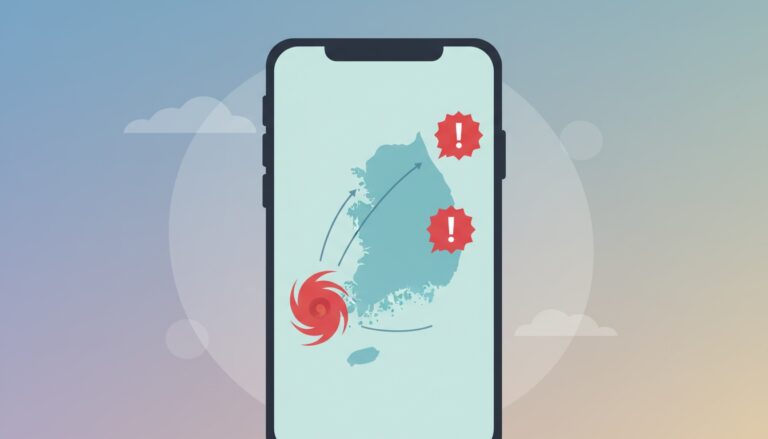
Surviving the Siren: Advanced Korean for Typhoons & Forecast Skepticism
Phase 1: The Alarm Goes Off
Hello! It’s your editor from Daily Hangul.
Picture this: You are sitting in a quiet café in Hongdae, sipping an iced Americano. Suddenly, a piercing siren wails—not from outside, but from the pockets of every single person in the room. Phones vibrate in unison on the tables. It’s terrifying if you don’t know what’s happening. Is it a war? An earthquake?
Usually, no. It’s the Emergency Disaster Text (재난 문자) telling you that a typhoon is taking a sharp turn toward the peninsula.
At the C2 level, simply saying “It is raining” isn’t enough. You need to understand the technical jargon on the news, the specific anxiety of a “direct hit,” and most importantly, the cultural sport of complaining about the weather forecast accuracy. Let’s get you sounding less like a textbook and more like a local watching the news.
Phase 2: The Vocabulary of Chaos
Here are the three heavy-hitters you’ll hear on the news (and in the office) when a storm is brewing.
1. 역대급 (Yeok-dae-geup)
- Pronunciation: [Yeok-dae-geup] (Sounds like ‘YUCK-day-gup’ but softer on the ‘k’)
- Meaning: Historic / Unprecedented / All-time level
- Editor’s Insight: The media loves this word. Every typhoon is somehow “역대급.” It implies that this event is going down in history. Koreans use this for everything, though—”역대급 맛집” (legendary restaurant) or “역대급 망신” (historic embarrassment).
- Situation: Casual & Formal.
2. 관통하다 (Gwan-tong-ha-da)
- Pronunciation: [Gwan-tong-ha-da]
- Meaning: To penetrate / To pass directly through
- Editor’s Insight: This is the verb you use when the typhoon isn’t just brushing the coast but is driving straight through the heart of the country. It carries a sense of violence and direct impact. If the news says “서울을 관통할 예정” (scheduled to cut through Seoul), cancel your dinner plans.
- Situation: Mostly Formal (News/Reporting), but used in serious conversation.
3. 오보 (O-bo)
- Pronunciation: [O-bo]
- Meaning: Incorrect report / False forecast
- Editor’s Insight: This is crucial for Korean small talk. The Korea Meteorological Administration (KMA) often gets heat for changing predictions. When the forecast is wrong, people sigh and say, “또 오보야?” (Is it a misreport again?).
- Situation: Formal noun, but used in casual complaining.
Phase 3: Textbook vs. Real Life
At the advanced level, you stop describing the weather and start analyzing the prediction of the weather.
| Textbook (Standard) | Real Life (The “Local” Vibe) |
|---|---|
| 일기 예보가 틀렸습니다. (The weather forecast was incorrect.) | 기상청 슈퍼컴퓨터가 나보다 못 맞히네. (The KMA supercomputer is worse at guessing than I am.) |
| 태풍의 경로가 바뀌었습니다. (The typhoon’s path has changed.) | 진로가 또 꺾였대. 유동적이라나 뭐라나. (They say the path bent again. Something about it being ‘fluid’ or whatever.) |
| 비가 많이 올 것으로 예상됩니다. (Heavy rain is expected.) | 이번에 진짜 물폭탄이래. (They say it’s a literal ‘water bomb’ this time.) |
Note: You might hear people call the KMA “구라청” (Gura-cheong). This is a slang mix of Gura (lie) and Gisangcheong (KMA). It’s very common, but don’t say it to a meteorologist!
Phase 4: The Art of Nunchi (Alert Etiquette)
When that loud Safety Alert (안전 안내 문자) goes off in public:
- Don’t Panic: If nobody else is running, you don’t need to run. Koreans are desensitized to these alarms.
- The Silent Nod: You’ll see everyone check their phone, read the message (usually about heavy rain or a typhoon warning), and then just go back to eating their kimchi jjigae. It’s a communal moment of “Ah, okay.”
- The Window Ritual: If a major typhoon is coming, you’ll see neighbors taping their windows. Some use an ‘X’ shape with duct tape; others use wet newspapers. If you ask a Korean colleague, “Should I tape my windows?” (창문에 테이프 붙여야 할까요?), they will immediately treat you like a younger sibling who needs protecting.
Phase 5: Scenario – The “Work From Home” Hope
Situation: Two colleagues are watching the news about Typhoon ‘Hinnamnor’ approaching. They are secretly hoping the office closes.
Characters:
* Mark (Foreigner): C2 level speaker, follows Korean news closely.
* Minji (Korean): Mark’s cynical coworker.
Dialogue:
Mark: 지금 뉴스 봤어요? 태풍 예상 경로가 서울을 완전히 관통한다는데요?
(Did you see the news just now? They say the projected path cuts right through Seoul?)
Minji: (Siips coffee skeptically) 에이, 설마요. 기상청 예보가 아침이랑 또 다르던데. 아직 유동적일걸요?
(Eh, no way. The KMA forecast is different from this morning. It’s probably still fluid, right?)
Mark: 아니요, 이번엔 미국이랑 일본 기상청 모델도 다 한국 상륙을 예측하고 있어요. 역대급이래요.
(No, this time the American and Japanese models are all predicting a Korean landfall too. They say it’s historic.)
Minji: (Eyes widen) 진짜요? 와, 그럼 내일 출근 못 하는 거 아니에요? 재택 각인데?
(Really? Wow, then maybe we can’t come to work tomorrow? Looks like a ‘Work From Home’ angle?)
Mark: 그쵸? 일단 창문에 신문지부터 붙여야겠네요.
(Right? I guess I should start by sticking newspapers on my windows first.)
Phase 6: 10-Second Shadowing
Let’s practice the tone of a disaster broadcast anchor. Serious, urgent, and clear.
현재 태풍은 / 중심기압 950헥토파스칼의 강한 세력을 유지한 채 / 북상하고 있습니다.
(Currently, the typhoon is moving north / while maintaining a strong force / with a central pressure of 950 hectopascals.)
- Tip: Pause slightly at the
/marks. Pronounce 헥토파스칼 (Hecto-pascal) quickly—it’s the unit Koreans use to judge a typhoon’s strength. The lower the number, the scarier the storm.
Phase 7: FAQ & Troubleshooting
Q: Can I turn off the Emergency Disaster Texts? They wake me up at 3 AM.
A: Technically, yes. But I don’t recommend turning off the “Emergency” (긴급) ones, only the “Safety” (안전) ones if you must. In iPhone settings, they are separate. However, living in Korea means sharing the collective suffering of the 3 AM siren. It’s part of the experience.
Q: Is it rude to criticize the weather forecast to my boss?
A: Not at all. Complaining about the weather forecast is a safe, neutral bonding activity. It’s like complaining about traffic. It actually makes you seem more integrated into Korean society.
Phase 8: Wrap-up
One-Liner: Knowing how to read a typhoon track map is a survival skill, but knowing how to joke about the “Gura-cheong” is a social skill.
Action Mission: Next time it rains when the forecast said sun, say to your friend: “기상청이 또…” (The KMA is at it again…) and shake your head. You are now a local.
Phase 9: Quick Quiz
1. Which word means a forecast was incorrect?
a) 제보 (Je-bo)
b) 오보 (O-bo)
c) 속보 (Sok-bo)
2. What is the slang term for the Meteorological Administration when they lie?
a) 거짓청 (Geojit-cheong)
b) 구라청 (Gura-cheong)
c) 바보청 (Babo-cheong)
3. If a typhoon goes straight through a city, which verb is used?
a) 관통하다 (To penetrate/pass through)
b) 스치다 (To graze)
c) 피하다 (To avoid)
(Answers: 1-b, 2-b, 3-a)
Frequently Asked Questions (FAQ)
Q: What does "역대급 (Yeok-dae-geup)" mean in Korean and how do you pronounce it?
A: In Korean, "역대급 (Yeok-dae-geup)" is pronounced [Yeok-dae-geup] and means: Historic / Unprecedented / All-time level
Q: What does "관통하다 (Gwan-tong-ha-da)" mean in Korean and how do you pronounce it?
A: In Korean, "관통하다 (Gwan-tong-ha-da)" is pronounced [Gwan-tong-ha-da] and means: To penetrate / To pass directly through
Q: What does "오보 (O-bo)" mean in Korean and how do you pronounce it?
A: In Korean, "오보 (O-bo)" is pronounced [O-bo] and means: Incorrect report / False forecast







