

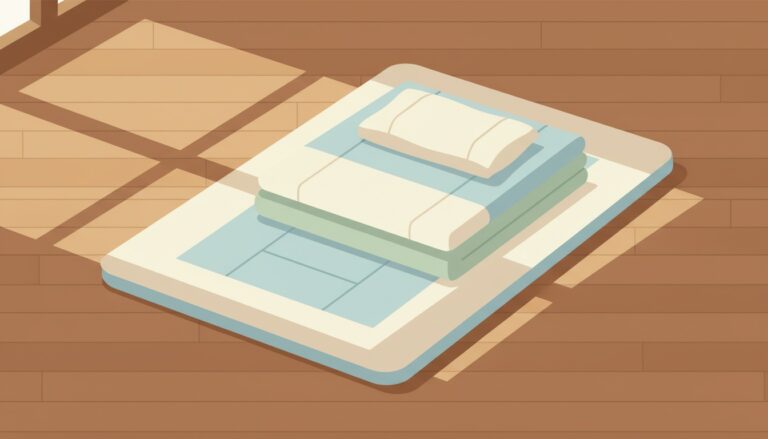
Introduction: The “Where is the Bed?” Shock
Hello! This is your Daily Hangul Editor. 👋
So, you’ve been invited to a Korean friend’s house, or maybe you are staying at a traditional Hanok guesthouse. You wake up in the morning, look around, and realize… there’s no bed frame! You just slept on the floor (thanks to the cozy Ondol heating).
Now, you want to be a polite guest and tidy up. In English, we say “Make the bed.” But if you translate that literally in Korean, people might look confused because there is no “bed” to make!
Today, we are going to learn how to handle the uniquely Korean morning ritual of 이불 개기 (Folding the bedding). Knowing this simple difference between “Making a bed” and “Folding a blanket” will instantly upgrade you from “Tourist” to “Culturally Aware Friend.” Let’s dive in!
Phase 2: Deep Dive (Core Expressions)
Here are the top 3 expressions you need for a Korean morning. Since we are at Level A1, we will focus on the polite ‘-yo’ (-요) ending, which is safe to use with almost anyone.
1. 이불 (I-bul)
- Pronunciation: E-bul [Sounds like “Evil” but with a soft ‘b’ instead of ‘v’]
- Meaning: Blanket / Bedding / Comforter
- Editor’s Insight: In Korea, Ibul is everything. It’s what covers you, and often what you sleep on (if it’s a set).
- Situation: Essential noun. Point at it and say “Ibul!”
2. 개다 (Gae-da) -> 개요 (Gae-yo)
- Pronunciation: Gae-yo [Sounds like “Gay-o” or similar to the ‘Ga’ in “Game”]
- Meaning: To fold (specifically for laundry or bedding).
- Editor’s Insight: You cannot use this word for paper! Paper is jeop-da. Clothes and blankets are gae-da. It implies neatness.
- Situation: Use this when cleaning up traditional floor bedding.
3. 도와줄까요? (Do-wa-jul-kka-yo?)
- Pronunciation: Do-wa-jul-ka-yo? [Think: “Do u want jul-ry?” – fast]
- Meaning: Shall I help you?
- Editor’s Insight: This is the magic phrase. Even if you are bad at folding, saying this makes you an angel in Korean culture.
- Situation: Casual but polite. Use it anywhere.
Phase 3: Textbook vs. Real Life
Textbooks often teach you formal commands. But in reality, we want to sound friendly.
| Textbook Korean (Robot Style 🤖) | Real Korean (Human Style 😎) |
|---|---|
| 이불을 정리하세요. (Please organize the blanket.) |
이불 개자! (Let’s fold the blankets! – Casual) |
| 침대를 정리합니다. (I am organizing the bed.) |
이불 좀 갤게요. (I’m gonna fold the bedding a bit. – Polite) |
| 도와 드리겠습니다. (I will offer assistance.) |
제가 할게요! (I’ll do it!) |
💡 A1 Tip: If “Ga-e-yo” is too hard, just say “Jeong-li” (Organize) + “Haeyo” (Do) = “Jeong-li Haeyo”. It works for everything!
Phase 4: Cultural Context (Korean Manners)
The “Vanishing Bedroom” Magic
Why do we fold the bedding instead of leaving it out? Because in traditional Korean homes, the sleeping room becomes the living room or dining room during the day.
- The Nunchi (Wit) Rule: If you see your host folding the blankets, don’t just watch! Immediately start grabbing the pillows. You don’t even need to speak. Just moving your hands shows you have good manners.
- Direction: Usually, the heavier mat (Yo) goes on the bottom, the blanket (Ibul) is folded on top, and the pillow (Begae) goes on the very top or in front.
Phase 5: Real-Life Scenario (Roleplay)
Setting: You (Alex) stayed at Minji’s house. It’s morning.
(Minji enters the room)
Minji: 잘 잤어요? (Did you sleep well?)
* [Jal ja-sseo-yo?]
Alex: 네! 이불 같이 개요. (Yes! Let’s fold the blankets together.)
* [Ne! Ibul ga-chi gae-yo.]
Minji: 아니에요, 괜찮아요. (No, it’s okay.)
* [An-i-e-yo, gwaen-chan-a-yo.]
Alex: (Grabbing a pillow) 제가 도와줄게요! (I will help!)
* [Je-ga do-wa-jul-ke-yo!]
Phase 6: 10-Second Shadowing Drill
Repeat this sentence to master the rhythm. Don’t rush!
“I will organize the blanket.”
제가 (I) / 이불 (Blanket) / 정리할게요 (Will organize).
Je-ga / I-bul / Jeong-li-hal-ke-yo.
- Focus: Stress the “I” (Ibul) and “Jeong” (Jeong-li).
Phase 7: FAQ & Troubleshooting
Q: Can I use “Make the bed” (침대 정리) for sleeping on the floor?
A: You can, but it sounds a bit odd because there is no Chim-dae (Bed). Use “Ibul jeong-li” (Blanket cleanup) or “Ibul gae-da” (Fold blanket) to sound more natural.
Q: Is “Gaeyo” (fold) used for clothes too?
A: YES! You can say “Pajamas gaeyo” (Fold the pajamas). It’s a very useful verb for housework.
Phase 8: Wrap-up
- Summary: Use “Gae-yo” when folding blankets on the floor, and “Jeong-li hae-yo” for general cleaning.
- Mission: Next time you wake up (even in a Western bed), say “Ibul jeong-li!” out loud as you pull the sheets up.
- Question: Do you prefer sleeping on a soft mattress or the warm Korean floor (Ondol)? Tell me in the comments!
Phase 9: Pop Quiz
Which verb do we use for “Folding” the blanket?
- 먹어요 (Meok-eo-yo)
- 개요 (Gae-yo)
- 가요 (Ga-yo)
Click to see the answer!
Answer: 2. 개요 (Gae-yo)
(1 is Eat, 3 is Go)
Frequently Asked Questions (FAQ)
Q: What does "이불 개기" mean in Korean and how do you pronounce it?
A: In Korean, "이불 개기" is pronounced [Folding the bedding] and means: . Knowing this simple difference between "Making a bed" and "Folding a blanket" will instantly upgrade you from "Tourist" to "Culturally Aware Friend." Let's dive in!







