

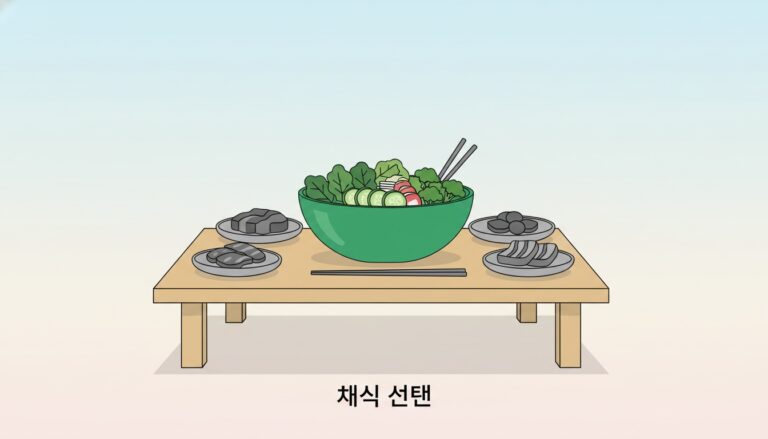
Hello there! It’s your lead editor from Daily Hangul.
I’ve been teaching Korean for years, and if there’s one moment that makes my vegetarian students sweat more than a sauna in July, it’s the dreaded ‘Hoesik’ (회식 – company dinner) announcement.
Imagine this: Your boss shouts, “Let’s go eat Samgyeopsal (pork belly)!” Everyone cheers. But you? You’re mentally calculating if you can survive on just lettuce leaves and spicy pepper paste for three hours.
Being vegetarian in Korea is getting easier, but the traditional Hoesik culture is still heavily meat-focused. If you don’t know how to navigate this, you might end up starving—or worse, accidentally eating ham because a sweet grandmother thought “ham isn’t meat.”
Today, we’re going to cover the B2 (Intermediate) level phrases you need to survive a team dinner politely, firmly, and with enough Nunchi (social sense) to keep everyone happy.
Phase 1: Deep Dive into Core Expressions
At the B2 level, we move beyond “Meat No!” We need to explain why and handle specific ingredients like broth.
1. 제가 채식을 해서요 (Je-ga chae-sik-eul hae-seo-yo)
- Pronunciation: Je-ga chae-shik-eul he-suh-yo
- (‘Chae’ sounds like the start of Chai tea / ‘Sik’ sounds like Sick)
- Meaning: “Because I practice vegetarianism…” / “Since I am a vegetarian…”
- Editor’s Insight: This is much better than just saying “I don’t eat meat.” It implies a lifestyle choice or a dietary principle, which commands a bit more respect in a formal setting. It is usually the opening clause of a sentence, followed by a request.
- Situation Check: Perfect for explaining to a boss or colleague why you aren’t touching the Galbi.
2. 고기 빼고 해주실 수 있나요? (Gogi ppae-go hae-ju-shil su in-na-yo?)
- Pronunciation: Go-ghee ppe-go he-ju-shil su in-na-yo?
- (‘Ppae’ sounds like the ‘Pe’ in Pet but with a stronger, double-P pop)
- Meaning: “Can you please make it without meat?” (Lit: Can you do it removing meat?)
- Editor’s Insight: The verb 빼다 (to remove/leave out) is essential here. You will use this for Bibimbap, Japchae, or fried rice.
- Pro Tip: In Korea, sometimes “meat” implies beef or pork. You might still get spam or seafood. To be safe, list what you want out: “햄이랑 고기 빼고 주세요” (Please take out the ham and the meat).
- Situation Check: Use this with the restaurant staff.
3. 혹시 육수도 고기 육수인가요? (Hok-shi yuk-su-do gogi yuk-su-in-ga-yo?)
- Pronunciation: Hok-she yook-su-do go-ghee yook-su-in-ga-yo?
- (‘Yuk’ sounds like the ‘ook’ in Look)
- Meaning: “By any chance, is the broth also meat-based?”
- Editor’s Insight: This is the phrase that separates beginners from intermediates. Many stews (Jjigae) look vegetarian but are made with beef bone broth or anchovy stock. Asking this specific question saves your stomach.
- Situation Check: Essential when ordering stews like Doenjang-jjigae (Soybean paste stew).
Phase 2: Textbook vs. Real Life
Textbooks make you sound like a robot. Let’s make you sound like a local.
| Textbook / Formal | Real Life (Natural & Smart) |
|---|---|
| 저는 고기를 먹지 않습니다. (I do not eat meat.) |
전 고기 안 먹어요. (I don’t eat meat – more casual flow.) |
| 채식주의자용 메뉴가 있습니까? (Do you have a menu for vegetarians?) |
여기 혹시 고기 안 들어간 메뉴 뭐 있어요? (Do you happen to have anything here without meat in it?) |
| 이것은 무엇으로 만들었습니까? (What was this made with?) |
이거 안에 뭐 들어가요? (What goes inside this?) |
Editor’s Note: Using “혹시” (Hok-shi – by any chance) before asking a question softens the blow significantly. It makes you sound less demanding and more considerate.
Phase 3: Cultural Context & Manners (Nunchi)
In Korea, communal eating is everything. If you refuse to eat anything, it ruins the mood. Here is how to handle it with Nunchi:
- The Pre-emptive Strike: Do not wait until you arrive at the BBQ restaurant to say you’re vegetarian. Tell the organizer (usually the youngest manager) a few days prior.
- Say: “제가 채식을 하는데, 혹시 장소 정할 때 참고해 주실 수 있을까요?” (I’m vegetarian, could you possibly consider that when picking the place?)
- The “Grill Master” Strategy: If the team ends up at a BBQ place anyway (it happens), don’t just sit there crossing your arms. Offer to grill the meat.
- It sounds ironic, but it shows you are participating in the group activity even if you aren’t eating the food. It earns you major respect points.
- The Side Dish Trap: Be careful with Kimchi. 90% of restaurant Kimchi has shrimp paste (saeujeot) or fish sauce. If you are a strict vegan, you need to ask.
Phase 4: Roleplay Scenario
Setting: A team meeting discussing where to go for the evening Hoesik.
Characters:
* Mark: Foreign employee (Vegetarian)
* Manager Choi: Korean team leader
Manager Choi: 오늘 회식은 갈비 어때? 다들 고기 먹고 싶지? (How about Galbi for tonight’s dinner? Everyone wants meat, right?)
Mark: (Smiling politely) 부장님, 죄송한데 제가 채식을 해서요. (Manager, sorry but I’m actually vegetarian.)
Manager Choi: 아, 진짜? 마크 씨 고기 아예 안 먹어? (Ah, really? Mark, you don’t eat meat at all?)
Mark: 네, 아예 안 먹습니다. 대신 제가 고기는 정말 맛있게 잘 굽습니다! (Yes, I don’t eat it at all. Instead, I am really good at grilling meat!)
Manager Choi: 하하, 그래? 그럼 횟집으로 갈까? 생선은 먹나? (Haha, really? Then shall we go to a raw fish place? Do you eat fish?)
Mark: 아니요, 해산물도 안 먹습니다. 혹시 비빔밥이나 쌈밥집은 어떨까요? (No, I don’t eat seafood either. How about a Bibimbap or Ssambap place?)
(Acting Tip: When suggesting a new menu, use a rising intonation at the end to sound like you are suggesting, not demanding.)
Phase 5: 10-Second Shadowing
Read this out loud. Pay attention to the pause marked by /.
“죄송하지만 / 혹시 이 국물에 / 고기나 멸치 육수 들어가나요?”
(I’m sorry but / by any chance / is there meat or anchovy stock in this broth?)
- Focus: Emphasize ‘혹시’ (Hok-shi) and ‘육수’ (Yuk-su).
Phase 6: FAQ & Troubleshooting
Q: Is it rude to ask them to change the restaurant because of me?
A: If it’s a huge group (10+ people), yes, it can be tricky. In that case, check the menu beforehand and see if you can order a side menu (like Soybean Noodle Soup or Bibim-guksu). If it’s a small team (4-5 people), it is perfectly okay to suggest alternatives!
Q: People keep offering me meat even after I said no. Why?
A: In Korean culture, putting food on someone’s plate is an act of affection (Jeong). They worry you are hungry. Just smile and say, “마음만 받을게요” (I’ll accept just your heart/kindness).
Phase 7: Wrap-up
Being vegetarian in Korea requires a bit of courage and a lot of vocabulary, but people are generally understanding if you explain it clearly.
Today’s Summary:
Don’t just say “No meat.” Explain “Je-ga chae-sik-eul hae-seo-yo” and clarify specific ingredients like broth (Yuk-su) or Ham.
Your Mission:
Next time you go to a convenience store or restaurant, ask: “혹시 여기에 고기 들어가요?” (Does meat go in this?) even if you know the answer. Practice makes perfect!
Got a horror story about ordering food in Korea? Tell me in the comments below! I read them all.
Phase 8: Quick Quiz
1. How do you politely say “Can you make it without meat?”
A) 고기 싫어요. (I hate meat.)
B) 고기 빼고 해주실 수 있나요? (Can you remove the meat?)
C) 고기 맛없어요. (Meat tastes bad.)
2. Which word means “Broth”?
A) 육수 (Yuk-su)
B) 밥 (Bap)
C) 반찬 (Banchan)
3. True or False:
Ordering Kimchi Stew (Kimchi-jjigae) is always safe for vegetarians.
Click to see answers
- B
- A
- False (It usually contains pork or pork broth! Always ask!)
Frequently Asked Questions (FAQ)
Q: What does "제가 채식을 해서요 (Je-ga chae-sik-eul hae-seo-yo)" mean in Korean and how do you pronounce it?
A: In Korean, "제가 채식을 해서요 (Je-ga chae-sik-eul hae-seo-yo)" is pronounced [Je-ga chae-shik-eul he-suh-yo] and means: a key conversational Korean expression covered in this lesson.
Q: What does "고기 빼고 해주실 수 있나요? (Gogi ppae-go hae-ju-shil su in-na-yo?)" mean in Korean and how do you pronounce it?
A: In Korean, "고기 빼고 해주실 수 있나요? (Gogi ppae-go hae-ju-shil su in-na-yo?)" is pronounced [Go-ghee ppe-go he-ju-shil su in-na-yo?] and means: a key conversational Korean expression covered in this lesson.
Q: What does "혹시 육수도 고기 육수인가요? (Hok-shi yuk-su-do gogi yuk-su-in-ga-yo?)" mean in Korean and how do you pronounce it?
A: In Korean, "혹시 육수도 고기 육수인가요? (Hok-shi yuk-su-do gogi yuk-su-in-ga-yo?)" is pronounced [Hok-she yook-su-do go-ghee yook-su-in-ga-yo?] and means: a key conversational Korean expression covered in this lesson.







