

Hello! This is your Daily Hangul Editor.
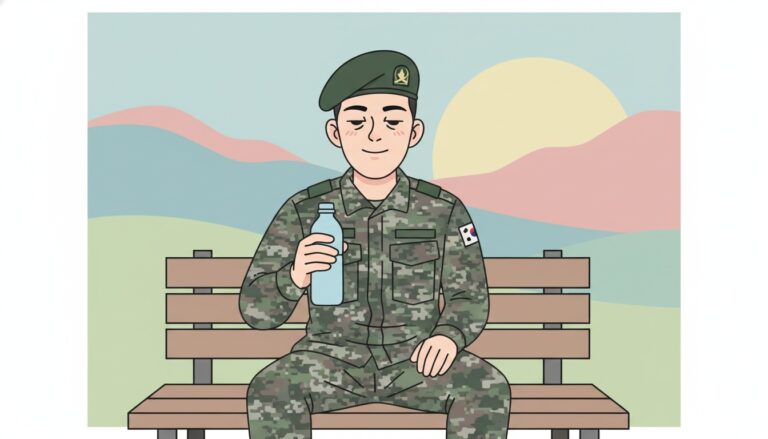
Have you ever watched a K-Drama like D.P. or Descendants of the Sun? Or maybe you have a Korean friend (or an “Oppa”) who just started their mandatory military service.
In Korea, military service (군대, Gundae) is a massive topic. And let’s be honest—when they come out on vacation, 90% of the conversation is about how hard the training was.
If you don’t know how to express or understand this pain, the conversation stops dead. But if you know these phrases, you become an instant insider. You’re not just a foreigner; you’re a “Comrade” (전우, Jeon-u).
Today, based on real questions from my students, we will learn how to complain about military training like a true Korean.
Phase 1: Deep Dive into Core Expressions
Here are the three most common ways to say “It was so hard.”
1. 훈련이 너무 힘들었어요 (The Standard)
- Pronunciation: [Hullyeoni neomu himdeureosseoyo]
- Sound-alike: Hull-yawn-ee nom-oo him-deu-ross-uh-yo
- Meaning: The training was too hard.
- Editor’s Insight: This is the “vanilla” version. It is polite and grammatically perfect. You can use this with anyone—parents, teachers, or strangers.
2. 진짜 죽을 뻔했어요 (The Dramatic Realism)
- Pronunciation: [Jinjja jugeul ppeonhaesseoyo]
- Sound-alike: Jean-jjah joo-geul-ppon-hess-uh-yo
- Meaning: I really almost died.
- Editor’s Insight: This is the gold standard. Koreans love to exaggerate. In the army, a 10km march feels like 100km. Using “Jugeul ppeon” (Almost died) captures that feeling perfectly. It’s safe to use with friends and polite enough (due to ‘yo’) for friendly seniors.
3. 장난 아니었어요 (The “No Joke”)
- Pronunciation: [Jangnan anieosseoyo]
- Sound-alike: Jang-nan-ah-knee-oss-uh-yo
- Meaning: It was no joke / It was insane.
- Editor’s Insight: Use this when you want to emphasize the intensity. It implies, “Words cannot describe how bad it was.”
Phase 2: Textbook vs. Real Life
Textbooks teach you to report facts. Real life is about sharing emotions.
| Textbook Korean 🤖 | Real “Street” Korean 🔥 |
|---|---|
| 훈련이 매우 힘들었습니다. (The training was very difficult.) |
와, 진짜 죽는 줄 알았어요. (Wow, I seriously thought I was dying.) |
| 피곤합니다. (I am tired.) |
온몸이 부서질 것 같아요. (It feels like my whole body is breaking.) |
| 고생했습니다. (You worked hard.) |
고생 많았어, 진짜. (You suffered a lot, seriously.) |
Note: For A2 learners, sticking to “죽을 뻔했어요” is the safest way to sound natural without being rude.
Phase 3: Cultural Context & Manners (Nunchi)
1. The “Gosaeng” Rule
If a Korean soldier says, “It was so hard,” you must validate their suffering. Never say, “Oh, really? That’s nice.” You must say “고생했어요” (You suffered/worked hard). This is basic Korean etiquette.
2. Body Language
When saying “It was hard,” Koreans often:
* Sigh deeply (Haa…)
* Rub their shoulders or neck.
* Shake their head side to side.
If you do this while speaking, your Korean sounds 3x more fluent!
Phase 4: Roleplay Script
Situation: Min-su is on leave from the army, meeting his foreign friend, Alex, at a cafe.
Alex: 민수 씨, 군대 어때요? (Min-su, how is the army?)
[Min-su ssi, gundae eottaeyo?]
Min-su: (Sighing deeply) 하… 말도 마세요. (Haa… Don’t even ask.)
[Haa… maldo maseyo.]
Alex: 왜요? 훈련이 많이 힘들어요? (Why? Is the training very hard?)
[Waeyo? Hullyeoni mani himdeureoyo?]
Min-su: 네, 어제 행군했는데 진짜 죽을 뻔했어요. (Yes, we marched yesterday and I really almost died.)
[Ne, eoje haenggunhaenneunde jinjja jugeul ppeonhaesseoyo.]
Alex: 아이고… 진짜 고생했어요. 맛있는 거 먹으러 가요! (Oh my… You really suffered. Let’s go eat something good!)
[Aigo… jinjja gosaenghaesseoyo. Masinneun geo meogeureo gayo!]
Phase 5: 10-Second Shadowing
Read this aloud to practice your intonation. Pause where you see the /.
“Honestly, / the training / was no joke.”
솔직히, / 훈련 / 장난 아니었어요.
[Soljiki, / hullyeon / jangnan anieosseoyo.]
- Tip: Stress the word 장난 (Jangnan) to emphasize the intensity!
Phase 6: FAQ & Troubleshooting
Q: Can I use “죽을 뻔했어요” to my boss?
A: It depends. If your boss is friendly and asking about your hike over the weekend, yes! But in a formal business report? No. Use “많이 힘들었습니다” (It was very difficult) instead.
Q: What is “Haenggun” (행군)?
A: It means “Marching.” It involves walking 20km-40km with a 20kg bag. It is the number one thing soldiers complain about. Memorize this word!
Phase 7: Wrap-up
One-Liner Summary:
When talking about military training, don’t just say it was hard—say “I almost died” (죽을 뻔했어요) to sound authentic.
Your Mission:
Next time you have a tough day at work or the gym, tell your Korean friend: “오늘 진짜 힘들어서 죽을 뻔했어요.” They will laugh and instantly sympathize with you!
Quiz:
Which phrase is the best response when a soldier says the training was hard?
1. 재미있었겠네요. (Must have been fun.)
2. 고생했어요. (You suffered/worked hard.)
3. 안녕히 가세요. (Goodbye.)
(Check the comments for the answer!)
Frequently Asked Questions (FAQ)
Q: What does "훈련이 너무 힘들었어요 (The Standard)" mean in Korean and how do you pronounce it?
A: In Korean, "훈련이 너무 힘들었어요 (The Standard)" is pronounced [Hullyeoni neomu himdeureosseoyo] and means: a key conversational Korean expression covered in this lesson.
Q: What does "진짜 죽을 뻔했어요 (The Dramatic Realism)" mean in Korean and how do you pronounce it?
A: In Korean, "진짜 죽을 뻔했어요 (The Dramatic Realism)" is pronounced [Jinjja jugeul ppeonhaesseoyo] and means: a key conversational Korean expression covered in this lesson.
Q: What does "장난 아니었어요 (The "No Joke")" mean in Korean and how do you pronounce it?
A: In Korean, "장난 아니었어요 (The "No Joke")" is pronounced [Jangnan anieosseoyo] and means: a key conversational Korean expression covered in this lesson.







