

Phase 1: Introduction
Hello! This is your Lead Editor at Daily Hangul.
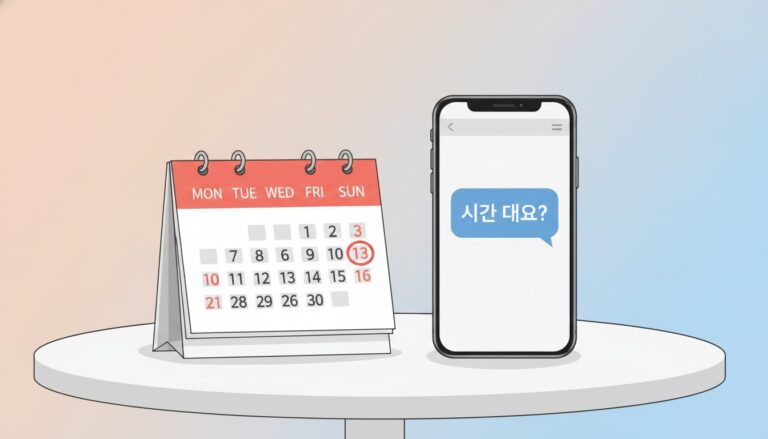
Picture this: You finally met a cool Korean friend at a language exchange meetup. The vibe is great, you share similar interests in K-Pop, and you want to hang out again. You try to say, “Let’s meet next week!” but you stumble, mumble something about “tomorrow,” and they look confused.
Awkward silence. 😅
Scheduling is the lifeline of relationships in Korea. If you can’t nail down a date, that friendship might fade into the dreaded “Let’s eat sometime” (which often means never).
Don’t worry. As a tutor who has seen students accidentally schedule dates for last year, I’ve got you covered. This guide is transparently built on the most common mistakes A1 beginners make when moving from “Hello” to “Let’s hang out.”
Phase 2: Deep Dive (Core Phrases)
Here are the absolute essentials to lock in that plan.
1. 언제 시간 돼요? (When are you free?)
- Pronunciation: [Eon-je si-gan dwae-yo?]
- Eon-je sounds like “On-Jay” (Z).
- Dwae-yo sounds like “Day-yo”.
- Meaning:
- Literal: When time becomes?
- Real Nuance: When are you available? / When works for you?
- Editor’s Insight: This is the magic key. It puts the ball in their court politely. It’s softer than asking “Do you have time?”
- Situation Check: ✅ Casual (Friends) | ✅ Polite (Colleagues/Seniors)
2. 다음 주 (Next week)
- Pronunciation: [Da-eum ju]
- Da-eum sounds like “Da” (dad) + “Eum” (humming sound).
- Ju sounds like “Jew” (jewel).
- Meaning: Next week.
- Editor’s Insight: Beginners often mix up ‘This week’ (I-beon ju) and ‘Next week’ (Da-eum ju). Think of Da as in “Da next one.”
- Situation Check: ✅ Universal
3. [Day] + 에 ([Day] + on/at)
- Pronunciation: [~eh]
- Sounds like “Eh” (as in “Eh, what’s up?”)
- Meaning: The particle that marks time. equivalent to “on” or “at.”
- Editor’s Insight: In English, we say “See you on Monday.” In Korean, it’s “Monday-eh see you.” Don’t eat the particle! It makes your sentence sound complete.
Phase 3: Textbook vs. Real Life
Textbooks are great for exams, but the streets of Seoul are different. Here is how to sound natural.
| Textbook (Robot Vibe 🤖) | Real Life (Insider Vibe 😎) |
|---|---|
| 시간이 있습니까? (Do you have time?) Too stiff. Sounds like an interrogation. |
시간 돼요? (Does time work?) Standard polite. |
| 무슨 요일에 만납니까? (On which day do we meet?) |
언제 볼까요? (When shall we see/meet?) Friendly and proactive. |
| 약속을 잡읍시다. (Let’s make an appointment.) |
다음 주 어때요? (How about next week?) Casual suggestion. |
Note: Since you are A1 (Beginner), sticking to “시간 돼요?” is your safest bet to sound polite yet natural!
Phase 4: Cultural Context & Manners
The “Empty Promise” Trap (K-Culture 101)
In Korea, there is a famous phrase: “밥 한번 먹어요” (Let’s eat together sometime).
- Warning: 80% of the time, this is just a polite “Goodbye,” not a real plan.
- How to tell the difference? If they suggest a specific date (like “Next week Tuesday”), it’s real. If they just say it and wave goodbye, don’t wait by the phone.
The “Calendar Check” Pause
Koreans live on their smartphones. When you ask “When are you free?”, expect a 5-second silence while they open KakaoTalk or their calendar app. Don’t rush them! It’s not an awkward silence; it’s a logistical silence.
Phase 5: Roleplay Script
Setting: A cafe in Hongdae. You (Alex) want to meet your Korean language partner (Min-ji) again.
Characters:
* Alex (You): Eager student.
* Min-ji: Korean friend.
(Alex puts down his coffee cup and looks at Min-ji)
Alex: 민지 씨, 우리 다음 주에 만나요?
(Min-ji ssi, uri da-eum ju-eh man-na-yo?)
Min-ji, shall we meet next week?
Min-ji: 좋아요! 언제 시간 돼요?
(Jo-a-yo! Eon-je si-gan dwae-yo?)
Good! When are you free?
Alex: 저는 금요일에 시간 돼요.
(Jeo-neun geum-yo-il-eh si-gan dwae-yo.)
I am free on Friday.
Min-ji: 오, 저도 돼요! 그럼 금요일에 봐요.
(Oh, jeo-do dwae-yo! Geu-reom geum-yo-il-eh bwa-yo.)
Oh, me too! Then see you on Friday.
Phase 6: 10-Second Shadowing
Practice this sentence until your tongue remembers it. Focus on the pause!
“Are you free next week Friday?”
다음 주 / 금요일에 / 시간 돼요?
[Da-eum ju / Geum-yo-il-eh / si-gan dwae-yo?]
- Tip: Raise your intonation slightly at the end (dwae-yo? ↗) to show it’s a question.
Phase 7: FAQ & Troubleshooting
Q: Can I just say the day without “Next week”?
A: If it’s this coming Friday, yes. But if today is Monday and you mean the Friday of next week, you MUST add 다음 주 (Da-eum ju). Otherwise, they will show up this week!
Q: Can I use this with my boss?
A: Yes, but add “혹시” (Hok-si) at the beginning. “Hok-si… eon-je si-gan dwae-yo?” (By any chance… when are you free?). It makes you sound super polite and considerate.
Phase 8: Wrap-up
- Summary: To set a date, remember: Specific Time (Next week) + Day + eh + Sigan dwae-yo?
- Action Mission: Open your phone calendar right now. Point to next Friday and say out loud: “다음 주 금요일!”
- Question: What is the hardest part about making plans in a foreign language for you? Tell me in the comments!
Phase 9: Quiz
1. How do you say “When are you free?” naturally?
A) bab meogeosseoyo?
B) eon-je si-gan dwae-yo?
C) saranghae
2. Which particle means “at” or “on” for time?
A) Ga (가)
B) Reul (를)
C) Eh (에)
3. If someone says “Let’s eat sometime” without a date, it usually means…
A) They are starving right now.
B) They want to marry you.
C) It’s just a polite goodbye greeting.
(Answers: 1.B, 2.C, 3.C)
Frequently Asked Questions (FAQ)
Q: What does "언제 시간 돼요? (When are you free?)" mean in Korean and how do you pronounce it?
A: In Korean, "언제 시간 돼요? (When are you free?)" is pronounced [Eon-je si-gan dwae-yo?] and means: a key conversational Korean expression covered in this lesson.
Q: What does "다음 주 (Next week)" mean in Korean and how do you pronounce it?
A: In Korean, "다음 주 (Next week)" is pronounced [Da-eum ju] and means: a key conversational Korean expression covered in this lesson.
Q: What does "[Day] + 에 ([Day] + on/at)" mean in Korean and how do you pronounce it?
A: In Korean, "[Day] + 에 ([Day] + on/at)" is pronounced [~eh] and means: a key conversational Korean expression covered in this lesson.







