

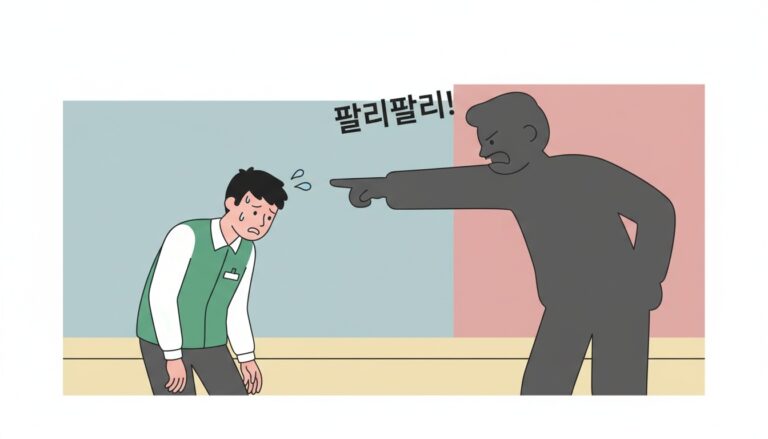
“He threw the receipt at me!” 😱
How to Share Your Worst Part-time Job Stories in Korean
Hello, Daily Hangul family! It’s your Head Editor here.
Today, we are going to talk about something spicy. If you live in Korea or watch K-dramas, you know that working a part-time job (아르바이트 or 알바) is a rite of passage. But let’s be real—not every shift is sunshine and rainbows.
Imagine this: You are drinking soju with your Korean friends. Everyone is sharing stories. You want to tell them about that one customer who made you cry (or angry!) last week, but all you can say is, “The customer was bad.” (손님이 나빴어요.)
Boring, right? And it doesn’t capture your frustration!
To really bond with Koreans, you need to know how to complain with style. Today, I’ll teach you the B1-level expressions to describe those “nightmare customers” vividly. Note: This guide is based on real vents from our students working in cafes and convenience stores in Hongdae!
Phase 1: The “Big 3” Expressions for Bad Customers
These are the words actual Koreans use. Forget the polite textbook vocabulary for a moment.
1. 진상 (Jin-sang)
- Pronunciation:
Jin-sang[Think of the ‘Gin’ in Ginger + ‘Sang’ as in ‘Song’ but with an ‘a’] - Meaning: A nuisance customer; a customer who acts terribly.
- Editor’s Insight: This is the #1 word you must know. It’s not a swear word, but it’s negative. You use this to describe the person or the situation.
- Situation Check: Casual conversation with friends or co-workers. NEVER say this to the customer’s face!
> Ex) 오늘 가게에 진상이 왔어.
> (A total nuisance customer came to the store today.)
2. 갑질하다 (Gap-jil-ha-da)
- Pronunciation:
Gap-jjil-ha-da[The ‘jil’ sounds strong and sharp!] - Meaning: To trip on power; to abuse authority.
- Editor’s Insight: You know the phrase “The customer is King”? When a customer takes that too far and treats staff like servants, that is 갑질. It’s a hot social issue in Korea.
> Ex) 그 손님이 나한테 갑질했어.
> (That customer tripped on their power over me / treated me poorly.)
3. 억지를 부리다 (Eok-ji-reul bu-ri-da)
- Pronunciation:
Eok-ji[Sounds like ‘Awk’ in awkward + ‘Gee’] - Meaning: To be unreasonable; to insist on something that makes no sense.
- Editor’s Insight: Use this when a customer asks for a refund on an empty coffee cup or demands a discount for no reason. It implies they are being stubborn and illogical.
> Ex) 안 된다고 했는데 계속 억지를 부리더라고.
> (I said no, but he kept being totally unreasonable.)
Phase 2: Textbook vs. Real Life (Street Korean)
Let’s upgrade your Korean from “Classroom Robot” to “Local Insider.”
| Textbook / Standard (A2) | Real Life / Natural (B1+) | Why? |
|---|---|---|
| 나쁜 손님이 있었어요. (There was a bad customer.) |
완전 진상이었어. (He was a total nightmare.) |
“Bad” is too simple. Jin-sang carries the emotion. |
| 그 사람은 예의가 없어요. (He has no manners.) |
개념이 없더라고. (He has no ‘concept’/common sense.) |
Gaenyeom (Concept) is slang for having common sense. |
| 화가 났지만 참았어요. (I was angry but I endured.) |
그냥 꾹 참았어. (I just held it in tight.) |
Adding Kkuk (tightly/firmly) emphasizes your struggle. |
Phase 3: Cultural Context & Nunchi 🤫
1. The “Customer is King” (손님은 왕이다) Syndrome
In Korea, service expectations are extremely high. Even if a customer is rude, part-timers are expected to bow and apologize. This is why 뒷담화 (Dwit-dam-hwa)—talking behind someone’s back after work—is such an important bonding culture. It’s how people relieve stress.
2. Non-verbal Cue: The Chest Thump
When describing a Jin-sang customer to a friend, you might see Koreans hitting their own chest with a fist. This gesture means “I am so frustrated and stuffed up inside!” (답답해!). Try doing this while telling your story—your friends will immediately empathize.
Phase 4: Real Life Scenario (Roleplay)
Setting: A convenience store break room. Min-su is venting to his co-worker, Ji-eun.
(Min-su sighs deeply while taking off his apron)
Min-su: 아… 진짜 스트레스 받아.
(Ah… I’m so stressed out.)
Ji-eun: 왜? 아까 그 아저씨 때문에?
(Why? Because of that older man earlier?)
Min-su: 응. 유통기한 지난 우유를 가져와서 환불해 달라고 억지를 부리잖아.
(Yeah. He brought milk that was past the expiration date and insisted unreasonably on a refund.)
Ji-eun: 와, 대박. 완전 진상이네. 그래서 어떻게 했어?
(Wow, crazy. He’s a total Jin-sang. So, what did you do?)
Min-su: 사장님한테 이른다고 갑질하길래, 그냥 죄송하다고 했지 뭐.
(He was power-tripping, saying he’d tell the owner, so I just said sorry.)
Phase 5: 10-Second Shadowing Drill 🗣️
Read this aloud to practice the frustrated intonation. Don’t sound happy! Sound tired.
“아, 진짜… / 말이 안 통하는 / 진상이었어.”
(Ah, seriously… / he was a nightmare customer / who I couldn’t communicate with.)
- Point: Stretch out the “아…” (Ah…) at the beginning to show annoyance.
- Point: Put stress on 진상 (Jin-sang).
Phase 6: FAQ & Troubleshooting
- Q: Can I use “Jin-sang” in front of my boss?
- A: Maybe. If your boss is cool and young, yes. If your boss is older or strict, use “좀 힘든 손님” (a difficult customer) instead. It’s softer.
- Q: Is “Gap-jil” only for customers?
- A: No! It’s used for anyone in power abusing it—bad bosses, rich people in dramas, or even seniors at school.
Phase 7: Wrap-up & Action Mission
Today’s Summary:
We learned how to vent about rude customers using 진상 (Nuisance), 갑질 (Power trip), and 억지 (Unreasonable insistence).
🚀 Your Mission:
Think about a time you met a rude person. Write one sentence in the comments describing them using today’s words!
(Ex: My boss did Gap-jil yesterday!)
Pop Quiz! 📝
- Which word best describes a customer who demands a refund for a coffee they already drank?
A) 천사 (Angel)
B) 진상 (Jin-sang)
C) 사장 (Boss) -
What does “갑질” (Gap-jil) mean?
A) Giving a big tip
B) Being very polite
C) Abusing power/authority -
(Fill in the blank) “The customer kept being unreasonable.” -> 손님이 계속 ( )를 부렸어.
A) 억지
B) 김치
C) 눈치
(Scroll down for answers)
Click to see answers
1. B, 2. C, 3. A
Frequently Asked Questions (FAQ)
Q: What does "뒷담화" mean in Korean and how do you pronounce it?
A: In Korean, "뒷담화" is pronounced [Dwit-dam-hwa] and means: —talking behind someone's back after work—is such an important bonding culture. It's how people relieve stress.







