

Phase 1: Panic at the Desk
Hello! Daily Hangul Editor here.
Let’s be honest. The scariest thing in a Korean office isn’t the boss. It isn’t the spicy lunch menu. It’s that half-second when the office phone rings, you look around, and realize you are the only one there.
Your heart drops. You know you have to pick it up. But what if they speak fast? What if they use complex honorifics? I had a student, Mark, who actually hid under his desk once to avoid answering the phone. We laughed about it later, but at the moment? Pure terror.
Today, I’m giving you the “panic button” phrases. You don’t need to be fluent. You just need to know how to take a simple message without sweating through your shirt. Let’s fix this.
Phase 2: The “Life-Saver” Phrases
Here are the three phrases that will get you through 90% of phone calls.
1. 지금 자리에 안 계세요.
- Pronunciation: [Ji-geum ja-ri-e an gye-se-yo] -> Jee-geum (like ‘gum’) ja-ree-eh ahn (like ‘on’) kyeh-seh-yo.
- Meaning: (Literal) They are not at the seat now. / (Real) He/She is unavailable.
- Editor’s Insight: This is your shield. It doesn’t matter if your boss is in the bathroom, at lunch, or hiding under their desk like Mark. You just say this. It’s polite and vague enough to work for everything.
- Situation: Formal (Standard polite).
2. 메모 남겨 드릴까요?
- Pronunciation: [Me-mo nam-gyeo deu-ril-kka-yo?]
- Meaning: Shall I leave a memo for you?
- Editor’s Insight: This makes you look incredibly professional (even if you understood nothing else the caller said). It shifts the burden. instead of you trying to memorize a complex message, you are offering to write something down. Usually, they’ll just say, “No, I’ll call back.”
- Situation: Professional / Polite.
3. 다시 전화해 주세요.
- Pronunciation: [Da-si jeon-hwa-hae ju-se-yo]
- Meaning: Please call again.
- Editor’s Insight: Use this when you are panicked. If the caller is speaking too fast or asking complicated questions, just combine #1 and #3: “He’s not here. Please call again.” It shuts down the conversation politely.
- Situation: Standard polite.
Phase 3: Textbook vs. Real Life
Textbooks make you sound like a robot. Here is how actual people talk in Seoul offices.
| Textbook (Stiff) | Real Life (Natural) |
|---|---|
| 잠시만 기다려 주십시오. (Please wait a moment.) | 잠시만요! (Just a sec! – Polite but quick) |
| 누구십니까? (Who are you?) | 어디세요? (Where are you [calling from]? – Much softer) |
| 메모를 하시겠습니까? (Would you like to do a memo?) | 메모 남겨 드릴까요? (Shall I leave a note for them?) |
Note: Asking “Who are you?” (누구세요?) to a client is considered rude. Asking “Where are you?” (어디세요?) implies “Which company are you calling from?” and is the standard way to ask for identity.
Phase 4: The Art of the “Post-it”
Taking a message in Korea isn’t just about words; it’s about Nunchi (reading the room).
If you take a message, do not just scribble it on a scrap of paper and leave it on a cluttered desk. That memo will disappear, and so will your reputation.
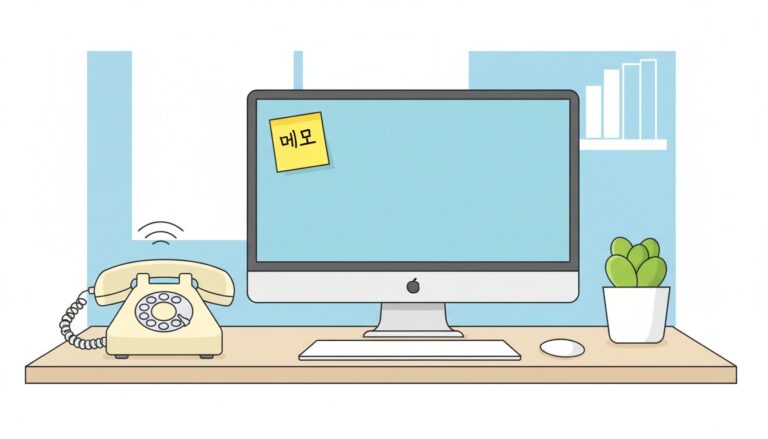
- Use a Yellow Post-it: Stick it on the monitor, not the desk. The monitor is sacred space.
- The “White Lie”: Even if your coworker is smoking outside or in the restroom, we usually tell callers: “잠시 회의 중이세요” (He is in a meeting for a moment) or “자리를 비우셨어요” (He emptied his seat / is away). We rarely say exactly where they went unless it’s lunch.
Phase 5: Roleplay – The 2 PM Panic
Setting: An office in Gangnam. You are alone. The phone rings.
Caller (Client): 안녕하세요, 김철수 부장님 계신가요? (Hello, is Manager Kim Cheol-su there?)
You: 아, 죄송하지만 지금 자리에 안 계세요. (Ah, I’m sorry, but he is not at his seat right now.)
Caller (Client): 그래요? 언제 들어오시나요? (Really? When is he coming back?)
You: (Looking at the clock, unsure) 정확히 모르겠어요… 메모 남겨 드릴까요? (I don’t know exactly… Shall I take a message?)
Caller (Client): 아니요, 제가 다시 전화할게요. (No, I will call again.)
You: 네, 알겠습니다. (Okay, understood.)
Phase 6: 10-Second Shadowing
Don’t just read it. Say it out loud until your mouth remembers the shape.
죄송하지만 / 지금 / 자리에 / 안 계세요.
(I’m sorry but / now / at seat / [he] is not here.)
Key Point: Raise your tone slightly at “세요” to sound softer. A flat tone sounds angry.
Phase 7: FAQ
Q: Can I just say “No” (아니요) if they ask for someone?
A: No! That sounds like you are rejecting the caller personally. Always start with “죄송하지만…” (I’m sorry, but…) or “지금은…” (Right now…).
Q: What if I didn’t hear the caller’s name?
A: Just ask: “성함이 어떻게 되세요?” (What is your name? – Honorific). If that’s too hard for A2 level, just fall back on “메모 남겨 드릴까요?” and hope they repeat it.
Phase 8: Wrap-up & Mission
Summary: When the phone rings, don’t panic. Tell them the person isn’t there, offer to write a memo, and stick it on the monitor.
Mission: Tomorrow at work (or school), write a Post-it note for a friend/colleague in Korean: “전화 왔었어요” (A call came). Stick it on their screen. See if they smile.
Tell me in the comments: Have you ever hung up on someone because you were too scared to speak Korean? (I won’t judge, I promise).
Phase 9: Pop Quiz
- Your boss is in the restroom. The phone rings. What is the BEST thing to say?
a) “He is in the toilet.”
b) “He went home.”
c) “Right now, he is not at his seat.” -
How do you politely ask who is calling?
a) 누구야? (Who are you?)
b) 어디세요? (Where are you?)
c) 이름이 뭐예요? (What is your name?) -
Where do you stick the urgent memo?
a) Under the keyboard
b) On the computer monitor
c) In the trash can
Click to see answers
1. c
2. b
3. b
Frequently Asked Questions (FAQ)
Q: What does "지금 자리에 안 계세요." mean in Korean and how do you pronounce it?
A: In Korean, "지금 자리에 안 계세요." is pronounced [Ji-geum ja-ri-e an gye-se-yo] and means: (Literal) They are not at the seat now. / (Real) He/She is unavailable.
Q: What does "메모 남겨 드릴까요?" mean in Korean and how do you pronounce it?
A: In Korean, "메모 남겨 드릴까요?" is pronounced [Me-mo nam-gyeo deu-ril-kka-yo?] and means: Shall I leave a memo for you?
Q: What does "다시 전화해 주세요." mean in Korean and how do you pronounce it?
A: In Korean, "다시 전화해 주세요." is pronounced [Da-si jeon-hwa-hae ju-se-yo] and means: Please call again.







