Phase 1: Introduction
Hello! This is your editor from Daily Hangul.
Imagine this: It’s Friday night. You’ve had a long week, you’ve just washed your face, and you are wearing your most comfortable (but arguably least fashionable) pajamas. You order some Chi-maek (Chicken & Beer), but then realized… the delivery rider is going to ring the bell, and you have to open the door face-to-face.
Panic mode, right?
Don’t worry. In Korea, “Contactless Delivery” (비대면 수령) is not just a COVID-19 relic; it’s a standard part of the culture. It’s convenient, safe, and saves you from awkward social interactions when you just want to eat.
Today, we will learn how to politely ask the rider to leave the food at your door without sounding rude. This is a B2 (Intermediate) level guide, so we will look beyond simple phrases and focus on the natural flow used by locals.
Phase 2: Deep Dive into Key Expressions
Here are the three most crucial phrases you need for the “Delivery Request” box in your app (Baemin, Yogiyo, Coupang Eats).
1. 문 앞에 두고 가 주세요.
- Pronunciation: Mun a-pe du-go ga ju-se-yo
- “Du-go” sounds like “Do” + “Go”.
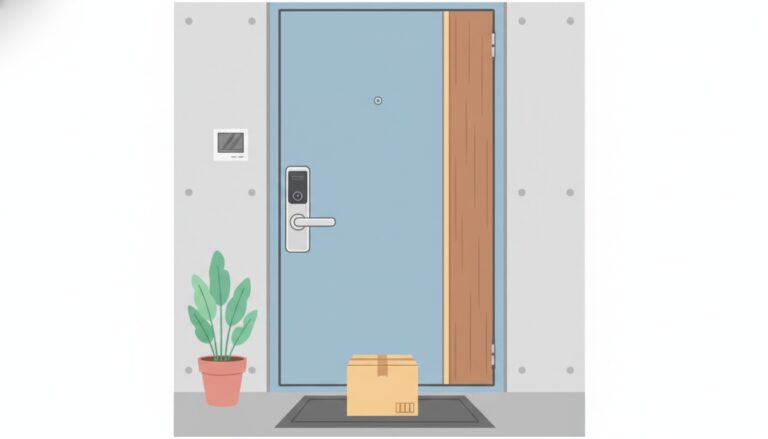
- Meaning: Please leave it in front of the door (and go).
- Editor’s Insight: This is the gold standard. Notice the compound verb 두고 가다 (to put down and leave). If you just say “문 앞에 있어요” (It is in front of the door), it sounds like you are describing a location, not making a request. Adding “가다” (to go) implies the action is finished and the rider can leave.
- Situation Check: Perfect for delivery apps or intercom requests. Formal and polite.
2. 벨 누르지 말고 노크해 주세요.
- Pronunciation: Bel nu-reu-ji mal-go no-keu-hae ju-se-yo
- “Neu” implies a sound similar to the ‘u’ in ‘put’, but with a wider mouth.
- Meaning: Please don’t ring the bell, just knock instead.
- Editor’s Insight: The grammar point -ji malgo (do not A, but do B) is key here. Korean apartments often have very loud intercoms. If you have a sleeping baby, a sensitive dog, or just hate loud noises, this is your lifesaver.
- Situation Check: Very common request. Riders appreciate specific instructions.
3. 도착하면 문자 주세요.
- Pronunciation: Do-cha-ka-myeon mun-ja ju-se-yo
- Meaning: Please text me when you arrive.
- Editor’s Insight: We use 문자 (text message) even though most notifications come through the app these days. It’s a set phrase. It ensures your food doesn’t sit out in the cold for too long because you didn’t hear the knock.
Phase 3: Textbook vs. Real Life
Let’s compare how a textbook teaches this versus how my friends actually type in the delivery app.
| Textbook Korean (Formal & Stiff) | Real Life Korean (Natural & Efficient) |
|---|---|
| 배달 음식을 문 앞에 놓아주십시오. (Please place the delivery food in front of the door.) |
문 앞에 놔주세요. (Just leave it at the door. – Contraction of 놓아 -> 놔) |
| 초인종을 누르지 마세요. (Do not press the doorbell.) |
벨 X, 노크 O (Bell X, Knock O – Written style for App requests) |
| 공동 현관 비밀번호는 1234입니다. (The common entrance password is 1234.) |
비번: 1234 호출 누르지 마세요. (PW: 1234. Don’t press call.) |
Note: At the B2 level, using contractions like 놔주세요 (instead of 놓아주세요) makes you sound much more native.
Phase 4: Cultural Context & Manners
1. The “Trust” Culture
Foreigners are often shocked that Koreans leave expensive packages and hot food in hallways for hours. Theft is extremely rare. Don’t be afraid to use “문 앞에 두세요” (Leave it at the door). It will be there when you open it.
2. The “Ppalli-Ppalli” (Hurry-Hurry) Factor
Delivery riders are paid per delivery and are always in a rush. They prefer clear, short instructions. If you write a long, polite essay in the request box, they might not have time to read it while driving.
* Bad: 기사님, 오시느라 수고 많으셨습니다. 혹시 괜찮으시다면 벨은 누르지 마시고… (Too long!)
* Good: 벨 X, 문 앞에 놔주세요. (Perfect.)
Phase 5: Roleplay Script
Setting: You live on the 5th floor. The rider buzzes the building intercom (Interphone).
- Rider: (Buzzer sounds) 배달이요! (Delivery!)
- You: 네! 문 앞에 두고 가 주시겠어요?
- (Ne! Mun a-pe du-go ga ju-si-ge-sseo-yo?)
- (Yes! Could you please leave it in front of the door and go?)
- Rider: 네, 알겠습니다.
- (Ne, al-get-seum-ni-da.)
- (Yes, understood.)
- You: 감사합니다. 조심히 가세요!
- (Gam-sa-ham-ni-da. Jo-sim-hi ga-se-yo!)
- (Thank you. Get home safe/Drive safe!)
Acting Tip: Even through the intercom, keep your voice bright. “조심히 가세요” is a warm phrase used for someone leaving your space.
Phase 6: 10-Second Shadowing
Read this out loud to practice your intonation. Pause at the / marks.
“혹시 / 벨 누르지 마시고 / 문 앞에 / 두고 가 주실 수 있나요?”
- Meaning: By any chance / could you not ring the bell / and leave it in front of the door / for me?
- Focus: Raise your tone slightly at the end (~나요?) to sound polite and requesting, not demanding.
Phase 7: FAQ & Troubleshooting
- Q: Can I say “던져 주세요” (Please throw it)?
- A: Absolutely not! Even if you are joking. It sounds aggressive. Stick to 두고 가세요 (Leave it).
- Q: Do I need to tip the rider?
- A: No. Tipping culture does not exist in Korea for delivery. You pay the delivery fee (배달비) in the app, and that is sufficient.
- Q: What if the rider calls me because they can’t find the house?
- A: Don’t panic. Say: “문자로 주소 다시 찍어 드릴게요.” (I will text you the address again.) It’s easier than trying to give directions verbally over a noisy phone connection.
Phase 8: Wrap-up & Action Item
One-Liner Summary: To enjoy contactless delivery, remember “문 앞에 두고 가 주세요” (Leave it at the door) and keep your instructions short for the busy rider.
Your Mission: Next time you order food or receive a Coupang package, check the “Delivery Request” (배달 요청사항) box. If it’s empty, try typing: “부재 시 문 앞에 놔주세요” (If I’m not here, please leave it at the door).
Let’s Chat: Have you ever had a funny misunderstanding with a delivery rider in Korea? Tell me in the comments!
Phase 9: Quiz
1. Which request is rude or unnatural to write in the delivery app?
A) 문 앞에 놔주세요.
B) 벨 누르지 말아 주세요.
C) 음식 던지고 가세요.
2. How do you say “Please text me when you arrive”?
A) 도착하면 전화 주세요.
B) 도착하면 문자 주세요.
C) 도착하면 소리 질러 주세요.
3. Which verb compound implies “Leave it and go”?
A) 가지고 오다
B) 두고 가다
C) 먹고 가다
Click to see answers
1. C (Please throw the food and go – Very rude!)
2. B
3. B
Frequently Asked Questions (FAQ)
Q: What does "문 앞에 두고 가 주세요." mean in Korean and how do you pronounce it?
A: In Korean, "문 앞에 두고 가 주세요." is pronounced [Mun a-pe du-go ga ju-se-yo] and means: a key conversational Korean expression covered in this lesson.
Q: What does "벨 누르지 말고 노크해 주세요." mean in Korean and how do you pronounce it?
A: In Korean, "벨 누르지 말고 노크해 주세요." is pronounced [Bel nu-reu-ji mal-go no-keu-hae ju-se-yo] and means: a key conversational Korean expression covered in this lesson.
Q: What does "도착하면 문자 주세요." mean in Korean and how do you pronounce it?
A: In Korean, "도착하면 문자 주세요." is pronounced [Do-cha-ka-myeon mun-ja ju-se-yo] and means: Please text me when you arrive.