

Phase 1: Introduction
Hello! This is your Daily Hangul Editor. 👋
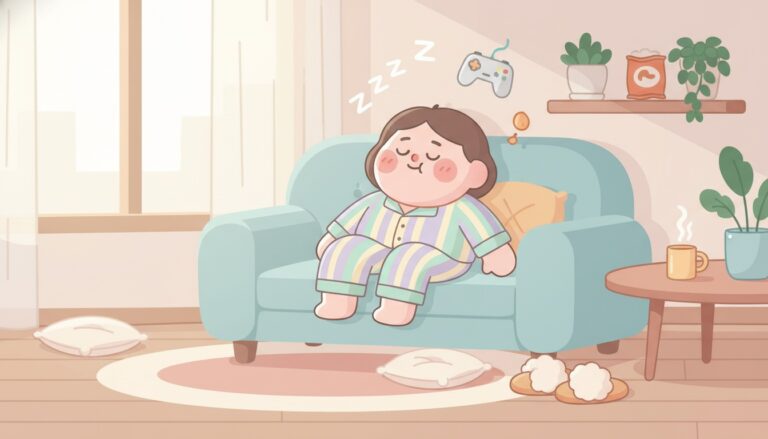
Imagine this: It’s a rainy Sunday morning. You have a pile of laundry to do, and your Korean textbook is staring at you from the desk. But your blanket is so warm, and Netflix just released a new K-Drama.
Your Korean friend texts you: “Hey, want to go hiking?”
You want to say, “No way, I’m too lazy today.”
If you look up “lazy” in the dictionary, you’ll find 게을러요 (Ge-eul-leo-yo). But wait! If you say this, you might be calling yourself a bad person with a character flaw. In Korea, admitting you are feeling lazy is an art form. You want to sound relatable, not like a sinner!
Today, I’ll teach you how to express that “I-don’t-want-to-move” feeling just like a local. This guide is based on real mistakes my A1 students have made, so you don’t have to make them.
Phase 2: Deep Dive (Core Expressions)
Here are the top 3 ways to express laziness or the desire to do nothing.
1. 게을러요 (Ge-eul-leo-yo)
- Pronunciation:
Ge-eul-leo-yo[Sounds like: Get-without-t + ul + luh + yo]- Meaning: I am lazy (by nature).
- Editor’s Insight: This is the direct dictionary translation. Be careful! It describes a personality trait, not just a temporary feeling. If you say this, you are saying, “I am a lazy person in general.”
- Situation Check: Casual ✅ | Formal ⚠️ (Don’t describe yourself this way in an interview!)
2. 귀찮아요 (Gwi-cha-na-yo) ✨ Golden Expression
- Pronunciation:
Gwi-cha-na-yo[Sounds like: Gwee (like squee) + cha + na + yo]- Meaning: It’s a hassle / I can’t be bothered.
- Editor’s Insight: Memorize this. When Koreans feel “lazy” to do something specific (like washing dishes or going out), we don’t say we are lazy. We say the action is Gwichanayo. It means, “I physically could do it, but I mentally don’t want to.”
- Situation Check: Casual ✅ | Formal ❌ (Never say this to your boss when given work!)
3. 집순이 / 집돌이 (Jip-sun-i / Jip-dol-i)
- Pronunciation:
Jip-sun-i(for females) /Jip-dol-i(for males)- Meaning: Homebody.
- Editor’s Insight: This isn’t a verb, but a noun. If you love staying home instead of going out, you can proudly introduce yourself as a Jip-sun-i. It’s a cute way to justify your laziness!
- Situation Check: Casual ✅ | Light Formal ✅
Phase 3: Textbook vs. Real Life
Let’s see how a robot talks versus how a Hongdae hipster talks.
| Textbook Korean 🤖 | Real Korean 🇰🇷 |
|---|---|
| 저는 게으른 사람입니다. (Jeoneun ge-eul-eun saram-imnida) “I am a lazy person.” |
아, 만사 귀찮아. (Ah, mansa gwichana) “Ah, everything is a hassle.” |
| 등산은 하고 싶지 않아요. (Deungsan-eun hago sipji anayo) “I do not want to hike.” |
나가기 귀찮아요. (Nagagi gwichanayo) “Going out is a bother.” |
💡 Bottom Note: For A1 beginners, strictly sticking to “귀찮아요” (Gwichanayo) is the safest and most natural way to refuse a plan because you’re feeling lazy.
Phase 4: Cultural Context & Manners
1. The “Ppalli-Ppalli” vs. “Gwichanism”
Korea is famous for its Ppalli-Ppalli (Hurry Hurry) culture. Because everyone works so hard, the desire to do absolutely nothing is a shared fantasy. There is even a slang word called 귀차니즘 (Gwichanism)—a combination of ‘Gwichanayo’ and ‘Ism’. It’s the philosophy of being lazy. Admitting you have “Gwichanism” today makes you very relatable.
2. Manners (Nunchi)
If a friend invites you out, don’t just say “No, I’m lazy.” That hurts feelings.
* Bad: “No. I’m lazy.” 🙅♀️
* Good: “Sorry, I’m so tired today. Everything is Gwichanayo… Next time?” 🙆♀️
Phase 5: Real-Life Scenario
Setting: Sunday afternoon. Your Korean friend, Minji, calls you.
- Minji: 날씨 좋다! 한강 갈래? (The weather is nice! Wanna go to Han River?)
- You (Alex): 음… 아니요. (Umm… No.)
(Sounding sleepy) - Minji: 왜? 아파? (Why? Are you sick?)
- You (Alex): 아니요, 그냥 다 귀찮아요. (No, just everything is a hassle.)
- Minji: ㅋㅋㅋ 알았어. 쉬어~ (Lol okay. Rest well~)
Acting Tip: When saying “귀찮아요,” stretch the vowels slightly and drop your shoulders to look truly unmotivated. “Gwi-cha-na-yooo…”
Phase 6: 10-Second Shadowing
Let’s practice the magic phrase. Read this aloud while sighing deeply.
“Today, I don’t want to do anything.”
오늘은 / 아무것도 / 안 할래요.
[ O-neul-eun / a-mu-geot-do / an hal-lae-yo ]
- Intonation: Stress ‘O-neul’ (Today) and ‘An’ (Not).
- Pause: Take a deep breath after ‘O-neul-eun’.
Phase 7: FAQ & Troubleshooting
Q: Can I use “Gwichanayo” to my Korean teacher if I didn’t do homework?
A: NO! 🚨 That implies you didn’t do the homework because you felt it was annoying/pointless. Instead, say “Too busy” (바빴어요 – Ba-ppas-seo-yo) or “It was hard” (어려웠어요 – Eo-ryeo-wos-seo-yo).
Q: Is “Ge-eul-leo-yo” (Lazy) a bad word?
A: It’s not a curse word, but it’s negative. You usually don’t want to label yourself or others as “lazy” unless you are joking.
Phase 8: Wrap-up
One-Liner Summary: Don’t say you are a lazy person (Identity); say the action is annoying/hassle (State of mind) using “귀찮아요 (Gwichanayo).”
🔥 Today’s Mission: Next time you are on the sofa and someone asks you to pass the remote control, sigh and say: “아… 귀찮아요.” (But please pass it eventually!)
Question for you: What is the one thing you are too “lazy” (Gwichana) to do today? Tell me in the comments!
Phase 9: Pop Quiz
- Which word means “It’s a hassle/I can’t be bothered”?
a) 예뻐요 (Ye-ppeo-yo)
b) 귀찮아요 (Gwi-cha-na-yo)
c) 빨라요 (Ppal-la-yo) -
How do you call a girl who loves staying at home?
a) 집순이 (Jip-sun-i)
b) 집돌이 (Jip-dol-i)
c) 게으름 (Ge-eul-eum) -
Can you say “Gwichanayo” to your boss?
a) Yes, honesty is best.
b) No, you might get fired.
(Answers: 1-b, 2-a, 3-b)
Frequently Asked Questions (FAQ)
Q: What does "게을러요 (Ge-eul-leo-yo)" mean in Korean and how do you pronounce it?
A: In Korean, "게을러요 (Ge-eul-leo-yo)" is pronounced [Ge-eul-leo-yo [Sounds like: Get-without-t + ul + luh + yo] and means: I am lazy (by nature).
Q: What does "귀찮아요 (Gwi-cha-na-yo) ✨ Golden Expression" mean in Korean and how do you pronounce it?
A: In Korean, "귀찮아요 (Gwi-cha-na-yo) ✨ Golden Expression" is pronounced [Gwi-cha-na-yo [Sounds like: Gwee (like squee] and means: It’s a hassle / I can't be bothered.
Q: What does "집순이 / 집돌이 (Jip-sun-i / Jip-dol-i)" mean in Korean and how do you pronounce it?
A: In Korean, "집순이 / 집돌이 (Jip-sun-i / Jip-dol-i)" is pronounced [Jip-sun-i (for females] and means: Homebody.







