

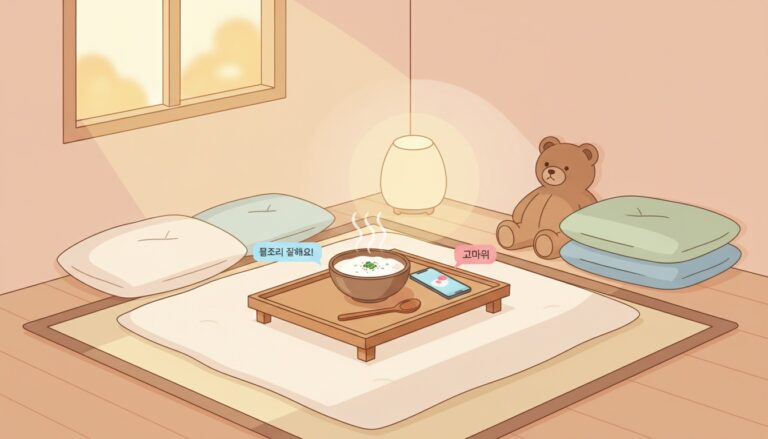
Phase 1: The Porridge Protocol (Immersive Hook)
Hello there! It’s your Daily Hangul editor.
Let’s set the scene. You’ve seen this in at least five K-Dramas. The main character catches a cold (usually after standing in the rain waiting for someone). The next day, their love interest shows up at their door with a white plastic bag. Inside? Bonjuk (branded rice porridge).
They set the table, look at the sick person with puppy eyes, and say one magical phrase.
In English subtitles, it often just reads “Rest well.” But the Korean feeling is much warmer, heavier, and more caring. If you just translate “Rest well” literally, you might sound like a robotic doctor. But if you learn the expressions we’re covering today, you’ll sound like that caring friend (or potential love interest) who actually knows how to comfort someone in Seoul style.
I’ve seen my students struggle with this. They want to show they care, but they end up saying nothing because they don’t know the polite way to tell someone to “stop working and go to sleep.”
Let’s fix that today.
Phase 2: Deep Dive into Caring Expressions
Here are the three ways to tell someone to take a break, ranked by how serious the situation is.
1. 푹 쉬세요 (Puk swiseyo)
- Pronunciation: [Pook swee-seh-yo]
(Tip: ‘Puk’ sounds like the sound a heavy body makes when collapsing into a soft mattress—POOF!)- Meaning: Please rest deeply/completely.
- K-Culture Moment: This is the standard “Good night” or “Get well” message. It implies, “Turn off your brain, put down your phone, and just sleep.”
- Editor’s Insight: The word ‘푹 (puk)’ is an adverb meaning ‘completely’ or ‘deeply.’ We don’t just say “Rest (쉬세요).” That sounds like a command. Adding “Puk” makes it sound like you want them to recharge 100%.
- Situation Spectrum:
[🚫 Formal/Boss] ———— [✅ Semi-formal] ———— [✅ Friends]
(Note: For close friends, drop the ‘yo’: “푹 쉬어!”)- 🤔 Think About It: In English, you might say “Take it easy.” Why do you think Koreans emphasize the depth (puk) of the rest rather than the ease of it?
2. 무리하지 마세요 (Murihaji maseyo)
- Pronunciation: [Moo-ree-ha-jee ma-seh-yo]
- Meaning: Don’t overdo it / Don’t push yourself too hard.
- K-Culture Moment: You’ll hear this in office dramas when a dedicated employee is working late despite coughing. The sympathetic manager will tap their shoulder and say this.
- Editor’s Insight: ‘무리 (Muri)’ means ‘unreasonable’ or ‘impossible.’ You are literally saying, “Don’t do the impossible.” It acknowledges that they are working hard, but you are worried about their health.
- Situation Spectrum:
[⚠️ Boss] ———— [✅ Colleagues] ———— [✅ Friends]3. 아프지 마세요 (Apeuji maseyo)
- Pronunciation: [Ah-peu-jee ma-seh-yo]
- Meaning: Don’t be sick.
- K-Culture Moment: K-Pop idols say this to fans all the time! “Our fans, don’t be sick!” (우리 팬들, 아프지 마세요!)
- Editor’s Insight: Grammatically, it’s a command (“Do not be sick”). Logically, you can’t control being sick. But emotionally? It means “Seeing you sick hurts my heart, so please get better for my sake.”
- Situation Spectrum:
[🚫 Strangers] ———— [✅ Idols/Fans] ———— [✅ Close Relations]
Phase 3: Textbook vs. Real Life
Let’s look at how actual Koreans text each other vs. what the books say.
| Situation | 📖 Textbook Korean | 🗣️ Real Korean (Text/Slang) | 💡 Why the difference? |
|---|---|---|---|
| To a friend with a cold | 빨리 낳으세요. (Please recover quickly.) | 얼른 나아! ㅠㅠ (Get better fast! crying emoji) | ‘낳으세요’ is a common spelling mistake even Koreans make (it means ‘give birth’!). The correct grammar is ‘나으세요’, but friends use casual speech + emojis. |
| Leaving work early | 안녕히 계세요. (Goodbye/Stay in peace.) | 저 먼저 가보겠습니다. 내일 봬요! (I’m leaving first. See you tomorrow!) | “Goodbye” feels like you’re leaving forever. “See you tomorrow” is the standard office exit. |
| Declining a drink when sick | 저는 아파서 술을 못 마셔요. (I cannot drink because I am sick.) | 저 오늘 컨디션이 좀 안 좋아서요… (My condition isn’t great today…) | Koreans rarely say direct “No.” Blaming your “condition” is the polite, indirect excuse. |
Bottom Note: For A2 learners, sticking to “푹 쉬세요” is the safest bet. It works for almost everyone.
Phase 4: Cultural Context — The “Juk” (Porridge) Theory
4-1. Non-verbal: The “Gifticon” Culture
In Korea, if you hear someone is sick, you don’t just say “Get well soon.” That’s considered a bit… empty.
We send a Gifticon (mobile voucher) via KakaoTalk. Usually for:
1. Juk (Porridge): Easy to digest.
2. Vitamin drinks: For energy.
3. Chicken: Because chicken cures everything (jokes, but kinda true).
If you can’t visit, sending a virtual porridge coupon says, “I am feeding you because I care.”
4-2. K-Food Connection: Why Porridge?
In the West, you might have chicken noodle soup. In Korea, it’s Juk (죽). Specifically, ‘Bonjuk’ is so ubiquitous it’s basically the headquarters of sick people. If you buy generic porridge from a convenience store (2+1 sale!), it’s casual. If you buy premium Abalone Porridge (전복죽), you really love that person.
Phase 5: Immersive Roleplay
Setting: It’s Tuesday, 2 PM. Your Korean coworker, Minji, looks pale and keeps coughing. The office is quiet.
Characters:
* YOU: A caring foreign colleague.
* Minji: Hardworking Korean coworker who hates causing trouble.
Dialogue:
YOU: 민지 씨, 괜찮아요? 얼굴이 안 좋아요.
(Minji-ssi, gwaenchannayo? Eolguri an joayo.)
(Minji, are you okay? Your face [color] doesn’t look good.)
Minji: 아, 그냥 감기예요. 괜찮아요. 😷
(Ah, geunyang gamgiyeyo. Gwaenchannayo.)
(Ah, it’s just a cold. I’m fine.)
YOU:
(Wait, she doesn’t look fine. What do you say?)
🔀 Your Turn! Pick your response:
* A) “집에 가세요!” (Go home!)
* B) “무리하지 마세요. 약은 먹었어요?” (Don’t overdo it. Did you take medicine?)
* C) “저랑 병원 가요.” (Let’s go to the hospital with me.)✅ Best Choice: B.
* Why? Option A is too direct (unless you are the boss). Option C is too dramatic for a simple cold. Option B shows concern without being pushy.
Minji: 네, 아까 먹었어요. 걱정해 줘서 고마워요.
(Yes, I took it earlier. Thanks for worrying.)
YOU: 오늘 퇴근하고 푹 쉬세요.
(Oneul toegeunhago puk swiseyo.)
(Please rest completely after work today.)
Phase 6: 10-Second Shadowing Drill
Let’s practice the perfect caring tone. Don’t say it like a robot! warm voice, slightly lower pitch.
The Sentence:
😟 너무 걱정하지 말고 / 푹~~~ 쉬세요.
(Neomu geokjeonghaji malgo / puuuuk~~~ swiseyo.)
Don’t worry too much, and just reeest.
- Intonation: Stress the ‘Puk’. Make it sound long and relaxing.
- Feeling: Imagine tucking a child into bed.
Phase 7: K-Culture Mini Glossary
| Korean | Romanization | Meaning | Context |
|---|---|---|---|
| 몸조리 | Momjori | Health care/recovery | Usually used for serious illness or postpartum care. “몸조리 잘하세요.” |
| 몸보신 | Mombosin | Body restoration | Eating healthy/energy food (like Samgyetang) to restore strength. |
| 링거 | Ring-geo | IV Drip | In K-Dramas, people go to the hospital just to get an IV drip for fatigue. It’s very common! |
| 눈치 | Nunchi | Social intuition | If everyone is working, you need ‘nunchi’ to leave early, even if you are sick. |
Phase 8: Traveler’s Survival Kit (Pharmacy Edition)
If YOU are the one who needs to rest while traveling in Korea, you need to find a 약국 (Yakguk – Pharmacy). They are everywhere and have a big “약” sign.
🆘 Survival Phrases
* 🇰🇷 “감기약 주세요.” (Gamgi-yak juseyo)
* 🗣️ Meaning: Please give me cold medicine.
* 🇰🇷 “몸살이에요.” (Momsarieyo)
* 🗣️ Meaning: I have body aches/fatigue. (Use this if you feel tired and achy but don’t have a cough).
* 🇰🇷 “졸리지 않은 약으로 주세요.” (Jolliji aneun yageuro juseyo)
* 🗣️ Meaning: Please give me non-drowsy medicine. (Crucial if you want to keep traveling!)📌 Editor’s Travel Note:
Korean cold medicine can be surprisingly strong. If the pharmacist gives you three pills in a little paper packet, just take them with water. Don’t ask too many questions; they work like magic.
Phase 9: Think Deeper — The “Burnout” Badge
Thinking about Language & Culture:
Have you noticed that “You look tired” can sometimes be a compliment in Korea? It implies, “Wow, you are working so hard.”
In many Western cultures, looking tired means you aren’t managing your health well. But in Korea’s high-pressure society, burning out was historically seen as a badge of honor—proof of your dedication to the group.
That’s why saying “무리하지 마세요” (Don’t overdo it) is such a powerful phrase. It challenges that norm. It tells the other person, “Your health is more important to me than your output.”
💬 Your Turn: In your country, if you leave work early because you have a cold, do people think you are responsible (for not spreading germs) or lazy? How does that compare to what you see in K-Dramas?
Phase 10: FAQ & Troubleshooting
Q: Can I say “푹 쉬세요” to my boss?
A: YES! It is polite enough. However, if you want to be extra respectful to a much older person or high-ranking boss, use: “편히 쉬십시오” (Pyeonhi swisipsio) – “Rest comfortably.” But honestly? “푹 쉬세요” works 95% of the time.
Q: What if I don’t know exactly what sickness they have?
A: Just use “쾌차하세요” (Kwae-cha-ha-se-yo). It sounds a bit formal, like “Wishing you a speedy recovery.” It’s perfect for a polite text message to a colleague you aren’t very close with.
❌ Common Mistake:
Don’t say “Sleep well” (잘 자요) to a sick person in the middle of the day. It sounds like you are ending the conversation abruptly. Stick to “Rest well” (쉬세요).
Phase 11: Wrap-up & Mission
One-Liner Summary:
When someone is sick, add “Puk” (Deeply) before “Rest” to show you really care.
🚀 Action Mission:
- 🥉 Bronze: Look in the mirror and practice the sympathetic face while saying “무리하지 마세요.”
- 🥈 Silver: Next time you see a tired cashier or waiter in Korea (or a K-restaurant), say “수고하세요” (Keep up the good work) warmly.
- 🥇 Gold: Find a friend who is studying or working hard. Send them a text: “오늘 너무 무리하지 말고 푹 쉬어!” (Don’t work too hard today and rest well!)
Phase 12: Quiz — The “Nunchi” Check
Situation: Your boss is coughing but keeps working. It is 6 PM (finish time). What do you say as you leave?
- “아프지 마세요!” (Don’t be sick! – Cute, but maybe too casual?)
- “먼저 들어가보겠습니다. 부장님도 얼른 들어가서 푹 쉬세요.” (I’m leaving first. Boss, you should go home early and rest too.)
- “왜 안 가요?” (Why aren’t you going? – Rude!)
Correct Answer: 2.
This is the perfect mix of announcing your departure politely and showing concern for the boss’s health. It implies “Please stop working” without ordering them to stop.
Frequently Asked Questions (FAQ)
Q: What does "푹 쉬세요 (Puk swiseyo)" mean in Korean and how do you pronounce it?
A: In Korean, "푹 쉬세요 (Puk swiseyo)" is pronounced [Pook swee-seh-yo] and means: Please rest deeply/completely.
Q: What does "무리하지 마세요 (Murihaji maseyo)" mean in Korean and how do you pronounce it?
A: In Korean, "무리하지 마세요 (Murihaji maseyo)" is pronounced [Moo-ree-ha-jee ma-seh-yo] and means: Don't overdo it / Don't push yourself too hard.
Q: What does "아프지 마세요 (Apeuji maseyo)" mean in Korean and how do you pronounce it?
A: In Korean, "아프지 마세요 (Apeuji maseyo)" is pronounced [Ah-peu-jee ma-seh-yo] and means: Don't be sick.







