

Welcome to Daily Hangul! 👋
Hello, language enthusiasts! It’s your Daily Hangul Editor here.
Imagine this: It’s a humid mid-July day in Korea. You’re visiting the Bukchon Hanok Village, sweating through your shirt, wondering why anyone would live without air conditioning. Then, you step onto the wooden floor of a traditional house, and suddenly—whoosh. A cool, crisp breeze hits you from nowhere.
I’ve seen so many of my advanced students stand there, stunned, asking, “Is the AC on hidden somewhere?”
Today, we are going deep into the architectural genius of the Hanok (한옥), specifically the Daecheong Maru (대청마루) and its scientific ventilation system. For C1 learners, simply saying “It is cool” (시원해요) isn’t enough. We need to talk about airflow, openness, and ancestral wisdom.
Let’s upgrade your Korean to an intellectual level.
Phase 1: Deep Dive into Key Expressions 🧠
Here are the three advanced expressions you need to describe this architectural phenomenon.
1. 맞바람이 치다 (Mat-baram-i chi-da)
- Pronunciation: [mat-ba-ram-i chi-da] Sounds like: ‘Mat’ (as in yoga mat) + ‘Ba-ram’ + ‘E’ + ‘Chee-da’
- Meaning: To have a cross-breeze blow through; a draft flowing from opposite sides.
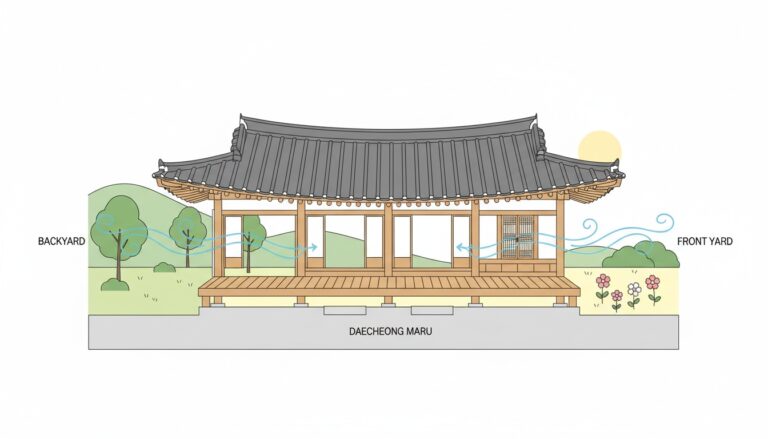
- Editor’s Insight: ‘바람이 불다’ is too basic. 맞바람 implies two windows or doors are open on opposite sides, allowing the wind to pass through directly. In a Hanok, the wind flows from the front yard to the backyard (or vice versa) through the Daecheong.
- Situation Check: Used in casual to semi-formal observations. Perfect for real estate viewing or visiting a Hanok cafe.
2. 탁 트인 개방감 (Tak teu-in gae-bang-gam)
- Pronunciation: [tak teu-in gae-bang-gam]
- Meaning: A sense of wide-open spaciousness; an unobstructed view.
- Editor’s Insight: This is a high-level phrase. 탁 트이다 means “wide open” (like a view of the ocean). 개방감 is “a sense of openness.” When you open the sliding doors (Bunhapmun) of the Daecheong, the space becomes one with nature. Architects and designers love this word.
- Situation Check: Formal/Descriptive. Use this when writing a review or complimenting someone’s house.
3. 여름을 나다 (Yeo-reum-eul na-da)
- Pronunciation: [yeo-reum-eul na-da]
- Meaning: To survive/endure/pass the summer.
- Editor’s Insight: You know “spend time” (보내다), but 나다 here implies overcoming the harshness of the season. The Daecheong is the specific space designed to help people 여름을 나다 comfortably without modern technology.
- Situation Check: Literary/Conversational. “How did our ancestors survive summer?” -> “조상님들은 대청마루에서 여름을 나셨어요.”
Phase 2: Textbook vs. Real Life 🗣️
How does a textbook explain the wind versus how a local feels it?
| Textbook Korean (Standard) | Real Korean (Advanced/Natural) |
|---|---|
| 바람이 잘 통합니다. (The wind circulates well.) |
통풍이 기가 막히네요. (The ventilation is absolutely breathtaking/amazing.) |
| 이곳은 정말 시원해요. (It is very cool here.) |
여기 완전 피서지가 따로 없네요. (This place is basically a summer resort / No need to go elsewhere.) |
| 경치가 잘 보입니다. (The scenery is visible well.) |
마루에 앉으니 속이 뻥 뚫리는 기분이에요. (Sitting on the Maru, I feel refreshed/unburdened inside.) |
- Editor’s Note: “기가 막히다” (breathtaking/dumbfounding) is a great C1 idiom to emphasize admiration for the architecture.
Phase 3: Cultural Context & The “Science of Wind” 🌬️
Why is the Daecheong cool?
It’s not magic; it’s the Bernoulli Principle and convection currents.
- The Backyard (뒤뜰): Usually planted with trees and shaded, making the air cold.
- The Front Yard (마당): Usually empty and covered in white soil (Masato), making the air hot.
Hot air rises in the front, and cool air from the back rushes in through the Daecheong to fill the void. This creates a natural 맞바람 (cross-breeze) even on a windless day.
💡 Manner Tip (Nunchi):
When visiting a historic Hanok, never step on the wooden threshold (munji-bang). Also, if you are sitting on the Daecheong with elders, do not lie down flat (spread-eagle). Sitting cross-legged or with legs modestly to the side is the proper etiquette.
Phase 4: Real-Life Scenario 🎬
Setting: A foreign architecture student (Alex) is visiting a Hanok expert (Min-su) at a heritage site.
Alex: (Looking around with admiration)
이 한옥은 구조가 참 독특하네요. 에어컨도 없는데 어떻게 이렇게 시원하죠?
(This Hanok has a unique structure. How is it so cool without AC?)
Min-su: (Smiling and pointing to the open doors)
비결은 바로 대청마루예요. 뒷마당의 찬 공기가 이쪽으로 불어오면서 자연스럽게 맞바람이 치거든요.
(The secret is the Daecheong Maru. Cold air from the backyard blows this way, naturally creating a cross-breeze.)
Alex:
아, 그게 바로 대류 현상이군요! 문을 다 올리니까 탁 트인 개방감도 정말 훌륭해요.
(Ah, that’s the convection phenomenon! With all the doors lifted, the sense of openness is excellent too.)
Min-su:
맞아요. 우리 조상님들은 이 과학적인 원리 덕분에 무더운 여름을 지혜롭게 나셨죠.
(Exactly. Thanks to this scientific principle, our ancestors wisely survived the sweltering summers.)
Phase 5: 10-Second Shadowing 🎙️
Read this aloud to practice your intonation and rhythm. Focus on the pause markers (/).
“대청마루에 앉아 있으면 / 자연스러운 맞바람 덕분에 / 에어컨 없이도 / 시원하게 여름을 날 수 있습니다.”
(When you sit on the Daecheong Maru / thanks to the natural cross-breeze / even without AC / you can coolly survive the summer.)
Phase 6: FAQ & Troubleshooting ⚠️
- Q: Can I use “통풍” (Ventilation) for clothes too?
- A: Yes! You can say “이 셔츠는 통풍이 잘 돼요” (This shirt breathes well/is well-ventilated). It’s a very versatile noun.
- Q: Is “맞바람” always good?
- A: Mostly good in summer architecture! But in a relationship context, “바람을 피우다” means to cheat. However, “맞바람” is strictly about wind (or sometimes responding to an affair with an affair, but that’s a drama context!). In architecture, it’s 100% positive.
Phase 7: Wrap-up & Mission 🎁
- Summary: The Daecheong Maru uses natural convection to create 맞바람 (cross-breeze), providing 개방감 (openness) to help Koreans 여름을 나다 (survive summer).
- Action Mission: Next time you are in a cafe with a terrace or open window, tell your friend: “여기 통풍이 잘 돼서 시원하다!” (It’s cool here because the ventilation is good!)
Have you ever experienced a Hanok in summer? Tell me in the comments below! 👇
Pop Quiz 📝
- Which word describes “surviving/enduring” a specific season like summer?
A) 보내다 (Bonaeda)
B) 나다 (Nada)
C) 가다 (Gada) -
What causes the natural wind in a Hanok (Temperature difference between yards)?
A) Ondol (온돌)
B) Daeryu (Convection/대류)
C) Dancheong (Painting/단청) -
How do you describe a view that is wide open and unobstructed?
A) 답답하다 (Stuffy)
B) 아늑하다 (Cozy)
C) 탁 트이다 (Wide open)
(Answers: 1. B, 2. B, 3. C)
Frequently Asked Questions (FAQ)
Q: What does "맞바람" mean in Korean and how do you pronounce it?
A: In Korean, "맞바람" is pronounced [cross-breeze] and means: even on a windless day.







