

Phase 1: Introduction
Hello! It’s your Daily Hangul Editor.
If you live with a cat, let me ask you a serious question: Who is the boss in your house?
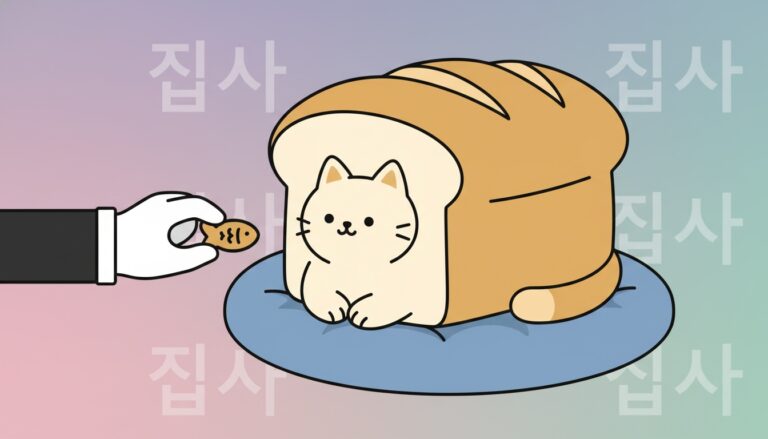
In many Western cultures, you might say, “I own a cat.” But in Korea, if you say that, you might sound a bit… old-fashioned. Here, the power dynamic is clear: The cat is the master, and you are the servant.
Today, we are diving into the Unit: Daily Routine of a Cat Butler. This isn’t just about cute words; it’s about understanding the specific humor and affection embedded in modern Korean pet culture. If you use these expressions, Korean cat lovers won’t just think you’re good at Korean—they’ll recognize you as “one of us.”
Transparency Note: This guide is curated based on real conversations between pet-loving Koreans in their 20s and 30s.
Phase 2: Deep Dive into Core Expressions
Here are the top 3 expressions you need to survive as a human servant to a feline master.
1. 집사 (Jipsa)
- Pronunciation: [Jip-sa] Sounds like ‘Jeep’ + ‘Sah’
- Meaning:
- Literal: Deacon / Butler
- Real Nuance: A cat owner.
- Editor’s Insight: You never say “I am a cat owner (주인).” You say “I am a butler (집사).” It implies that you scoop the litter box, serve the food, and are grateful for their attention.
- Situation Check: Used everywhere! Casual to formal settings (humorous intent).
2. 식빵 굽다 (Sikppang gupda)
- Pronunciation: [Sik-ppang gup-da] ‘Sik’ (sick) + ‘ppang’ (emphasis on the double P) + ‘gup-da’
- Meaning:
- Literal: To bake bread (white loaf bread)
- Real Nuance: When a cat tucks its paws underneath its chest and looks like a loaf of bread (The Loaf).
- Editor’s Insight: If you see a cat sitting like this, don’t say “The cat is sitting.” Say, “Look! It’s baking bread!” (식빵 굽고 있어!). You will sound incredibly native.
- Situation Check: Casual conversations.
3. 꾹꾹이 (Kkuk-kkugi)
- Pronunciation: [Kkuk-kkug-i] Imagine saying ‘Cook’ with a strong K at the start, twice, plus ‘ee’.
- Meaning:
- Literal: Press-press-ie
- Real Nuance: Kneading / Making biscuits.
- Editor’s Insight: This word comes from the onomatopoeia 꾹 (kkuk), which is the sound/feeling of pressing down firmly. It’s the cutest word in the Korean dictionary. Trust me.
- Situation Check: Very common among pet lovers.
Phase 3: Textbook vs. Real Life
Let’s upgrade your B2 Korean from “classroom safe” to “street smart.”
| Textbook Korean (Standard) | Real Korean (What actual ‘Butlers’ say) |
|---|---|
| 고양이를 키워요. (I raise a cat.) |
고양이 모시고 살아요. (I live serving a cat.) Note: ‘모시다’ is honorific!* |
| 고양이가 귀여워요. (The cat is cute.) |
우리 주인님 미모 열일하시네. (Our master’s beauty is working hard today.) |
| 고양이가 사고를 쳤어요. (The cat caused an accident.) |
냥아치가 또… (The ‘Cat-gangster’ did it again…) Note: 냥 (Cat) + 양아치 (Gangster/Thug)* |
Editor’s Note: Using 모시다 (to serve) instead of 키우다 (to raise) is the hallmark of intermediate-to-advanced wit.
Phase 4: Cultural Context & Manners
The “Nunchi” of Pet Ownership in Apartments
Most Koreans live in apartments, so noise sensitivity is high. While cats are generally quiet, running around at night (the “zoomies”) can cause 층간소음 (floor noise).
- Cultural Tip: If you invite a Korean friend over to meet your cat, don’t just pick the cat up immediately. Koreans often respect the cat’s personal space (just like humans!). Wait for the cat to approach. If the cat ignores your friend, you can joke:
- “아이고, 주인님이 오늘 기분이 안 좋으신가 봐요.” (Oh dear, the Master must be in a bad mood today.)
Phase 5: Roleplay Scenario
Setting: A cafe. Minji (Korean) and Alex (Foreigner) are looking at photos on Alex’s phone.
Minji: 와! 이 고양이 너랑 같이 사는 애야? (Wow! Is this the cat living with you?)
Alex: 응, 내 주인님이야. 이름은 ‘루나’야. (Yeah, that’s my Master. Her name is Luna.)
Minji: ㅋㅋㅋ 주인님이라니! 지금 뭐 하는 거야? 발이 안 보여. (Hahaha, Master? What is she doing now? I can’t see her feet.)
Alex: 아, 지금 소파 위에서 식빵 굽는 중이야. (Ah, she is in the middle of baking bread on the sofa.)
Minji: 너무 귀엽다! 근데 표정은 왜 그래? (So cute! But why is her facial expression like that?)
Alex: 간식 안 줬더니 냥무룩해졌어. (I didn’t give her snacks, so she became Nyang-muruk / sullen.)
Phase 6: 10-Second Shadowing
Read this aloud to practice the rhythm. Pay attention to the pauses /.
“우리 주인님이 / 지금 식빵 굽느라 / 바쁘셔서 / 건드리면 안 돼요.”
(Our master / is busy baking bread right now / so / I shouldn’t disturb him.)
- Intonation Tip: Raise your tone slightly on 주인님 (Master) to emphasize the importance, and drop the tone on 안 돼요 (shouldn’t) to sound serious.
Phase 7: FAQ & Troubleshooting
Q: Can I use “집사 (Jipsa)” for dog owners?
A: Generally, no. Dog owners usually call themselves 견주 (Owner) or 엄마/아빠 (Mom/Dad). Dogs serve humans (usually), but humans serve cats. That is the rule of nature in Korea! Using “Jipsa” for a dog might sound confusing unless the dog is very arrogant.
Q: Is it rude to call a cat ‘냥아치’ (Cat-gangster)?
A: Not at all! It’s an affectionate term used when they knock things over or steal your food. It implies “You little rascal!”
Phase 8: Wrap-up
Today’s Summary: You don’t own a cat; you are a Jipsa serving a Master who bakes bread and occasionally acts like a thug.
Your Mission: Go to Instagram and search for the hashtag #냥스타그램 (Nyang-stagram). Find a photo of a cat sitting with paws tucked in and comment: “식빵이 노릇노릇하게 잘 구워졌네요!” (The bread is baked golden brown/perfectly!)
Phase 9: Quiz
1. Which word best describes a person who lives with a cat?
a) 주인 (Owner)
b) 친구 (Friend)
c) 집사 (Butler)
2. What is the cat doing when it is “baking bread” (식빵 굽다)?
a) Cooking food
b) Sitting with paws tucked under the chest
c) Sleeping on its back
3. Combine ‘Cat’ (고양이) + ‘Sullen’ (시무룩) to describe a sad cat.
a) 고무룩
b) 냥무룩
c) 시냥룩
(Answers: 1. c / 2. b / 3. b)
Frequently Asked Questions (FAQ)
Q: What does "집사 (Jipsa)" mean in Korean and how do you pronounce it?
A: In Korean, "집사 (Jipsa)" is pronounced [Jip-sa] and means: Literal: Deacon / Butler
Q: What does "식빵 굽다 (Sikppang gupda)" mean in Korean and how do you pronounce it?
A: In Korean, "식빵 굽다 (Sikppang gupda)" is pronounced [Sik-ppang gup-da] and means: Literal: To bake bread (white loaf bread)
Q: What does "꾹꾹이 (Kkuk-kkugi)" mean in Korean and how do you pronounce it?
A: In Korean, "꾹꾹이 (Kkuk-kkugi)" is pronounced [Kkuk-kkug-i] and means: Literal: Press-press-ie







