

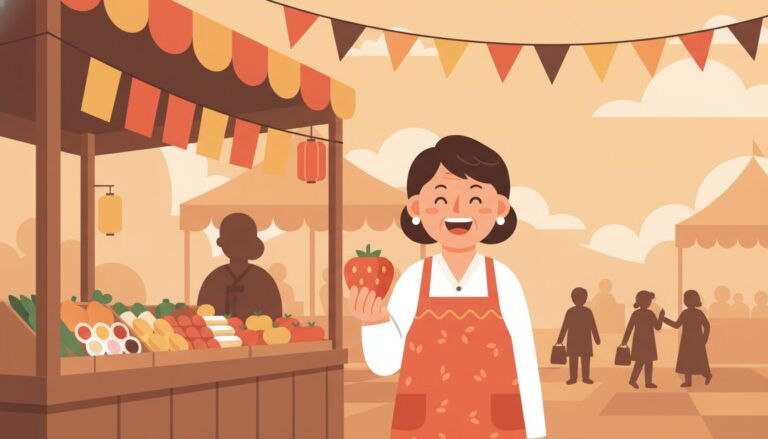
Introduction: The “Ajumma” Energy Check
Hello! This is your Daily Hangul Editor.
Imagine this: You are at the Nonsan Strawberry Festival or the Boryeong Mud Festival. The air is filled with the smell of frying oil and sweet fruits. Suddenly, a friendly lady (Ajumma) shoves a piece of fruit toward your mouth, shouting something rapid-fire in a dialect.
Panic sets in. Do you pay for it? Is it rude to say no? How do you say, “I’ll buy a box, but can you send it to my house in Seoul?”
Many intermediate learners freeze here. They know how to order at a calm café, but the high-energy chaos of a local festival (지역 축제) is a different beast. Today, we are upgrading your Korean from “Classroom polite” to “Festival savvy.” Let’s make sure you get the best goods and the best service (서비스).
Phase 2: Deep Dive (Key Expressions)
Here are the three golden phrases you need to survive and thrive at a local specialty market.
1. 이거 시식해 봐도 돼요?
- Pronunciation: [I-geo si-sik-hae bwa-do dwae-yo?]
- Sound analogy: “See-seek” sounds a bit like “Sea-sick” but without the nausea nuance!
- Meaning: “Can I try a sample of this?”
- Editor’s Insight: At festivals, 시식 (tasting/sampling) is a huge part of the culture. Don’t just stare at the food. If you use this phrase, the seller will likely be delighted and cut you a fresh piece. It shows you are a serious buyer, not just a tourist passing by.
- Situation Check: ✅ Casual & Polite (Standard polite).
2. 역시 제철이라서 그런지 진짜 싱싱하네요!
- Pronunciation: [Yeok-si je-cheol-i-ra-seo geu-reon-ji jin-jja sing-sing-ha-ne-yo!]
- Meaning: “As expected, since it’s in season, it’s really fresh!”
- Editor’s Insight: This is the B2 Level Power Move.
- 제철 (Jecheol): In season / Seasonal time.
- 싱싱하다 (Singsinghada): To be fresh (usually for produce/fish).
- Using this sentence instantly marks you as someone who understands Korean food culture. You aren’t just saying “It’s good (맛있어요).” You are complimenting the quality and the timing. The seller will love you.
- Situation Check: ✅ Perfect for flattery (Social lubrication).
3. 혹시 서울로 택배도 되나요?
- Pronunciation: [Hok-si Seo-ul-lo taek-bae-do dwe-na-yo?]
- Meaning: “By any chance, is delivery to Seoul possible?”
- Editor’s Insight: You can’t carry 10kg of Kimchi or a box of apples on the KTX train. Most festival vendors offer 택배 (Taekbae – Parcel service). Asking this ensures you can buy bulk (which is cheaper) without the heavy lifting.
- Situation Check: ✅ Essential for logistics.
Phase 3: Textbook vs. Real Life
Let’s loosen up that stiff grammar. At a noisy festival, short and effective wins.
| Textbook Korean (Too Formal/Stiff) | Real Life (Festival Vibes) 🎪 |
|---|---|
| 이것은 맛이 어때요? (How does this taste?) | 이거 많이 단가요? / 맵나요? (Is this very sweet/spicy?) |
| 가격을 깎아 주실 수 있습니까? (Could you discount the price?) | 사장님~ 조금만 더 깎아 주세요! (Boss~ Cut the price just a little!) |
| 이것을 사고 싶습니다. (I would like to buy this.) | 이거 한 박스 주세요. (Give me one box of this.) |
Editor’s Note: At B2 level, try using “사장님” (Boss/Owner) instead of “아저씨/아줌마” when addressing vendors. It sounds much more respectful and might earn you extra service (덤).
Phase 4: Cultural Context (Nunchi & Manners)
The Art of “Deom” (덤)
At Korean festivals, if you buy a significant amount (e.g., 3 boxes of apples), the seller might toss in a few extra apples for free. This is called 덤 (Deom).
* Don’t ask for it aggressively. It’s a gift of affection (Jeong).
* Do react happily. “와, 서비스 감사합니다!” (Wow, thanks for the service!) makes everyone happy.
The “Sampling” Nunchi
- Eye Contact: If you eat a sample, nod and make eye contact. Walking away immediately while chewing without saying anything is considered having “bad Nunchi.”
- The Exit Strategy: If you taste it but don’t want to buy, don’t say “It’s bad.” Say, “좀 더 둘러보고 올게요” (I’ll look around a bit more and come back).
Phase 5: Real Scenario Roleplay
Setting: A crowded Chestnut Festival (밤 축제) in Gongju.
Characters: Alex (Foreigner, B2 Level), Vendor (Friendly Korean Ajumma).
(Alex stops at a stall smelling roasted chestnuts.)
Alex: 사장님, 냄새가 너무 좋네요! 이거 시식해 봐도 돼요?
(Boss, the smell is amazing! Can I try a sample?)
Vendor: 아유, 물론이죠! 자, 이거 막 구운 거야. 뜨거우니까 조심해요.
(Oh, of course! Here, this was just roasted. It’s hot, so be careful.)
(Alex blows on the chestnut and eats it.)
Alex: 와, 진짜 달아요! 역시 제철이라 다르네요.
(Wow, it’s really sweet! As expected, it’s different because it’s in season.)
Vendor: 그치? 우리 밤이 공주에서 제일 유명해. 두 망 가져가!
(Right? Our chestnuts are the most famous in Gongju. Take two mesh bags!)
Alex: 그럼 두 망 주세요. 아, 혹시 서울로 택배도 되나요? 무거워서요.
(Then please give me two bags. Ah, by any chance, is shipping to Seoul possible? It’s heavy.)
Vendor: 당연하지! 주소만 적어주면 내일 도착해!
(Of course! Just write the address, it arrives tomorrow!)
Phase 6: 10-Second Shadowing Drill
Repeat this sentence to practice your intonation and rhythm. Focus on the pause after “Yeok-si.”
“역시 / 제철이라서 그런지 / 맛이 정말 깊네요!”
(Yeok-si / je-cheol-i-ra-seo geu-reon-ji / ma-si jeong-mal gim-ne-yo!)
Translation: As expected, maybe because it’s in season, the flavor is really deep!
Phase 7: FAQ & Troubleshooting
- Q: Can I use “Banmal” (casual speech) if the seller is younger than me?
- No. Even if the part-timer looks young, always use polite language (Yo-form) at a first meeting. It keeps the transaction professional and respectful.
- Q: Is it rude to bargain (Hageung)?
- Maybe. If the prices are clearly written on a sign, don’t bargain. If you are buying in bulk (5+ items) or it’s near closing time, you can cute-ly ask, “좀 깎아 주시면 안 돼요?” (Can’t you discount a bit?).
Phase 8: Wrap-up
One-Liner Summary: Use “시식” to taste, compliment with “제철,” and solve heavy luggage problems with “택배.”
Action Mission: Next time you pass a street food vendor or a market, try asking “이거 지금 제철이에요?” (Is this in season right now?) even if you know the answer. Watch their face light up!
Engage: What is the strangest or most delicious thing you’ve tasted at a Korean festival? Tell us in the comments!
Phase 9: Pop Quiz
- Which word means “In season”?
a) 택배 (Taekbae)
b) 제철 (Jecheol)
c) 시식 (Sichik) -
If you want to try a piece of food, what do you ask?
a) 이거 먹어! (Eat this!)
b) 이거 시식해 봐도 돼요? (Can I sample this?)
c) 이거 공짜예요? (Is this free?) -
What is the polite title to call a vendor?
a) 야! (Hey!)
b) 사장님 (Boss/Owner)
c) 너 (You)
(Answers: 1-b, 2-b, 3-b)
Frequently Asked Questions (FAQ)
Q: What does "제철" mean in Korean and how do you pronounce it?
A: In Korean, "제철" is pronounced [Jecheol] and means: In season / Seasonal time.
Q: What does "싱싱하다" mean in Korean and how do you pronounce it?
A: In Korean, "싱싱하다" is pronounced [Singsinghada] and means: To be fresh (usually for produce/fish).
Q: What does "택배" mean in Korean and how do you pronounce it?
A: In Korean, "택배" is pronounced [Taekbae - Parcel service] and means: . Asking this ensures you can buy bulk (which is cheaper) without the heavy lifting.
Q: What does ""사장님"" mean in Korean and how do you pronounce it?
A: In Korean, ""사장님"" is pronounced [Boss/Owner] and means: instead of "아저씨/아줌마" when addressing vendors. It sounds much more respectful and might earn you extra service (







