

Phase 1: Introduction
Hello! This is your Senior Editor at Daily Hangul.
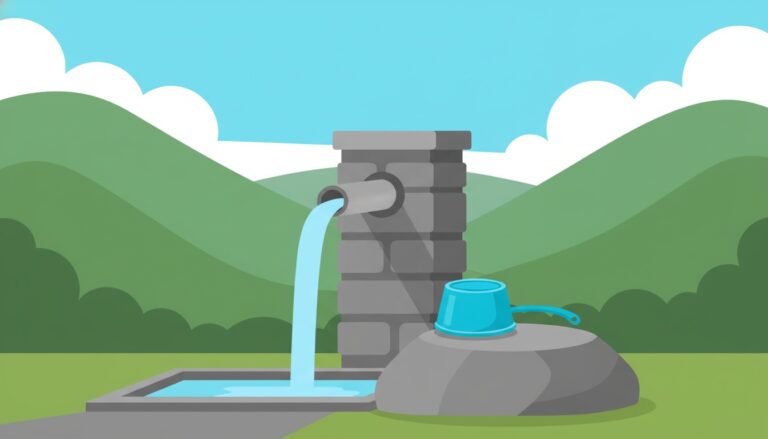
Imagine this: It’s a beautiful Sunday morning. You’ve decided to conquer a mountain in Seoul (maybe Namsan or Bukhansan) just like the locals. You are sweating, your legs are burning, and suddenly, you see an oasis—a small spring where grandmas and grandpas are lining up to fill their water bottles.
This is the 약수터 (Yaksu-teo), or “medicinal mineral spring.”
But wait. Can you just drink that water? Do you need to buy it? How do you ask without looking like a clueless tourist?
If you don’t know the phrases we cover today, you might stay thirsty or, worse, commit a major hygiene party foul with the communal ladle! This guide is built from real questions my students asked after their first Korean hike. Let’s make you look like a hiking pro.
Phase 2: Deep Dive (Core Expressions)
Here are the top 3 expressions you need to survive at the spring.
1. 물 (Mul)
- Pronunciation: [Mul] — Sounds a bit like ‘Moon’ but replace the ‘n’ with an ‘l’. Keep your lips round!
- Meaning: Water
- Editor’s Insight: This is the most essential survival word. At a restaurant, at the gym, or on a mountain—you need Mul.
- Situation Check: Universal. You can use it anywhere.
2. 이거 마셔도 돼요? (I-geo ma-syeo-do dwae-yo?)
- Pronunciation: [I-geo ma-syeo-do dwae-yo] — Try breaking it down: E-go + Ma-show-do + Day-yo?
- Meaning: Can I drink this?
- Editor’s Insight: In Korea, not all outdoor water is safe. Some is for washing hands only. This question is your safety net. It implies, “Is this safe for consumption?”
- Situation Check: Polite/Formal. Safe to use with strangers or older hikers.
3. 시원하다! (Si-won-ha-da!)
- Pronunciation: [She-won-ha-da]
- Meaning: It’s refreshing / It’s cool.
- Editor’s Insight: Koreans love saying how they feel out loud. After a gulp of cold water, shouting “Ah, Si-won-ha-da!” will instantly make the grandpas around you smile and treat you like a local.
- Situation Check: Casual exclamation. You are talking to yourself or the air, so the form doesn’t matter much, but this form is standard.
Phase 3: Textbook vs. Real Life
Textbooks often teach stiff, military-style Korean. Let’s see how real hikers talk.
| Textbook Korean (Too Formal) | Real Life Korean (Natural & Insider) |
|---|---|
| 이 물은 마실 수 있습니까? (Is it possible to drink this water?) |
이거 마셔도 돼요? (Can I drink this?) |
| 물 주세요. (Please give me water.) |
물 좀 마실게요. (I’m just gonna have some water.) |
| 맛이 좋습니다. (The taste is good.) |
와, 물 맛 좋다! (Wow, the water tastes great!) |
Note: Since you are A1 (Beginner), sticking to “이거 마셔도 돼요?” is the safest and most natural choice!
Phase 4: Cultural Context & Manners
The “Bagaji” (바가지) Rule
At a Yaksu-teo, you will see plastic ladles, usually blue or red, floating in the water or hanging nearby. These are called Bagaji.
⚠️ CRITICAL WARNING:
Do NOT put your mouth directly on the ladle!
- Scoop the water with the ladle.
- Pour the water from the ladle into your own cup or bottle.
- Or, pour it into your cupped hands to drink.
- If you touch your lips to the ladle, everyone will stare at you in horror. It’s a communal tool!
Nunchi (Eye-measure)
If there is a line, don’t fill up 10 giant bottles while people behind you are just waiting for a sip. Nunchi means reading the room. If the line is long, take a quick drink and move aside.
Phase 5: Real Life Scenario (Roleplay)
Setting: A mid-mountain spring on Bukhansan. Alex is thirsty.
Characters: Alex (Foreigner), Ajumma (Korean lady hiker).
Alex: (Pointing at the water hesitantly)
저기요… 이거 물이에요?
(Jeo-gi-yo… i-geo mul-i-e-yo?)
Excuse me… is this water?
Ajumma: (Nodding vigorously)
네, 약수예요. 약수.
(Ne, yak-su-ye-yo. Yak-su.)
Yes, it’s mineral water. Medicinal water.
Alex: (Still cautious)
이거 마셔도 돼요?
(I-geo ma-syeo-do dwae-yo?)
Can I drink this?
Ajumma: (Handing him a ladle)
그럼요! 아주 시원해요.
(Geu-reom-yo! A-ju si-won-hae-yo.)
Of course! It’s very refreshing.
Alex: (Drinks from his hands, not the ladle)
와… 진짜 시원하다!
(Wa… jin-jja si-won-ha-da!)
Wow… it’s really refreshing!
Phase 6: 10-Second Shadowing
Listen to the rhythm. Practice saying this feeling of relief!
와 / 물 / 진짜 / 시원하다!
(Wa / mul / jin-jja / si-won-ha-da!)
Wow, the water is really refreshing!
- Point 1: Stretch the “Wa~” to show amazement.
- Point 2: Put stress on Si-won-ha-da.
Phase 7: FAQ & Troubleshooting
- Q: Can I drink from any stream on the mountain?
- A: NO! Only drink from designated Yaksu-teo places. Look for a sign that says “적합” (Jeok-hap – Suitable/Pass) on the water quality report board nearby. If it says “부적합” (Bu-jeok-hap), do not drink.
- Q: Can I say “Si-won-ha-da” for hot soup too?
- A: Yes! Ironically, Koreans say “Si-won-ha-da” for both ice-cold water and hot, spicy soup. It describes the feeling of relief, not just temperature.
Phase 8: Wrap-up
Today’s One-Liner:
To stay hydrated and safe, just remember: “이거 마셔도 돼요?” (Can I drink this?).
Your Mission:
Next time you drink a glass of cold water at home, take a sip and loudly say, “Ah! Si-won-ha-da!” Get used to the feeling!
Let’s Chat:
Have you ever hiked in Korea? Did you try the spring water? Tell me in the comments!
Phase 9: Quiz
1. What is the Korean word for “Water”?
A) Bap (밥)
B) Mul (물)
C) Sul (술)
2. You see a blue plastic ladle at the spring. What should you do?
A) Drink directly from it with your mouth.
B) Take it home as a souvenir.
C) Use it to pour water into your hands or cup.
3. How do you ask “Can I drink this?”
A) I-geo ma-syeo-do dwae-yo?
B) I-geo eol-ma-ye-yo? (How much is this?)
C) I-geo mwo-ye-yo? (What is this?)
Click to see answers
1. B, 2. C, 3. A
Frequently Asked Questions (FAQ)
Q: What does "물 (Mul)" mean in Korean and how do you pronounce it?
A: In Korean, "물 (Mul)" is pronounced [Mul] and means: Water
Q: What does "이거 마셔도 돼요? (I-geo ma-syeo-do dwae-yo?)" mean in Korean and how do you pronounce it?
A: In Korean, "이거 마셔도 돼요? (I-geo ma-syeo-do dwae-yo?)" is pronounced [I-geo ma-syeo-do dwae-yo] and means: Can I drink this?
Q: What does "시원하다! (Si-won-ha-da!)" mean in Korean and how do you pronounce it?
A: In Korean, "시원하다! (Si-won-ha-da!)" is pronounced [She-won-ha-da] and means: It’s refreshing / It’s cool.







