

Phase 1: Introduction
“Wait, the restroom is locked?”
Hello! This is your Daily Hangul Senior Editor. 👋
Imagine this: You are at a trendy cafe in Seongsu-dong. You’ve just finished your delicious Iced Americano, and nature calls. You rush to the restroom, but the door won’t open. There’s a digital number pad on the door handle. You panic.
You run back to the counter, but you don’t know what to ask. “Open door please?” “Code?”
Don’t worry. This happens to everyone. Today, we are learning the #1 survival abbreviation in modern Korea. Knowing this word is the difference between being a confused tourist and a savvy local. Let’s unlock the secret of “Bi-beon.”
Phase 2: Deep Dive (Key Expressions)
Here are the must-know terms to survive the “digital lock” culture in Korea.
1. 비번 (Bi-beon)
- Pronunciation:
Bi-beon[Sounds like: Bee + Bun (like a hamburger bun)]- Meaning: Password / Code
- Editor’s Insight: This is the short form of 비밀번호 (Bi-mil-beon-ho). Koreans love shortening words. Saying the full four syllables feels too long in a busy cafe. Whether it’s for Wi-Fi or the restroom door, just say “Bi-beon.”
- Situation Check: ✅ Casual & Polite (Standard daily life)
2. 와이파이 (Wa-i-pa-i)
- Pronunciation:
Wa-i-pa-i[Just like English Wi-Fi, but pronounce every syllable clearly]- Meaning: Wi-Fi
- Editor’s Insight: Sometimes young people text it as 와파 (Wa-pa), but when speaking, full “Wa-i-pa-i” is clearer. Note: In Korea, almost every place has free Wi-Fi, but 99% are locked with a Bi-beon.
- Situation Check: ✅ Everyone uses this.
3. 알려주세요 (Al-ryeo-ju-se-yo)
- Pronunciation:
Al-ryeo-ju-se-yo- Meaning: Please let me know / Please tell me.
- Editor’s Insight: This is a magic verb. You aren’t just “asking”; you are politely requesting them to share information.
- Situation Check: ✅ Polite standard.
Phase 3: Textbook vs. Real Life
Let’s see how a textbook robot speaks versus how a cool person in Seoul speaks.
| Textbook Korean 🤖 | Real Life Korean (Daily Hangul Style) ✨ |
|---|---|
| 비밀번호가 무엇입니까? (Bi-mil-beon-ho-ga mu-eot-im-ni-kka?) “What is the password?” |
비번 좀 알려주세요. (Bi-beon jom al-ryeo-ju-se-yo) “Could you let me know the pass?” |
| 와이파이 비밀번호 있어요? (Wa-i-pa-i bi-mil-beon-ho iss-eo-yo?) “Is there a Wi-Fi password?” |
여기 와이파이 비번 뭐예요? (Yeo-gi wa-i-pa-i bi-beon mwo-ye-yo?) “What’s the Wi-Fi pass here?” |
💡 Bottom Note: In the Real Life column, we use 좀 (Jom). It literally means “a little,” but it softens your request, making you sound much friendlier!
Phase 4: Cultural Context & Manners
👀 The “Receipt Check” Rule (Nunchi)
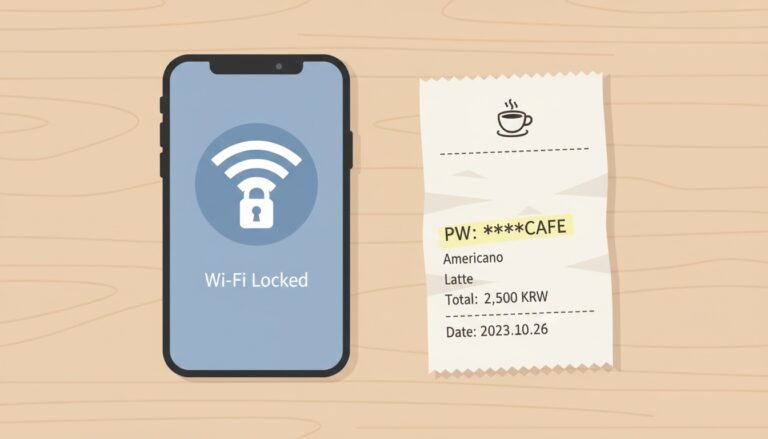
Before you run to the counter to ask for the Bi-beon, check your receipt first!
In 90% of Korean franchises (like Starbucks, Ediya, or Mega Coffee), the Wi-Fi password and the Restroom password are printed at the bottom of your receipt.
- Scenario: If you ask a busy part-timer, “Bi-beon mwo-ye-yo?” and it’s on your receipt, they might point to it silently. That’s a classic “foreigner mistake.”
- Pro Tip: Look for the words Wi-Fi or 화장실 (Hwa-jang-sil = Restroom) on the paper slip.
Phase 5: Real-Life Scenario (Roleplay)
📍 Setting: A crowded cafe near Hongdae station. You need to use your laptop.
Characters:
* Tom: A foreign student (A2 Level)
* Staff: Busy Korean barista
(Tom walks up to the counter holding his phone)
Tom: 저기요, 와이파이 비번 좀 알려주세요.
(Jeo-gi-yo, wa-i-pa-i bi-beon jom al-ryeo-ju-se-yo.)
“Excuse me, could you tell me the Wi-Fi password?”
Staff: (Pointing to the receipt on the tray) 영수증 하단에 있어요!
(Yeong-su-jeung ha-dan-e iss-eo-yo!)
“It’s at the bottom of the receipt!”
Tom: (Embarrassed smile) 아! 몰랐어요. 감사합니다.
(Ah! Mol-lass-eo-yo. Gam-sa-ham-ni-da.)
“Ah! I didn’t know. Thank you.”
Phase 6: 10-Second Shadowing
Let’s practice the most useful phrase for today. Repeat this until it flows naturally!
“Excuse me, what is the restroom password?”
혹시 / 화장실 비번 / 뭐예요?
[Hok-si / Hwa-jang-sil Bi-beon / Mwo-ye-yo?]
- Intonation Tips:
- Start Hok-si (By any chance) slightly lower.
- Raise the pitch slightly on Bi-beon (Important word!).
- End with a soft upward curve on yo?
Phase 7: FAQ & Troubleshooting
Q: Can I use “Bi-beon” with my boss or a much older person?
A: Generally, Yes. “Bi-beon” has become a standard noun like “TV” or “Mart.” However, if you are in a very strict formal interview or meeting the company President, use the full word 비밀번호 (Bi-mil-beon-ho) just to be 100% safe.
Q: Is “Code” used in Korea?
A: Not really for door locks. If you say “Code,” they might think of a QR code. Stick to Bi-beon.
Phase 8: Wrap-up
📝 One-Liner Summary:
Don’t say the long “Bi-mil-beon-ho”; just say “Bi-beon” to sound like a local when asking for Wi-Fi or toilet access.
🏃 Action Mission:
Go to a cafe today, look at your receipt, and find the word “PW” or “비밀번호”. Circle it! If you can’t find it, practice asking the staff: “Bi-beon jom al-ryeo-ju-se-yo!”
💬 Engagement:
Have you ever been stuck outside a Korean restroom because of a digital lock? Tell me your story in the comments!
Phase 9: Quiz
1. What is the short form of ‘Bi-mil-beon-ho’ (Password)?
a) Bi-ho
b) Bi-mil
c) Bi-beon
2. Where can you usually find the password in a Korean cafe?
a) Written on the barista’s forehead
b) On the receipt
c) Under the table
3. Which phrase is most natural to ask for the password?
a) Bi-beon give me.
b) Bi-beon jom al-ryeo-ju-se-yo.
c) I want Bi-beon.
(Scroll down for answers)
Answers: 1. (c), 2. (b), 3. (b)
Frequently Asked Questions (FAQ)
Q: What does "비번 (Bi-beon)" mean in Korean and how do you pronounce it?
A: In Korean, "비번 (Bi-beon)" is pronounced [Bi-beon [Sounds like: Bee + Bun (like a hamburger bun] and means: Password / Code
Q: What does "와이파이 (Wa-i-pa-i)" mean in Korean and how do you pronounce it?
A: In Korean, "와이파이 (Wa-i-pa-i)" is pronounced [Wa-i-pa-i [Just like English Wi-Fi, but pronounce every syllable clearly] and means: Wi-Fi
Q: What does "알려주세요 (Al-ryeo-ju-se-yo)" mean in Korean and how do you pronounce it?
A: In Korean, "알려주세요 (Al-ryeo-ju-se-yo)" is pronounced [Al-ryeo-ju-se-yo] and means: Please let me know / Please tell me.







