

👋 안녕하세요! This is your Daily Hangul Editor.
So, you’ve survived the interview, nailed the self-introduction, and now your boss drops a bomb on you: “Ms. Smith, please train the new intern starting today.”
Panic mode, right? 😱
Teaching someone in your second language is terrifying. You need to be authoritative yet polite, clear yet not aggressive. If you mess this up, the new employee (and your boss) might think you lack leadership skills.
But don’t worry. As a tutor who has seen many foreigners navigate Korean office hierarchies, I can tell you that Korean office language is 80% attitude and 20% vocabulary.
Today, I will turn you into the coolest ‘Sasu’ (사수 – Mentor/Senior) in the office. Let’s get started!
🔍 Phase 1: Deep Dive into Key Expressions
Here are the top 3 phrases you need to guide a Sinip (Newbie) without sounding like a military commander.
1. ~해주시면 돼요. [~haejusimyeon dwaeyo]
- Pronunciation: hae-ju-shi-myun dwe-yo (Think of ‘dwe’ like the ‘dwe’ in ‘dwell’)
- Meaning: “You just need to do ~.” / “Please kindly do ~.”
- Editor’s Insight: This is the magic wand of instruction.
- Bad (Too direct): 이거 하세요. (Do this.) 🚫
- Good (Soft & Professional): 이거 해주시면 돼요. (It will be fine if you do this.) ✅
- It implies, “It’s not difficult, and that’s all required of you.”
- Situation Check: Use this when explaining simple tasks, like copying papers or sending emails.
2. 혹시 이해 안 가는 부분 있어요? [Hoksi ihae an ganeun bubun isseoyo?]
- Pronunciation: Hok-shi ee-hae an ga-neun bu-bun ee-sso-yo?
- Meaning: “By any chance, is there any part you don’t understand?”
- Editor’s Insight: The word ‘혹시 (Hoksi)’ is your shield. It softens any question. Without it, asking “Do you understand?” (이해했어요?) can sound aggressive, like you are interrogating them.
- Situation Check: Always ask this after explaining a complex workflow.
3. 메모해 두시는 게 좋아요. [Memohae dusineun ge joayo]
- Pronunciation: Meh-mo-hae doo-she-neun ge jo-ah-yo
- Meaning: “It’s better if you take a note.”
- Editor’s Insight: Korean work culture values meticulousness. Instead of ordering “Write this down!” (받아 적으세요!), this phrase suggests it as a helpful tip for their benefit. It makes you sound like a caring senior, not a nagging boss.
🆚 Phase 2: Textbook vs. Real Life
Textbooks teach you to be correct. We teach you to be natural. See the difference below.
| Textbook Korean 📖 | Real Office Korean 💼 | Nuance Difference |
|---|---|---|
| 질문 있습니까? (Do you have questions?) |
궁금한 거 있으면 편하게 물어보세요. (If you’re curious about anything, ask comfortably.) |
The left is for the army. The right makes you the “cool mentor.” |
| 이것을 읽으십시오. (Read this.) |
이거 한번 훑어보세요. (Take a look through this.) |
‘훑어보다’ (to skim/look through) sounds much less demanding than ‘읽다’ (read). |
| 알겠습니까? (Do you understand?) |
감 오시나요? (Do you get the feel of it?) |
‘감 (Gam)’ means ‘sense/feeling’. This is very B1+ level slangy professional talk! |
Editor’s Note: Using “감 오시나요?” will surprise them. They’ll think, “Wow, this person really knows Korean vibes!”
🎭 Phase 3: Cultural Context & Manners
The Sasu-Busasu Relationship
In Korea, being a Sasu (사수 – Mentor) and Busasu (부사수 – Mentee) is a special bond. You are responsible for their mistakes.
- Don’t scold in public: If the newbie makes a mistake, call them to a meeting room or talk quietly. Saving their ‘Face’ (Chemyon – 체면) is crucial.
- Buy the first coffee: It’s an unwritten rule. On the first day of training, buy them an Iced Americano. It breaks the ice instantly.
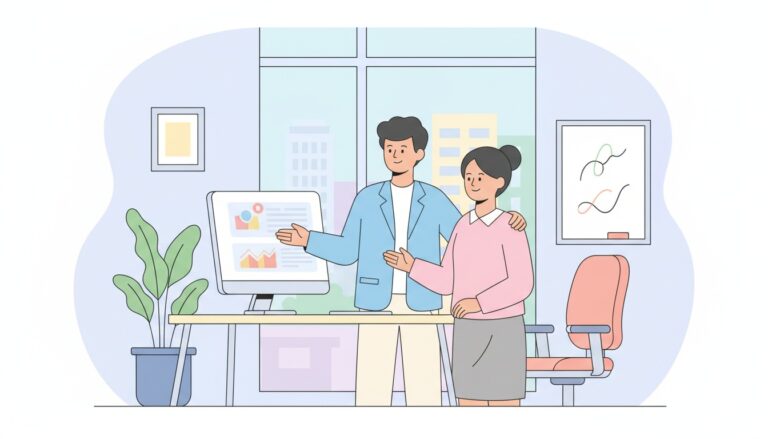
- Eye Contact: When explaining, look at them, but pointing at the screen with an open hand (not a finger) is more polite.
🎬 Phase 4: Real-Life Roleplay
Scenario: You (Alex) are teaching the new employee (Min-su) how to use the company software.
Alex: 민수 씨, 여기 로그인 먼저 해주시면 돼요.
(Min-su ssi, yeogi logeuin meonjeo haejusimyeon dwaeyo.)
(Min-su, you can just log in here first.)
Min-su: 네, 알겠습니다. 그 다음에는요?
(Ne, algestseumnida. Geu daeumeneunyo?)
(Yes, understood. And after that?)
Alex: 이 버튼 누르고 보고서 업로드하세요. 혹시 헷갈리는 거 있어요?
(I beoteun nureugo bogoseo eomnodeuhaseyo. Hoksi hetgallineun geo isseoyo?)
(Press this button and upload the report. Is there anything confusing by any chance?)
Min-su: 아니요, 아직은 괜찮습니다.
(Aniyo, ajigeun gwaenchanseumnida.)
(No, I’m okay for now.)
Alex: (Smiling) 처음엔 다 어려워요. 모르는 거 있으면 바로 저한테 물어보세요.
(Cheoeumen da eoryeowoyo. Moreuneun geo isseumyeon baro jeohante mureoboseyo.)
(It’s difficult for everyone at first. If there’s something you don’t know, ask me right away.)
🗣️ Phase 5: 10-Second Shadowing Drill
Let’s practice the “Cool Senior” tone. Read this aloud while imagining you are pointing at a computer screen kindly.
“이건 중요한 거니까 / 꼭 메모해 두시는 게 / 좋아요.”
Guide:
* Pause after ‘geonica’ and ‘ge’.
* Stress ‘Memohae’ slightly to emphasize importance.
❓ Phase 6: FAQ & Troubleshooting
Q: The new employee is older than me. Can I use polite language (Yo-ending)?
A: YES. In the office, rank usually overrides age in terms of work instruction. However, you should stick to ‘~어요/아요’ (Polite form) or ‘~시겠어요?’ (Honorifics). Never use Banmal (Casual speech) just because you are the senior, especially if they are older. It looks very rude.
Q: Can I say “Do you understand?” (이해했어요?) directly?
A: Try to avoid it. It sounds like you are checking their IQ. Use “괜찮으세요?” (Are you okay with this?) or “어렵진 않으세요?” (Is it not too difficult?) instead.
🎁 Phase 7: Wrap-up & Action Item
Today’s Summary: Use “~해주시면 돼요” for instructions and “혹시” to soften your questions.
🚀 Your Mission:
Next time you ask someone to do something (even a friend), try using “이것 좀 해줄 수 있어?” (Can you do this for me?) instead of “이거 해!” (Do this!). Feel the difference in their reaction!
Talk to me: Have you ever had to teach someone in Korean? What was the hardest part? Let me know in the comments!
📝 Phase 8: Quick Quiz
1. Which phrase is the softest way to give an instruction?
A) 이거 하십시오. (Do this.)
B) 이거 해. (Do it.)
C) 이거 해주시면 돼요. (You can do this.)
2. What word softens a question like “Do you have questions?”
A) 당장 (Right now)
B) 혹시 (By any chance)
C) 빨리 (Quickly)
3. What is the Korean term for a ‘Mentor/Senior’ who teaches you work?
A) 사수 (Sasu)
B) 선수 (Seonsu)
C) 백수 (Baeksu)
(Answers: 1.C, 2.B, 3.A)
Frequently Asked Questions (FAQ)
Q: What does "~해주시면 돼요. [~haejusimyeon dwaeyo]" mean in Korean and how do you pronounce it?
A: In Korean, "~해주시면 돼요. [~haejusimyeon dwaeyo]" is pronounced [hae-ju-shi-myun dwe-yo (Think of 'dwe' like the 'dwe' in 'dwell'] and means: "You just need to do ~." / "Please kindly do ~."
Q: What does "혹시 이해 안 가는 부분 있어요? [Hoksi ihae an ganeun bubun isseoyo?]" mean in Korean and how do you pronounce it?
A: In Korean, "혹시 이해 안 가는 부분 있어요? [Hoksi ihae an ganeun bubun isseoyo?]" is pronounced [Hok-shi ee-hae an ga-neun bu-bun ee-sso-yo?] and means: "By any chance, is there any part you don't understand?"
Q: What does "메모해 두시는 게 좋아요. [Memohae dusineun ge joayo]" mean in Korean and how do you pronounce it?
A: In Korean, "메모해 두시는 게 좋아요. [Memohae dusineun ge joayo]" is pronounced [Meh-mo-hae doo-she-neun ge jo-ah-yo] and means: "It's better if you take a note."







