

Hello! Daily Hangul Editor here.
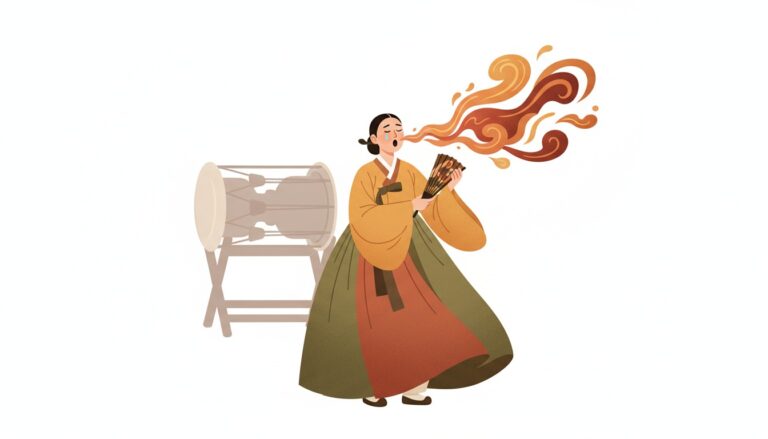
Have you ever listened to Pansori (traditional Korean musical storytelling) and felt a strange mixture of goosebumps and confusion? The singer’s voice sounds raspy, almost like they are crying, and suddenly the drummer shouts something out loud.
Many advanced learners tell me, “I understand the words, but I don’t know how to describe the feeling. It’s different from Western opera.”
If you only say “노래가 좋아요” (The song is good), you are missing out on the soul of Korean culture. Today, we are diving into the C1-level expressions needed to discuss the artistry of Pansori and Gugak. Mastering these terms will not only help you appreciate the art but will make native speakers look at you with genuine respect. You aren’t just a tourist; you are someone who understands Han (한).
Let’s upgrade your cultural vocabulary.
Phase 2: Deep Dive into Key Expressions
To talk about Korean traditional music, we need to go beyond simple adjectives. Here are three expressions that capture the essence of the art.
1. 한이 서려 있다 (Han-i seo-ryeo it-da)
- Pronunciation: [Hani seryeo it-da] ‘Han’ sounds like the ‘Han’ in Hans Solo, but softer. ‘Seo-ryeo’ implies something is permeating or dwelling inside.
- Meaning: To be imbued with deep sorrow/resentment (Han).
- Editor’s Insight: Han is untranslatable. It’s not just sadness; it’s a collective, historical grief and resilience. When a Pansori singer’s voice cracks with emotion, we don’t say “They sound sad.” We say, “Their voice is imbued with Han.” This is the ultimate compliment in this genre.
- Situation Check: Used in serious, appreciative critiques. Suitable for conversations with older Koreans or art enthusiasts.
2. 추임새를 넣다 (Chuimsae-reul neot-da)
- Pronunciation: [Chu-im-sae-reul neot-da] ‘Chu’ like ‘chew’, ‘im’ like ‘him’ without h, ‘sae’ like ‘say’.
- Meaning: To add exclamation/encouragement (during a performance).
- Editor’s Insight: In Western classical music, you remain silent. In Korean Gugak, silence is awkward! The drummer (Gosu) and the audience participate by shouting words like “얼쑤!” (Eol-ssu) or “좋다!” (Jot-da). This act is called Chuimsae. Knowing when to do this marks you as a true insider.
- Situation Check: Use this verb to describe the action. “The audience added Chuimsae actively.”
3. 심금을 울리다 (Sim-geum-eul ul-li-da)
- Pronunciation: [Sim-geum-eul ul-li-da] ‘Sim’ like ‘Sim’ card, ‘geum’ sounds like ‘gum’ but with lips closed tight.
- Meaning: To touch one’s heartstrings (Literal: To make the heart-harp vibrate).
- Editor’s Insight: This is a high-level C1 idiom. Instead of just saying “It was moving” (감동적이었어요), use this phrase when the performance was emotionally overwhelming. It suggests a resonance that shakes your soul.
- Situation Check: Formal or poetic contexts. Great for writing reviews or expressing deep admiration.
Phase 3: Textbook vs. Real Life
At the C1 level, we want to move away from generic reactions to specific aesthetic appreciation.
| Textbook / Basic (A2-B1) | Real Korean / Art Lover (C1) |
|---|---|
| 공연이 정말 감동적이었어요. (The performance was moving.) | 여운이 길게 남네요. (The lingering imagery/feeling remains for a long time.) |
| 가수의 목소리가 커요. (The singer’s voice is loud.) | 소리에 힘이 있고 깊이가 있어요. (The sound has power and depth.) |
| 슬픈 느낌이 들었어요. (I felt a sad feeling.) | 애절한 감정이 잘 전달되었어요. (The mournful emotion was conveyed well.) |
Bottom Note: “여운 (Yeo-un)” is a beautiful word meaning the feeling that remains after the art ends. Use this to sound sophisticated.
Phase 4: Cultural Context & Manners
The Concept of ‘Madang’ (Open Courtyard)
Unlike a proscenium stage where there is a “fourth wall,” traditional Korean performances historically took place in a Madang. This means the boundary between performer and audience is blurred.
- Nunchi Tip: If you go to a Pansori performance, don’t be afraid to make eye contact with the singer. They draw energy from your reaction.
- The Timing of Chuimsae: While participation is encouraged, don’t shout randomly. The best time is right after a singer finishes a dramatic phrase or takes a breath. If you are unsure, wait for the drummer to shout “Eol-ssu!” and just nod along. A badly timed shout can break the Heung (excitement).
Phase 5: Roleplay Script
Setting: Outside the National Theater of Korea after watching a Pansori performance of ‘Chunhyangga’.
Characters: Mark (Foreign learner, C1 level), Ji-eun (Korean friend).
Ji-eun: (Wiping a tear) 와, 오늘 명창 분 소리가 진짜 장난 아니더라.
(Wow, the master singer’s sound was seriously no joke today.)
Mark: 응, 맞장구쳐주는 고수 분도 대단했지만, 소리꾼의 목소리에 한이 서려 있는 것 같았어.
(Yeah, the drummer playing along was great, but it felt like the singer’s voice was imbued with Han.)
Ji-eun: (Surprised) 마크, 이제 ‘한’이라는 감정도 알아? 대단한데? 특히 옥중가 부를 때 어땠어?
(Mark, you know the emotion of ‘Han’ now? That’s impressive. How was it especially when she sang the Prison Song?)
Mark: 진짜 심금을 울리더라. 가사를 다 못 알아들어도 눈물이 날 뻔했어.
(It really touched my heartstrings. Even though I couldn’t catch all the lyrics, I almost cried.)
Ji-eun: 맞아. 그게 바로 판소리의 매력이지. 우리 술 한잔하러 가자. 여운이 가시질 않네!
(Right. That’s the charm of Pansori. Let’s go for a drink. The lingering feeling just won’t go away!)
Phase 6: 10-Second Shadowing
Practice this sentence to describe a voice that is rough yet touching. Focus on the pause to emphasize the emotional words.
“거친 목소리 속에 / 묘하게 슬픔이 배어 있어서 / 듣는 내내 가슴이 먹먹했어요.”
- Pronunciation: Geo-chin mok-so-ri so-ge / myo-ha-ge seul-peum-i bae-eo i-sseo-seo / deun-neun nae-nae ga-seum-i meong-meok-hae-sseo-yo.
- Meaning: Within that rough voice / sadness was strangely embedded / so my chest felt tight (overwhelmed) the whole time listening.
Key Point: Pause at /. Pronounce ‘먹먹했어요’ as [멍머캐써요] (meong-meok-hae-sseo-yo) due to assimilation rules.
Phase 7: FAQ & Troubleshooting
Q: Is it rude to say a Pansori singer’s voice sounds “cracked” or “husky”?
A: Not at all! In Pansori, a husky, raspy voice is often developed intentionally through years of rigorous training (sometimes even coughing up blood, historically). This is called “수리성 (Suriseong).” You can compliment it by saying “목소리가 걸걸하고 매력적이에요” (The voice is husky and charming).
Q: Can I use “한이 서려 있다” for K-Pop songs?
A: Generally, no. It’s too heavy for upbeat K-Pop. However, you can use it for very emotional ballads or traditional trot music. Using it for a bubblegum pop song would sound sarcastic or strange.
Phase 8: Wrap-up
- One-Liner Summary: Use “한이 서려 있다” for deep sorrow and “추임새” for audience interaction to sound like a true connoisseur of Korean art.
- Action Mission: Search for “Pansori Chunhyangga” on YouTube. Listen for 2 minutes and try to spot when the drummer says “Eol-ssu!” (얼쑤). Try saying it along with him!
- Engagement: Have you ever heard a song that transcended language barriers? Tell me about it in the comments!
Phase 9: Pop Quiz
- Which word describes the “lingering feeling” that remains after a performance?
- a) 눈치 (Nunchi)
- b) 여운 (Yeo-un)
- c) 기분 (Gibun)
- What is the correct behavior for the audience during a Pansori performance?
- a) Complete silence until the end.
- b) Clapping continuously.
- c) Adding ‘Chuimsae’ (exclamations) at appropriate moments.
- What does “심금을 울리다” mean?
- a) To play the drums loudly.
- b) To touch one’s heartstrings.
- c) To sing with a high pitch.
(Answers: 1. b, 2. c, 3. b)
Frequently Asked Questions (FAQ)
Q: What does "한이 서려 있다 (Han-i seo-ryeo it-da)" mean in Korean and how do you pronounce it?
A: In Korean, "한이 서려 있다 (Han-i seo-ryeo it-da)" is pronounced [Hani seryeo it-da] and means: To be imbued with deep sorrow/resentment (Han).
Q: What does "추임새를 넣다 (Chuimsae-reul neot-da)" mean in Korean and how do you pronounce it?
A: In Korean, "추임새를 넣다 (Chuimsae-reul neot-da)" is pronounced [Chu-im-sae-reul neot-da] and means: To add exclamation/encouragement (during a performance).
Q: What does "심금을 울리다 (Sim-geum-eul ul-li-da)" mean in Korean and how do you pronounce it?
A: In Korean, "심금을 울리다 (Sim-geum-eul ul-li-da)" is pronounced [Sim-geum-eul ul-li-da] and means: To touch one's heartstrings (Literal: To make the heart-harp vibrate).







