

Phase 1: Introduction
Hello! This is your Daily Hangul Editor. 👋
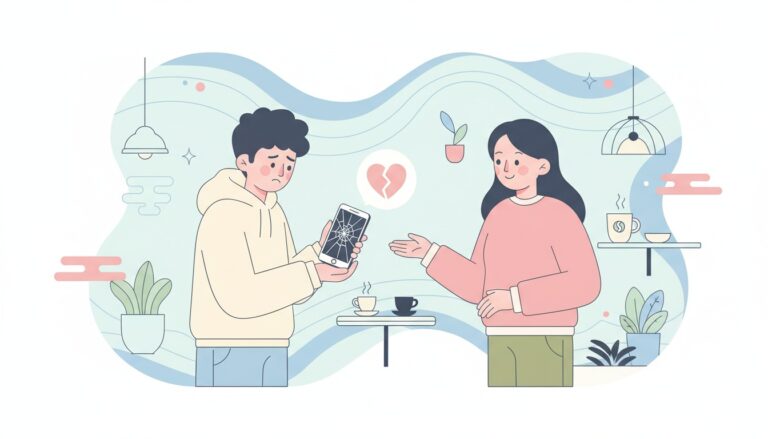
Imagine this: You borrowed your Korean friend’s portable fan (a summer essential in Korea!) or their expensive noise-canceling headphones. You were being careful, but then—CRACK. It slipped from your hand. 😱
Your heart drops. In this moment, simply saying “Sorry” (미안해) is often not enough. In Korean culture, how you react to your own mistake is just as important as the apology itself.
If you handle this poorly, you might look irresponsible. But if you handle it with the right “Korean vibe,” you might actually strengthen your friendship.
Today, we are moving beyond basic survival Korean (A1) to B1 (Intermediate) level. We will learn how to explain the situation, express deep regret, and offer a solution.
Phase 2: Deep Dive into Key Expressions
Here are the three expressions that will save your social life when disaster strikes.
1. 어떡하죠? (What should I do?)
- Pronunciation: [Eo-tteok-ha-jo] Sounds like ‘Uh-tuck-ha-joe’
- Meaning: What should I do? / Oh no!
- Editor’s Insight: This is the Magic Opener. Before you even say sorry, you need to show you are panicked. In English, you might say “Oh my god.” In Korean, starting with a worried “어떡하지?” (Casual) or “어떡하죠?” (Polite) shows you care about the object as much as they do. Do not say this calmly. Panic is key!
- Situation Check: Universal (Use
요for polite, drop it for friends).2. 제가 실수로 망가뜨렸어요. (I broke it by mistake.)
- Pronunciation: [Je-ga sil-su-ro mang-ga-tteu-ryeo-sseo-yo]
- Meaning: I broke it / ruined it by mistake.
- Editor’s Insight: At B1 level, stop using ‘했어요’ (did) for everything. 망가뜨리다 (to break/ruin/wreck) is the specific verb for non-shatterable items (like electronics or bags). If you dropped a glass, use 깨뜨렸어요.
- Situation Check: Polite/Formal.
3. 똑같은 걸로 사 줄게. (I will buy you the exact same one.)
- Pronunciation: [Ttok-ka-teun geol-lo sa jul-kke]
- Meaning: I’ll buy you the same thing.
- Editor’s Insight: This uses the grammar structure -(으)l 게, which represents a promise or volition. In Korea, offering a tangible solution immediately is the best apology. Even if they say “It’s okay,” the offer itself heals the relationship.
- Situation Check: Casual (Friends).
Phase 3: Textbook vs. Real Life
How does a robot apologize vs. a real Korean friend?
| Textbook (Correct but dry) 🤖 | Real Life (Natural & Emotional) MZ 🇰🇷 |
|---|---|
| 물건을 고장 냈습니다. (I broke the item.) |
아 어떡해… 이거 고장 난 것 같아. (Ah, what do I do… I think this is broken.) |
| 죄송합니다. (I am sorry.) |
진짜 미안해! 내가 고의로 그런 게 아니야. (I’m so sorry! I didn’t mean to do that.) |
| 보상하겠습니다. (I will compensate you.) |
내가 당장 물어 줄게! 계좌 번호 줘. (I’ll pay you back right now! Give me your bank account number.) |
💡 Note: “물어 주다” (to reimburse/pay back for damages) is a great B1 idiom to replace the formal “보상하다” or “변상하다” in casual conversation.
Phase 4: Cultural Context & Manners
The Art of “Over-Reacting” (오버 액션)
In Western cultures, staying calm is a virtue. In Korea, if you break something and stay too calm, you might seem shameless (뻔뻔하다).
- Visual Distress: Your face should look more upset than the owner’s face. If you look like you are about to cry, the Korean person will instinctively switch to comforting you (“Oh, it’s okay, don’t worry!”).
- The “Hands” Rule: When handing back the broken item, use two hands and bow your head slightly, even with friends. It shows you acknowledge the severity of the mistake.
- Refusal of Compensation: If you offer to buy a new one, they will 100% say “No, it’s fine.” Ask at least two more times. This is the dance of Nunchi. If they still say no after 3 times, buy them a nice coffee or meal instead.
Phase 5: Roleplay Script
Situation: You (Alex) borrowed a portable charger from your Korean co-worker (Minji) and dropped it. It won’t turn on.
Alex: (Looking extremely worried) 민지 씨, 어떡하죠? 제가 큰 실수를 했어요.
(Minji-ssi, what should I do? I made a big mistake.)
Minji: 네? 무슨 일이에요?
(Huh? What happened?)
Alex: 빌려주신 충전기를 떨어뜨렸는데… 작동이 안 돼요. 정말 죄송해요.
(I dropped the charger you lent me… and it’s not working. I am really sorry.)
Minji: 아, 진짜요? 괜찮아요. 좀 오래된 거라 바꿀 때 됐어요.
(Ah, really? It’s okay. It was old, so it was time to change it anyway.)
Alex: 아니에요. 제가 똑같은 걸로 변상해 드릴게요.
(No. I will compensate you with the exact same one.)
Phase 6: 10-Second Shadowing
Read this aloud to practice the rhythm of regret. Pause at the slashes /.
“진짜 미안해 / 내가 일부러 그런 게 / 절대 아니야.”
(Jin-jja mi-an-hae / nae-ga il-bu-reo geu-reon ge / jeol-dae a-ni-ya.)
“I’m really sorry. I absolutely did not do it on purpose.”
🎧 Key Point: Stress the word 절대 (Jeol-dae) to emphasize “absolutely.”
Phase 7: FAQ & Troubleshooting
- Q: Can I just give them cash immediately?
- A: Be careful. With close friends, sending money via KakaoPay is cool. But with older people or co-workers, offering to buy the actual item is more polite. Cash can sometimes feel cold or transactional.
- Q: What if I can’t find the same item?
- A: Say this: “똑같은 모델을 못 찾았는데, 더 좋은 걸로 사 드릴게요.” (I couldn’t find the same model, so I’ll buy you a better one.)
Phase 8: Wrap-up
One-Liner Summary:
When you break something, Panic first, Apologize second, and Offer to pay third.
🚀 Your Mission:
Even if you haven’t broken anything, practice the phrase “어떡하지?” (What should I do?) next time you make a small mistake (like dropping your chopsticks). See if your Korean friends laugh at your natural reaction!
Phase 9: Pop Quiz
Which reaction is the MOST culturally appropriate for a B1 learner?
- (Smiling) Oops, I broke it. Sorry.
- (Serious face) 어떡하죠? 제가 실수로 망가뜨렸어요. 변상할게요.
- (Calm face) 이거 얼마예요? 돈 줄게요.
(Scroll down for answer)
Answer: 2. Number 1 is too light, and Number 3 is rude/transactional. Number 2 shows worry, acknowledges the mistake, and offers a solution.
Frequently Asked Questions (FAQ)
Q: What does "어떡하죠? (What should I do?)" mean in Korean and how do you pronounce it?
A: In Korean, "어떡하죠? (What should I do?)" is pronounced [Eo-tteok-ha-jo] and means: What should I do? / Oh no!
Q: What does "똑같은 걸로 사 줄게. (I will buy you the exact same one.)" mean in Korean and how do you pronounce it?
A: In Korean, "똑같은 걸로 사 줄게. (I will buy you the exact same one.)" is pronounced [Ttok-ka-teun geol-lo sa jul-kke] and means: I'll buy you the same thing.







