

Introduction: Why Do I Still Sound Like a Robot?
Hello! This is your Senior Editor at Daily Hangul. 👋
Let me guess your current situation. You’ve reached an Intermediate (B2) level. You can order food, introduce yourself, and even crack a joke or two. But there’s one moment where you freeze: The “Gray Area” of Politeness.
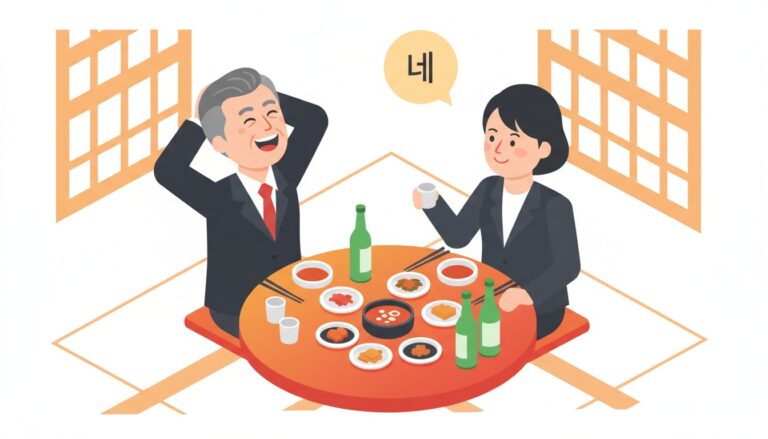
Imagine this: You are at a company dinner (Hoesik) with your boss. It’s a relaxed atmosphere. He’s laughing. If you use strict formal language (-nida style), you kill the vibe and sound like a soldier. If you use casual language (Banmal), you might get fired (okay, maybe just a death stare). 😅
Many of my B2 students confess, “Teacher, I feel like I’m either too stiff or too rude. There is no middle ground!”
Today, we are going to master the art of Situation-Based Honorifics. This isn’t just about grammar; it’s about social distance management. Let’s turn you from a “foreigner who speaks Korean” into a “communicator who understands Korea.”
Phase 2: Deep Dive (Key Expressions)
Here are three power moves to navigate the polite-but-friendly zone.
1. The Magic Particle: -(으)시-
At B2 level, you know this inserts respect. But the trick is when to drop it in casual endings.
어디 가세요? (Eodi ga-seyo?)
- Pronunciation: [Eodi ga-seh-yo?] ‘Se’ sounds like ‘Say’ without the heavy ‘y’ glide.
- Meaning: Where are you going?
- Editor’s Insight: This is the ultimate “Social Lubricant.” You are using the polite ending (-yo), but by adding -si- (becoming -seyo), you are elevating the listener.
- Situation Check: Use this with anyone older than you, strangers, or superiors, even in relaxed settings. Never use this for yourself (e.g., “I go” is never “Ga-seyo”).
2. Asking for Permission to Lower Speech: 말씀 낮추세요
편하게 말씀 낮추세요. (Pyeonhage malsseum natchuseyo.)
- Pronunciation: [Pyeon-ha-ge mal-sseum nat-chu-se-yo]
- Meaning: Please speak comfortably/casually (literally: Please lower your words comfortably).
- Editor’s Insight: If an older Korean person keeps using formal polite language with you, it creates a wall. Saying this shows you are culturally aware and want a closer relationship. It’s a very classy move.
- Situation Check: Use when an older person or superior is being too polite to you.
3. The Humble Suggestion: -(으)실래요?
이거 드셔 보실래요? (Igeo deusyeo bosillaeyo?)
- Pronunciation: [I-geo deu-shyeo bo-shil-lae-yo?] ‘Lae’ sounds like the ‘la’ in ‘layout’.
- Meaning: Would you like to try eating this?
- Editor’s Insight: -(으)ㅂ시다 (Let’s do…) can sound bossy to a superior. -(으)실래요? asks for their preference gently. It’s soft, polite, but friendly.
- Situation Check: Perfect for lunch with coworkers or offering a snack to a senior acquaintance.
Phase 3: Textbook vs. Real Life
Textbooks love the “Soldier Style” (Hasipsio-che). Real life loves the “Soft Professional” style.
| Textbook (Too Stiff/Formal) | Real Life (Natural & Sense-ful) | Nuance Check |
|---|---|---|
| 식사하셨습니까? (Siksa-hasyeot-seumnikka?) |
식사하셨어요? (Siksa-hasyeosseoyo?) |
The left sounds like an interrogation. The right sounds like you care. |
| 저에게 주십시오. (Jeoege jusipsio.) |
저한테 주시겠어요? (Jeohante jusigesseoyo?) |
Using Hante and Gesseoyo softens the demand into a request. |
| 죄송합니다. (Joesong-hamnida.) |
죄송해요, 제가 실수했네요. (Joesong-haeyo, jega silsu-henneyo.) |
Mixing polite endings with an explanation is more human than a robotic apology. |
Bottom Note: At the B2 level, your goal is not just correctness, but connection. Moving from -(스)ㅂ니다 to -아요/어요 while keeping honorific vocabulary (like Siksa instead of Bap) is the key to sounding fluent.
Phase 4: Cultural Context (The Art of ‘Nunchi’)
The “Eye Contact” Rule
In Western culture, strong eye contact shows confidence. In Korea, staring too intensely at a superior (especially while they are scolding you or giving a speech) can be seen as defiant.
* Tip: Look at the person’s nose or mouth area occasionally to soften your gaze. This is non-verbal honorifics!
The “Buffer” Silence
When a superior asks a difficult question, answering immediately with a flat “No” is rude.
* The Korean Way: Hesitate for a second. “아… 그게…” (Ah… well…). This hesitation signals, “I want to say yes, but I can’t, and I’m sorry about that.” It preserves their “Face” (Che-myeon).
Phase 5: Real-Life Scenario (Roleplay)
Setting: A cafe meeting. Mark (Foreigner, Employee) is ordering coffee for Manager Park (Korean, Superior).
(Manager Park is looking at the menu)
Mark: 부장님, 뭐 드시겠어요? (Manager, what would you like to have?)
[Bujang-nim, mwo deusi-gesseoyo?]
Manager: 난 그냥 아아(아이스 아메리카노). 마크 씨는? (I’ll just have Iced Americano. What about you, Mark?)
[Nan geunyang Ah-Ah. Mark-ssi neun?]
Mark: 저는 라떼 마실게요. (I will drink a latte.)
[Jeoneun latte masil-keyo.]
(Mark goes to the counter. Manager hands him a card.)
Manager: 법인 카드로 계산해. (Pay with the corporate card.)
Mark: (Taking it with two hands) 네, 알겠습니다. 감사합니다! ((Two hands) Yes, understood. Thank you!)
[Ne, alget-seumnida. Gamsahamnida!]
Acting Tip: Notice how Mark uses “드시다” (Honorific verb) for the Manager, but “마시다” (Regular verb) for himself? This distinction creates the perfect level of politeness.
Phase 6: 10-Second Shadowing
Let’s practice a sentence that is polite but natural for a request.
“Could you please help me for a moment if you have time?”
시간 되시면 / 잠깐만 / 도와주실 수 / 있으세요?
[Si-gan dwe-si-myeon / jam-kkan-man / do-wa-ju-sil su / it-seu-se-yo?]
- Key Focus: Pitch up slightly at the end (-yo?) to sound inviting, not demanding. Pause briefly after dwe-si-myeon.
Phase 7: FAQ (Troubleshooting)
Q: My coworker is younger than me, but he entered the company first (Senior). Can I use Banmal?
A: Absolute NO. In the workplace, rank/experience usually overrides age. Use polite language (Yo-ending) until you both agree to switch. It’s safer to be too polite than rude.
Q: Can I mix “-nida” and “-yo”?
A: YES! This is what native speakers do. Use -nida for factual statements or starting a presentation, and -yo for emotional connection or lighter topics. It makes your speech have rhythm.
Phase 8: Wrap-up
One-Liner Summary:
True B2 proficiency is knowing how to lower yourself (Humble) and elevate the listener (Honorific) without sounding like a textbook robot.
🔥 Today’s Mission:
Go to a cafe or convenience store. When the staff gives you something, instead of just “감사합니다” (Thanks), try adding eye contact and a slight bow while saying “수고하세요” (Keep up the good work / Thank you for your effort). Watch their expression change!
Have you ever accidentally used Banmal to a stranger? Tell me your horror story in the comments! 👇
Phase 9: Pop Quiz 📝
1. You are suggesting a lunch menu to your boss. Which is the MOST natural and polite B2 level expression?
a) 김치찌개 먹어. (Kimchi-jjigae meogeo.)
b) 김치찌개 드실래요? (Kimchi-jjigae deusillaeyo?)
c) 김치찌개 먹읍시다. (Kimchi-jjigae meogeupsida.)
2. How do you say “Please speak comfortably/casually” to an older person who is being too formal?
a) 말 놓으세요. (Mal noeuseyo – Direct)
b) 말씀 낮추세요. (Malsseum natchuseyo – Polite/Indirect)
c) 조용히 하세요. (Joyonghi haseyo – Be quiet)
3. Which sentence correctly uses the Humble form?
a) 제가 사장님을 데리고 왔어요. (I brought the boss.)
b) 제가 사장님을 모시고 왔어요. (I escorted/brought the boss.)
c) 제가 사장님을 잡고 왔어요. (I caught the boss.)
(Answers: 1-b, 2-b, 3-b)
Frequently Asked Questions (FAQ)
Q: What does ""드시다"" mean in Korean and how do you pronounce it?
A: In Korean, ""드시다"" is pronounced [Honorific verb] and means: for the Manager, but
Q: What does ""마시다"" mean in Korean and how do you pronounce it?
A: In Korean, ""마시다"" is pronounced [Regular verb] and means: for himself? This distinction creates the perfect level of politeness.







