

Introduction: The K-Drama Fantasy vs. My Student’s Sweat
Hello, Daily Hangul family! This is your Head Editor.
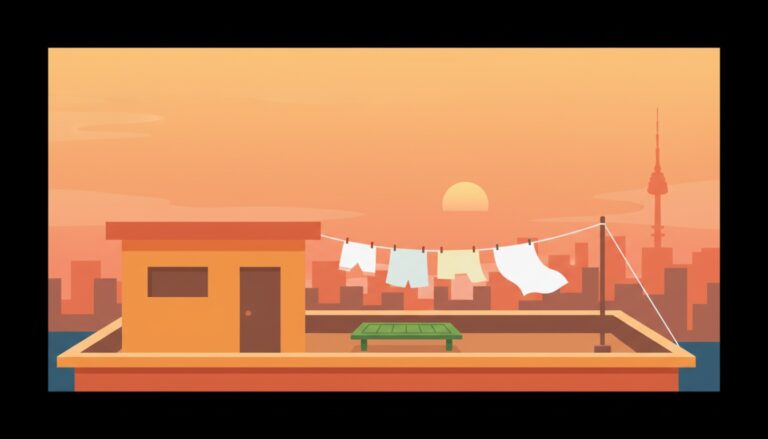
Raise your hand if you’ve seen this scene in a K-Drama: The protagonist, usually a hardworking candy-type character, lives on a rooftop. They drink Soju on a flat wooden platform (Pyeong-sang) while looking at the beautiful Seoul night view. It looks so romantic, right?
I recently had a student, Alex, who insisted on renting an 옥탑방 (Oktapbang – Rooftop Room) immediately after landing in Seoul. Two weeks later, he came to class looking exhausted. “Teacher,” he said, “I didn’t know I would be climbing Mount Everest every day just to go home.”
Today, we are going to learn the B1 level expressions you need to discuss housing in Korea—specifically, how to talk about the romance and the harsh reality of rooftop living. Knowing these phrases won’t just improve your Korean; it might save you from freezing in winter or melting in summer!
Phase 2: Deep Dive into Key Expressions
1. 옥탑방 (Oktapbang)
- Pronunciation: [Ok-tap-bang] Think of ‘Oak’ tree + ‘Top’ + ‘Bang’ (like a drum).
- Meaning: Rooftop Room / Rooftop House
- Editor’s Insight: This word combines ‘Ok’ (Roof/House top) + ‘Tap’ (Tower) + ‘Bang’ (Room). It carries a unique cultural nuance: “Youth, Struggle, and Freedom.” It’s usually the cheapest housing option, but it offers the best views.
- Situation Check: Safe to use with everyone.
2. 여름엔 덥고 겨울엔 춥다 (Yeoreum-en deopgo gyeoul-en chupda)
- Pronunciation: [Yeo-reum-en deop-go gyeo-ul-en chup-da]
- Meaning: It’s hot in summer and cold in winter.
- Editor’s Insight: This is the classic sentence Koreans use to describe an Oktapbang. The grammar point ~고 (-go) connects two descriptive verbs.
- Real nuance: “Prepare yourself for extreme weather.”
- Situation Check: Casual to Polite (Informal: ~추워 / Formal: ~춥습니다).
3. 수압이 약하다 (Su-ab-i yak-ha-da)
- Pronunciation: [Su-a-bi ya-ka-da] ‘Su’ like ‘Sue’, ‘Ab’ like ‘Up’ but softer.
- Meaning: The water pressure is weak.
- Editor’s Insight: Because rooftop rooms are at the top of the building, water often has to travel far against gravity. If you are viewing a house, you must turn on the faucet and say this phrase if the water just trickles out.
- Situation Check: Essential for house hunting.
Phase 3: Textbook vs. Real Life
Let’s upgrade your Korean from “Classroom Robot” to “Seoul Resident.”
| Textbook Korean (Standard) | Real Life Korean (Natural/Trend) |
|---|---|
| 전망이 아주 좋아요. (The view is very good.) |
뷰가 예술이에요! / 뷰 맛집이네. (The view is art! / This place is a ‘view restaurant’ [delicious view].) |
| 계단이 많아서 힘들어요. (It is hard because there are many stairs.) |
엘베가 없어서 죽겠어요. (I’m dying because there’s no ‘El-be’ [Elevator].) |
| 방이 낭만적이에요. (The room is romantic.) |
옥탑 감성 미쳤다. (The rooftop ‘vibe’ is crazy/insane.) |
Editor’s Note: “감성 (Gamseong)” is a huge buzzword in Korea right now. It means vibe, feeling, or sensitivity. “옥탑 감성” is that specific cozy, retro feeling of rooftop living.
Phase 4: Cultural Context & Manners
1. The “Samgyeopsal” Rule
One major perk of the Oktapbang is the outdoor space (옥상 – Oksang). In dramas, people always grill pork belly (Samgyeopsal) there.
* Reality: In real life, check with your landlord (집주인) first! Some buildings forbid open flames or loud gatherings.
2. Layer Noise (층간소음)
Even though you are on the roof, your floor is someone else’s ceiling.
* Nunchi Tip: If you walk around with heavy heels or drag chairs late at night, the person living below will come up to complain. Wear slippers (슬리퍼) inside!
Phase 5: Real Life Scenario (Roleplay)
Setting: Sarah (Foreigner) is checking out a rooftop room with Minji (Korean friend).
Sarah: (Looking at the view)
와, 진짜 뷰가 예술이다! 드라마 주인공이 된 것 같아.
(Wa, jin-jja byu-ga ye-sul-i-da! Drama ju-in-gong-i doen geot ga-ta.)
Wow, the view is art! I feel like a drama protagonist.
Minji: (Checking the window frames)
낭만은 있는데… 난방비 걱정 안 돼? 여기 창문이 얇아.
(Nang-man-eun it-neun-de… nan-bang-bi geok-jeong an dwae? Yeo-gi chang-mun-i yal-a.)
It has romance, but… aren’t you worried about heating bills? The windows are thin here.
Sarah: 아, 맞다. 한국 겨울은 춥지?
(Ah, mat-da. Han-guk gyeo-ul-eun chup-ji?)
Ah, right. Korean winters are cold, right?
Minji: 응, 옥탑방은 여름엔 덥고 겨울엔 추워. 잘 생각해야 돼.
(Eung, Oktapbang-eun yeo-reum-en deop-go gyeo-ul-en chu-wo. Jal saeng-gak-hae-ya dwae.)
Yeah, rooftop rooms are hot in summer and cold in winter. You need to think carefully.
Phase 6: 10-Second Shadowing Drill
Don’t just read it, say it out loud! Focus on the contrast intonation.
“The view is great, but the water pressure is a bit weak.”
Sentence:
전망은 좋은데, / 수압이 좀 / 약해요.
Pronunciation Guide:
Jeon-mang-eun jo-eun-de, / Su-a-bi jom / ya-kae-yo.
- Tip: Pause slightly at the
/. Stress the words 전망 (View) and 수압 (Water pressure) to highlight the contrast.
Phase 7: FAQ & Troubleshooting
- Q: Can I use “방 (Bang)” to talk to a realtor?
- A: Yes! But in a formal setting (like signing a contract), using 매물 (Mae-mul) which means ‘property for sale/rent’ makes you sound like a pro. But for B1 level, “방” or “집” is perfectly fine.
- Q: Is it rude to ask about mold (곰팡이)?
- A: Absolutely not! It is essential. You can say: “혹시 곰팡이 문제는 없나요?” (By any chance, are there any mold problems?). Mold is common in Oktapbang due to humidity difference.
Phase 8: Wrap-up & Action Item
- Summary: Oktapbangs offer a romantic “뷰 맛집” (great view) but come with the reality of being “여름엔 덥고 겨울엔 춥다” (extreme weather).
- Mission: Next time you are in a cafe or building with a high view, say to yourself (or a friend): “와, 여기 뷰가 예술이네!” (Wow, the view here is art!)
-
Discussion: Would you trade comfort for a K-Drama romantic rooftop life? Tell me in the comments!
Phase 9: Pop Quiz
1. Which word best fills the blank?
“This rooftop room has a great vibe!”
= 이 옥탑방 완전 _____ 있다!
(A) 냄새 (Smell)
(B) 감성 (Vibe/Sentiment)
(C) 수압 (Water Pressure)
2. How do you say “The water pressure is weak”?
(A) 수압이 세요.
(B) 수압이 없어요.
(C) 수압이 약해요.
3. What is the “Reality” of Oktapbang described in the post?
(A) There are elevators everywhere.
(B) It is hot in summer and cold in winter.
(C) The rent is always expensive.
(Answers: 1. B, 2. C, 3. B)
Frequently Asked Questions (FAQ)
Q: What does "옥탑방 (Oktapbang)" mean in Korean and how do you pronounce it?
A: In Korean, "옥탑방 (Oktapbang)" is pronounced [Ok-tap-bang] and means: Rooftop Room / Rooftop House
Q: What does "여름엔 덥고 겨울엔 춥다 (Yeoreum-en deopgo gyeoul-en chupda)" mean in Korean and how do you pronounce it?
A: In Korean, "여름엔 덥고 겨울엔 춥다 (Yeoreum-en deopgo gyeoul-en chupda)" is pronounced [Yeo-reum-en deop-go gyeo-ul-en chup-da] and means: It's hot in summer and cold in winter.
Q: What does "수압이 약하다 (Su-ab-i yak-ha-da)" mean in Korean and how do you pronounce it?
A: In Korean, "수압이 약하다 (Su-ab-i yak-ha-da)" is pronounced [Su-a-bi ya-ka-da] and means: The water pressure is weak.







