

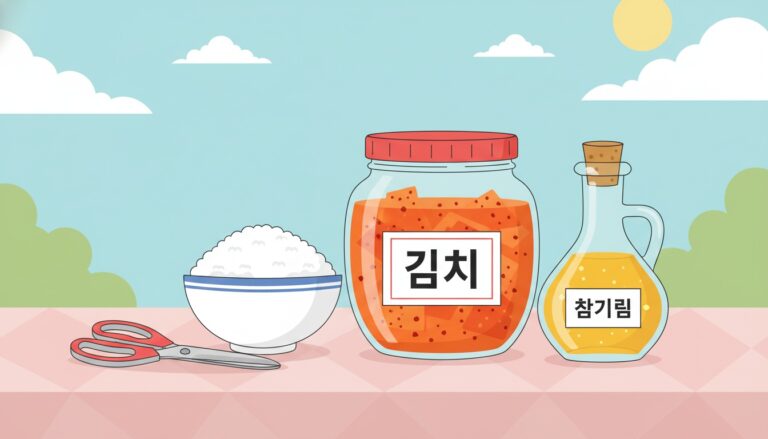
Phase 1: Introduction (안녕하세요!)
Hello! This is your Daily Hangul Editor. 👋
So, you’ve watched a K-Drama, and there’s that scene—someone comes home late, opens the fridge, dumps some red spicy cabbage into a pan with rice, and eats it with such joy. Yes, today we are preparing ingredients for Kimchi-bokkeumbap (Kimchi Fried Rice)!
Many of my students tell me, “Teacher, I tried making it, but it tasted just like… warm spicy salad with rice. It wasn’t tasty!”
The secret isn’t just the cooking skill; it’s choosing the right ingredients. If you use the wrong Kimchi, the game is over before you start. Today, I’ll teach you the specific words you need to find the perfect ingredients so your Korean friends will say, “Wa, jinjja masisseo!” (Wow, delicious!).
Let’s get your kitchen ready!
Phase 2: Deep Dive (Core Expressions)
Here are the 3 ingredient-related terms that will save your cooking.
1. 신김치 (Sin-gimchi)
- Pronunciation: [Sin-gimchi] Sounds like ‘Sheen-gim-chee’
- Meaning: Sour (Fermented) Kimchi
- Editor’s Insight: 💡 This is the most important part! You cannot use fresh Kimchi for fried rice. It must be sour. ‘Sin’ comes from the adjective ‘sida’ (sour). If you go to a market, ask specifically for this.
- Situation Check: Essential for cooking. Not usually eaten as a side dish alone because it’s too strong.
2. 참기름 (Chamgireum)
- Pronunciation: [Cham-gi-reum] ‘Cham’ like ‘Charm’ + ‘Gi’ like ‘Geese’ + ‘Reum’ (Roll the R, sounds a bit like ‘room’)
- Meaning: Sesame Oil
- Editor’s Insight: This is the magic sauce. Just one spoon at the end changes everything. Don’t confuse it with cooking oil (Sikyongyu). Cham means ‘true/real’, so it’s the ‘real oil’!
- Situation Check: Used for seasoning, not deep frying!
3. 썰다 (Sseol-da)
- Pronunciation: [Sseol-da] Sounds like ‘Sol-da’
- Meaning: To chop / To slice
- Editor’s Insight: In English, we ‘cut’ paper and ‘cut’ vegetables. In Korean, we usually ‘jareuda’ (cut paper/hair) but ‘sseolda’ (chop food ingredients). If you say “Kimchi jallajuseyo,” it’s understood, but “Kimchi sseoreojuseyo” sounds like a chef.
- Situation Check: Use this when preparing food ingredients.
Phase 3: Textbook vs. Real Life
How to sound like a local when shopping or prepping.
| Textbook Korean (Standard) | Real Life Korean (Natural) | Note |
|---|---|---|
| 김치를 주세요. (Please give me Kimchi.) | 신김치 있어요? (Do you have sour Kimchi?) | For cooking, specificity is key! |
| 김치를 작게 자르세요. (Cut the Kimchi small.) | 가위로 대충 썰어요. (Roughly chop it with scissors.) | Real Koreans use scissors for Kimchi! |
| 기름을 넣으세요. (Put in oil.) | 참기름 한 바퀴 둘러요. (Swirl the sesame oil once around.) | A common cooking instruction. |
Note: “대충” (Daechung) means roughly/loosely. In home cooking, we don’t measure perfectly!
Phase 4: Cultural Context (Korean Manners)
✂️ The Scissor Culture
In Western cooking, using scissors (Gawi) for food might look strange. But in Korea, scissors are the ultimate kitchen tool.
When preparing Kimchi for fried rice, putting it on a cutting board will stain the board red (and it never comes off!).
* Local Tip: Put the Kimchi in a bowl and use scissors to snip it vertically inside the bowl. No mess, clean cutting board! If you see a Korean doing this, don’t look shocked—it’s efficiency!
Phase 5: Real Scenario (Roleplay)
Setting: Alex is at a small Korean mart, looking for ingredients for dinner.
👩🏻 Ajumma (Store Owner): 어서 오세요! 뭐 찾으세요?
(Eoseo oseyo! Mwo chajeuseyo? / Welcome! What are you looking for?)
🧑🏼 Alex: 안녕하세요! 김치볶음밥 만들 거예요.
(Annyeonghaseyo! Kimchi-bokkeumbap mandeul geoyeyo. / Hello! I’m going to make Kimchi fried rice.)
👩🏻 Ajumma: 아, 그럼 신김치 사야 돼요.
(Ah, geureom sin-gimchi saya dwaeyo. / Ah, then you need to buy sour Kimchi.)
🧑🏼 Alex: 네, 그리고 참기름도 주세요.
(Ne, geurigo chamgireum-do juseyo. / Yes, and please give me sesame oil too.)
Acting Tip: When saying “Ah~” at the beginning of the sentence, nod your head slightly to show you understand the context!
Phase 6: 10-Second Shadowing
Let’s practice the most crucial instruction for this dish. Read this out loud for 10 seconds!
“신김치를 / 가위로 / 작게 / 썰어요.”
(Sin-gimchi-reul / ga-wi-ro / jak-ge / sseor-eo-yo.)Meaning: Chop the sour Kimchi small with scissors.
- Intonation: Raise your pitch slightly on ‘Kimchi’ and ‘Gawi’.
- Pause: Pause briefly after ‘Kimchi’ and ‘Scissors’ for clarity.
Phase 7: FAQ (Troubleshooting)
- Q: Can I use ‘Sin-gimchi’ for regular eating (side dish)?
- A: You can, but it might be too sour (face-scrunching sour). It is best for stews (Jjigae) or fried rice. For just eating, look for 맛김치 (Mat-gimchi) or 겉절이 (Geot-jeori – Fresh Kimchi).
- Q: Is ‘Sseolda’ (to chop) rude?
- A: No! It is the standard verb for cooking. You can use it with friends or teachers when talking about food prep.
Phase 8: Wrap-up
Today’s One-Liner: To make tasty fried rice, you need Sin-gimchi (Sour Kimchi), not fresh ones!
🚀 Your Mission: Open your fridge or go to a Korean mart. Find a jar of Kimchi. Smell it. If it smells strong and sour, say out loud: “이거 신김치예요!” (This is sour Kimchi!). If it smells fresh, wait a few days before cooking!
Tell me in the comments: Do you prefer your Kimchi fresh (crunchy) or sour (soft)? 👇
Phase 9: Quiz
- Which ingredient is best for Kimchi Fried Rice?
a) Geot-jeori (Fresh Kimchi)
b) Sin-gimchi (Sour Kimchi)
c) Mul-kimchi (Water Kimchi) -
What tool do Koreans often use to cut Kimchi easily?
a) Knife
b) Spoon
c) Scissors (Gawi) -
What is “Sesame Oil” in Korean?
a) Chamgireum
b) Sikyongyu
c) Ganjang
(Scroll down for answers)
Click to see answers
1. b) Sin-gimchi
2. c) Scissors
3. a) Chamgireum
Frequently Asked Questions (FAQ)
Q: What does ""이거 신김치예요!"" mean in Korean and how do you pronounce it?
A: In Korean, ""이거 신김치예요!"" is pronounced [This is sour Kimchi!] and means: . If it smells fresh, wait a few days before cooking!







