Introduction: The Mystery of the Pink Seat 🌸
Hello, Daily Hangul family! It’s your Senior Editor here.
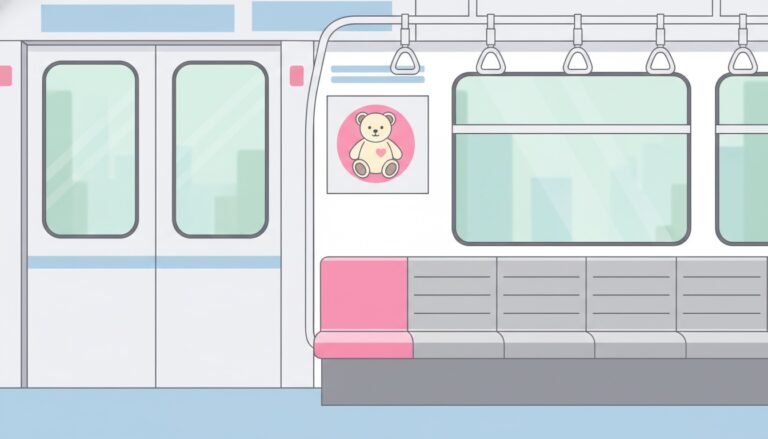
Imagine this: You are on the Seoul Subway (Line 2, perhaps?). It is packed like a can of sardines. Suddenly, you spot a miracle—one empty seat. But wait… the seat is bright pink, and there is a sticker of a teddy bear or a baby on the wall above it.
Do you sit? Or do you stand?
If you sit there, you might feel thousands of eyes burning a hole in your back. Today, we are decoding the “Pink Seat” (Pregnant Women’s Priority Seat). Knowing this isn’t just about language; it prevents awkward misunderstandings and makes you look like a respectful “local” instantly.
Note: This guide assumes you are an absolute beginner (A1).
Phase 2: Deep Dive (Key Expressions)
Here are the top 3 expressions you need to survive the Pink Seat zone.
1. 임산부 배려석 (Im-san-bu bae-ryeo-seok)
- Pronunciation: [Im-san-bu bae-ryeo-seok]
- Sound like: “Im” (like Impossible) + “San” (like San Diego) + “Bu” (like Boo!) + “Bae” (like Bed) + “Ryeo” (like Rio de Janeiro) + “Seok” (like Suck, but softer).
- Meaning: Pregnant Women’s Priority Seat.
- Editor’s Insight: You don’t need to say this word, but you must read or hear it. If you see this written in pink, that seat is sacred territory.
2. 여기 앉으세요 (Yeogi anjeuseyo)
- Pronunciation: [Yeo-gi an-jeu-se-yo]
- Sound like: “Yo-gi” (like Yogi Bear) + “An” (like On) + “Jeu” (like Juice) + “Se-yo” (Say-Yo).
- Meaning: Please sit here.
- Situation Check: Perfect when you are sitting (by mistake) or standing nearby, and you see a pregnant woman approaching.
- Formality: Polite (Honorific). Safe to use with everyone.
3. 죄송합니다 (Joesonghamnida)
- Pronunciation: [Joe-song-ham-ni-da]
- Sound like: “Jay-song” + “Ham” (like Hamburger) + “Ni-da” (Knee-da).
- Meaning: I am sorry.
- Editor’s Insight: If an elderly person or a pregnant woman scolds you for sitting there, don’t panic. Just say this, bow slightly, and stand up. It fixes everything.
Phase 3: Textbook vs. Real Life
Books teach you stiff grammar. Koreans use nunchi (awareness).
| Situation | Textbook / Formal 🤖 | Real Life / Natural 🇰🇷 |
|---|---|---|
| Offering a seat | 이 자리에 앉으십시오. (Please sit in this seat.) | 여기요! (Over here!) + Gesturing to seat |
| Apologizing | 대단히 죄송합니다. (I am terribly sorry.) | 아, 죄송해요. (Ah, sorry.) + Stand up quickly |
| Is this seat taken? | 여기 사람이 있습니까? (Is a person here?) | (Koreans rarely ask. They just look for a bag on the seat.) |
Editor’s Tip: For A1 beginners, body language is 80% of the communication here. A warm smile + pointing at the empty seat is often more powerful than perfect grammar.
Phase 4: Cultural Context (The “Pink Badge” Rule)
🛑 The Golden Rule of the Pink Seat
In Korea, you will see women carrying a Pink Badge (a keychain) on their bags.
- What it means: “I am pregnant.”
- The Twist: Even if a woman does NOT look pregnant (early stages), if she has that badge, she gets the seat. No questions asked.
The “Nunchi” (Eye-measure) Game:
Many Koreans leave this seat empty even when the train is full.
* Can I sit there if it’s empty?
* Strictly speaking? Maybe.
* Socially? Better not. If you sit there, act like you are sitting on thorns—be ready to jump up instantly.
Phase 5: Roleplay Scenario
Setting: Subway Line 2 (Green Line). It is rush hour.
Characters:
* Alex: A tourist (sitting in the pink seat by accident).
* Jimin: A Korean woman with a Pink Badge on her bag.
(Jimin stands in front of Alex. She sighs softly.)
Alex: (Notices the pink badge on her bag. Realizes his mistake!)
아! 죄송합니다!
(Ah! Joesonghamnida!)
Ah! I’m sorry!
(Alex stands up immediately and gestures to the seat.)
Alex: 여기 앉으세요.
(Yeogi anjeuseyo.)
Please sit here.
Jimin: (Smiles) 감사합니다.
(Gamsahamnida.)
Thank you.
Phase 6: 10-Second Shadowing Drill
Let’s practice the magic phrase to be a kind hero.
Read this aloud while imagining you are offering your seat.
여기 / 앉으세요.
Yeogi / anjeuseyo.
(Here / sit please.)
- Focus Point: Stress the “Yeo” in Yeogi and raise your tone slightly at “Se-yo” to sound inviting, not demanding.
Phase 7: FAQ & Troubleshooting
Q: Is the Pink Seat the same as the Grey Seat (Elderly Seat)?
A: No! The Grey Seats (usually at the ends of the car) are for the elderly. The Pink Seat is specifically for expecting mothers. But honestly? If you are young and healthy, avoid both if possible.
Q: Can I sit there if I have a heavy bag?
A: Generally, No. People might stare. It is better to put your bag on the shelf above.
Phase 8: Wrap-up
Today’s Summary:
If you see a Pink Seat or a Pink Badge, keep the seat empty or offer it immediately with “Yeogi anjeuseyo.”
Mission of the Day:
Next time you take public transport (even in your country), try to spot the priority seats. If you were in Korea, would you be standing or sitting right now?
Let’s Chat:
Have you ever sat in a priority seat by mistake in another country? Tell me your story in the comments! 👇
Phase 9: Pop Quiz 📝
1. What color represents the Pregnant Women’s Priority Seat in Korea?
A) Blue
B) Pink
C) Green
2. What should you say when offering a seat?
A) Yeogi anjeuseyo (Sit here)
B) Jal ga (Bye)
C) Hajima (Don’t do it)
3. True or False: You should only offer the seat if the woman looks heavily pregnant.
(Hint: Remember the badge!)
(Scroll down for answers)
.
.
.
Answers: 1. B, 2. A, 3. False (Look for the badge!)
Frequently Asked Questions (FAQ)
Q: What does "임산부 배려석 (Im-san-bu bae-ryeo-seok)" mean in Korean and how do you pronounce it?
A: In Korean, "임산부 배려석 (Im-san-bu bae-ryeo-seok)" is pronounced [Im-san-bu bae-ryeo-seok] and means: a key conversational Korean expression covered in this lesson.
Q: What does "여기 앉으세요 (Yeogi anjeuseyo)" mean in Korean and how do you pronounce it?
A: In Korean, "여기 앉으세요 (Yeogi anjeuseyo)" is pronounced [Yeo-gi an-jeu-se-yo] and means: a key conversational Korean expression covered in this lesson.
Q: What does "죄송합니다 (Joesonghamnida)" mean in Korean and how do you pronounce it?
A: In Korean, "죄송합니다 (Joesonghamnida)" is pronounced [Joe-song-ham-ni-da] and means: a key conversational Korean expression covered in this lesson.