

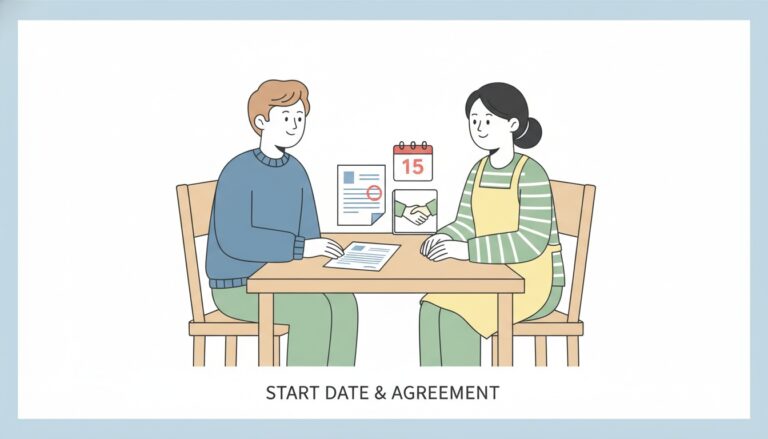
1. Introduction: The Moment of Truth
Hello! This is your Senior Editor at Daily Hangul.
Imagine this: You are studying abroad in Seoul. You found a perfect cafe near your university with a sign that says “알바 구함” (Staff Wanted). You walk in, muster up your courage, and hand over your resume. The manager looks at it, nods, and then looks you in the eye to ask:
“그래서, 언제부터 일할 수 있어요?”
(So, when can you start working?)
Your heart races. You know the days of the week, but how do you say “I can start literally right now” or “I need to finish exams first” without sounding rude?
If you hesitate here, the manager might think you aren’t confident. But don’t worry! Today, we will learn the magic phrases to secure that job on the spot. As a tutor who has helped many students get their first “Alba” (part-time job), I’ve got your back.
2. Deep Dive: Core Expressions
Here are the three most critical phrases you need to answer the “Availability” question.
1. [바로 일할 수 있어요]
- Pronunciation: [Baro il-hal su isseo-yo]
(Tip: ‘Baro’ sounds a bit like ‘Borrow’ but shorter. ‘Il’ sounds like ‘Eel’.) - Meaning: I can work right away / immediately.
- Editor’s Insight: This is the Gold Standard answer. In the fast-paced Korean service industry, managers love people who are ready now. Even if you can actually start tomorrow, saying “Baro” (immediately) shows immense enthusiasm.
- Situation Check: 🟢 Formal/Interview (Perfect for impressing the boss).
2. [다음 주부터 가능해요]
- Pronunciation: [Daeum ju-buteo ga-neung-hae-yo]
- Meaning: It is possible [to start] from next week.
- Editor’s Insight: Use this if you genuinely need time. ‘가능해요’ (Possible) is a very useful, polite word in interviews. It sounds professional and soft compared to just saying “Next week.”
- Situation Check: 🟢 Formal/Interview (Safe and polite).
3. [화요일하고 목요일만 돼요]
- Pronunciation: [Hwayoil-hago Mogyoil-man dwae-yo]
- Meaning: Only Tuesday and Thursday work.
- Editor’s Insight: This is for when your schedule is fixed (like due to classes). The particle ‘-만’ (man) means ‘only’. It sets a clear boundary. Be sure to say this apologetically if the boss wants you every day!
- Situation Check: 🟢 Formal/Interview (Direct but necessary).
3. Textbook vs. Real Life
Textbooks teach you to be robotic. Real life requires you to be human. Here is the difference.
| Textbook Korean 🤖 | Real “Street” Korean 🇰🇷 |
|---|---|
| 언제든지 좋습니다. (Anytime is good.) Sounds a bit like a soldier. |
시간 다 괜찮아요! (All times are fine!) Friendly and flexible. |
| 월요일은 안 됩니다. (Monday is not possible.) A bit cold/direct rejection. |
월요일은 수업이 있어서요… (I have class on Monday, so…) Soft refusal with a reason. |
| 내일부터 할 수 있습니다. (I can do it from tomorrow.) |
내일부터 바로 출근 가능해요. (I can come to work right from tomorrow.) Uses ‘Chul-geun’ (clock-in) for a pro vibe. |
Editor’s Note: As an A2 learner, stick to the Real Korean column to sound less like a foreigner reading a script and more like a potential team member.
4. Cultural Context: The Art of “Nunchi”
In a Korean job interview, your answer is only 50% of the communication. The other 50% is Attitude and Nunchi (sensing the vibe).
- The “Eagerness” Factor: If the cafe looks busy and the manager looks stressed, the correct answer is almost always “바로 일할 수 있어요” (Right away). If you hesitate, they might hire the next person who says “Yes.”
- Eye Contact: Do not stare into the manager’s soul. In Western culture, strong eye contact shows confidence. In Korea, too much direct eye contact can be seen as challenging authority. Look at their nose or chin occasionally.
- ** posture:** When saying these phrases, lean forward slightly. It shows you are engaged and eager to listen.
5. Real-Life Scenario (Roleplay)
Setting: A busy convenience store (Pyeonuijeom). You are being interviewed by the owner (Sajang-nim).
Characters:
* Min-su: The strict but tired owner.
* Alex: The foreign student (You).
Min-su: (Looking at schedule) 우리 가게는 주말에 아주 바빠요. 혹시 주말에도 일할 수 있어요?
(Our store is very busy on weekends. By any chance, can you work on weekends too?)
Alex: (Nodding eagerly) 네! 주말은 다 괜찮아요.
(Yes! Weekends are all fine.)
Min-su: 오, 그래요? 그럼 언제부터 나올 수 있어요?
(Oh, really? Then when can you come in?)
Alex: 내일부터 바로 가능해요! 열심히 하겠습니다.
(I can start right from tomorrow! I will work hard.)
Min-su: (Smiling) 좋아요. 내일 봅시다.
(Good. See you tomorrow.)
6. 10-Second Shadowing Drill
Practice this sentence until it rolls off your tongue. Repeat it 5 times!
“사장님, / 저는 / 내일부터 / 바로 / 일할 수 있어요!”
- Intonation Guide:
- Sa-jang-nim (Rising tone – getting attention)
- Jeo-neun (Brief pause)
- Nae-il-bu-teo (Standard tone)
- Ba-ro (Stress this word! It’s the selling point)
- Il-hal su i-sseo-yo (Falling tone – confident statement)
7. FAQ & Troubleshooting
- Q: Can I use polite informal language (Banmal) if the boss seems young?
- A: Absolutely NOT. Even if the boss is younger than you, they are the employer. Always use ‘-(으)요’ or ‘-(습)니다’ endings until they explicitly tell you to relax.
- Q: What if I only want to work for a short time?
- A: Be careful. Most Korean employers prefer long-term staff (at least 3-6 months). If you say “I can only work for 1 month,” you might not get hired. It’s often better to say you can work “오래 할 수 있어요” (I can work for a long time) if you aren’t sure.
8. Wrap-up & Action Item
Today’s Summary:
To get the job, emphasize availability. Use “바로 가능해요” (Possible immediately) to win the boss’s heart.
🔥 Your Mission:
Next time you walk past a store with a hiring sign, imagine the owner asking you “When can you start?” and whisper to yourself: “바로 가능해요!” getting your brain ready for the real moment.
Have you ever had a job interview in Korean? How did it go? Tell me in the comments!
9. Pop Quiz
1. The boss asks when you can start. You are free immediately. What is the BEST answer?
A) 내년에 봐요. (See you next year.)
B) 바로 일할 수 있어요. (I can work right away.)
C) 주말은 안 돼요. (Weekends are no good.)
2. Which word means “Possible” and is polite to use in interviews?
A) 싫어요 (Hate it)
B) 몰라요 (Don’t know)
C) 가능해요 (Possible)
3. True or False: You should stare directly into the boss’s eyes for the entire interview to show dominance.
A) True
B) False
(Answers: 1. B, 2. C, 3. B)
Frequently Asked Questions (FAQ)
Q: What does "[다음 주부터 가능해요]" mean in Korean and how do you pronounce it?
A: In Korean, "[다음 주부터 가능해요]" is pronounced [Daeum ju-buteo ga-neung-hae-yo] and means: It is possible [to start] from next week.
Q: What does "[화요일하고 목요일만 돼요]" mean in Korean and how do you pronounce it?
A: In Korean, "[화요일하고 목요일만 돼요]" is pronounced [Hwayoil-hago Mogyoil-man dwae-yo] and means: Only Tuesday and Thursday work.







