

Phase 1: Introduction (Empathy)
Hello! This is your Head Editor at Daily Hangul. 👋
So, you’ve finally gathered the courage to visit a Jjimjilbang (Korean Sauna). You are wearing the orange shorts and t-shirt, you have your towel, and you are standing in front of the “Salt Room” (64°C / 147°F).
You open the door, and a blast of hot air hits your face. Inside, people are lying on straw mats, completely silent. You want to go in, but you don’t want to look like a confused tourist standing in the doorway letting the heat out.
“Do I just walk in? Do I say excuse me? Why is that guy shouting that he feels ‘cool’ when he’s sweating buckets?”
Don’t worry. This is a classic panic moment for my students. Today, I’ll teach you exactly how to enter that hot room with confidence and even make the locals think, “Wow, they know our culture!”
(Note: This guide is based on real questions from our A2 level students, Sarah and Mike, who visited a sauna in Busan last month!)
Phase 2: Deep Dive (Core Phrases)
Here are the top 3 phrases you need to survive the heat.
1. 아, 시원하다 (Ah, siwonhada)
- Pronunciation: [Ah, shi-won-ha-da]
- “Ah” sounds like the sound you make when you finally sit down after a long day.
- “Shi” sounds like “She”.
- “Won” sounds like “One”.
- Meaning:
- Literal: Ah, it is cool/cold.
- Real Nuance: Ah, this feels refreshing / relieving!
- Editor’s Insight: 💡 This is the most important cultural paradox in Korea. When older Koreans enter a boiling hot tub or sauna, they say “It’s cool (Siwonhada).” They aren’t lying! They are talking about the feeling of their muscles relaxing and the stress leaving their body. If you say this while sweating, you become an instant insider.
- Situation Check: Casual (talking to yourself or friends).
2. 자리 있어요? (Jari isseoyo?)
- Pronunciation: [Ja-ri i-sseo-yo?]
- “Ja-ri” (Seat/Spot)
- “I-sseo-yo” (Is there / Do you have)
- Meaning: Is this seat taken? / Is there a spot?
- Editor’s Insight: Jjimjilbangs can be crowded on weekends. Before you lay your mat down next to a sleeping Ajumma (middle-aged woman), it’s polite to ask this to ensure you aren’t stealing her friend’s spot.
- Situation Check: Polite standard (Safe for strangers).
3. 너무 뜨거워요 (Neomu tteugeowoyo)
- Pronunciation: [Neo-mu tteu-geo-wo-yo]
- “Tteu” is tricky. Try to say “Time” but freeze your tongue at the “T” position to build pressure, then release it hard without air coming out.
- Meaning: It is too hot.
- Editor’s Insight: Use this when you can’t take the heat anymore and need to escape to the “Ice Room.” It’s a great phrase to bond with friends who are suffering with you.
- Situation Check: Polite standard.
Phase 3: Textbook vs. Real Life
Textbooks often teach you to be too formal. Here is how to sound natural in a sweaty sauna.
| Textbook (Too Robot) 🤖 | Real Life (Daily Hangul Style) 😎 |
|---|---|
| 이 방은 온도가 높습니까? (Is the temperature high in this room?) |
여기 많이 뜨거워요? (Is it very hot here?) |
| 실례합니다. 지나가겠습니다. (Excuse me. I will pass through.) |
잠시만요~ (Just a moment~ / Passing through~) |
| 기분이 상쾌합니다. (I feel refreshed.) |
아~ 시원하다! (Ah~ So refreshing/cool!) |
💡 Note: In a Jjimjilbang, people are relaxed. You don’t need super formal “Business Korean.” A polite “Yo” (-요) ending is perfect.
Phase 4: Cultural Context & Manners
The “Nunchi” (눈치) of the Door
In a Jjimjilbang, the heat is precious.
* Don’t stand in the open doorway deciding if you want to go in.
* Do enter quickly and close the door immediately. If you hold the door open, people inside will stare at you because you are letting the “medicine” (the heat) escape!
The Sheep Head (Yangmeori)
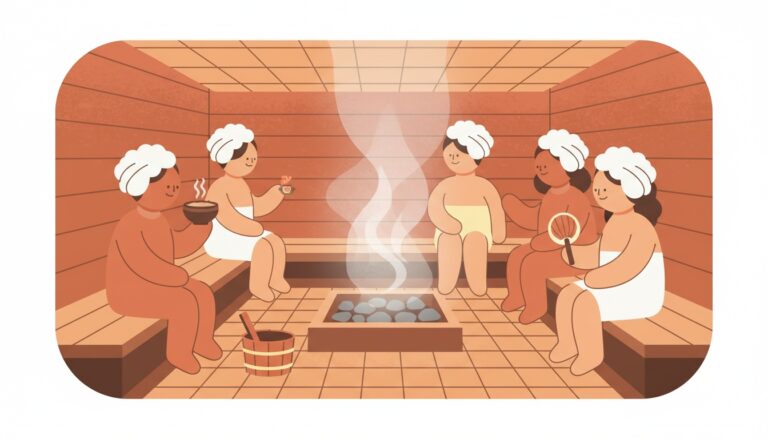
Have you seen people wearing towels on their heads that look like sheep horns? This is called Yangmeori (양머리). It’s not just for K-Dramas! It actually helps keep your head cool and catches sweat from dripping into your eyes.
Phase 5: Real-Life Scenario (Roleplay)
Setting: A 70°C Bulgama (Fire Kiln) room. It is packed.
Characters: Alex (You) & Korean Uncle (Stranger)
Alex: (Opening the door slightly and peeking in)
자리 있어요?
(Jari isseoyo?)
(Is there a spot?)
Korean Uncle: (Shifting his legs to make space)
네, 여기 오세요.
(Ne, yeogi oseyo.)
(Yes, come here.)
Alex: (Sitting down and sweating immediately)
와… 진짜 뜨거워요.
(Wa… jinjja tteugeowoyo.)
(Wow… it’s really hot.)
Korean Uncle: (Smiling and closing his eyes)
그래도 시원하죠?
(Geuraedo siwonhajyo?)
(But it feels refreshing/cool, right?)
Alex: (Trying to understand the paradox)
네… 시원하네요!
(Ne… siwonhaneyo!)
(Yes… it is refreshing!)
Phase 6: 10-Second Shadowing
Let’s practice the magic phrase. Read this out loud in a relaxed, exhaling voice.
“Ah, it feels so good (refreshing)!”
아, / 진짜 / 시원하다!
[Ah, / Jin-jja / Shi-won-ha-da!]
- Intonation Tip: Stretch the “Ah~” at the beginning like you just drank cold water on a hot day. Stress the “Jin” in Jinjja.
Phase 7: FAQ & Troubleshooting
Q: Can I bring my phone into the hot room?
A: Maybe, but be careful. Most saunas have warning signs saying phones might explode or battery life will drain quickly in high heat (over 60°C). It’s better to leave it in the locker or outside the hot room.
Q: Is it okay to sleep in these rooms?
A: Yes! You will see many people sleeping. Just make sure you don’t snore too loudly, and be careful of dehydration. If you feel dizzy, say “Nagalkkayo?” (Shall we go out?) and leave.
Phase 8: Wrap-up
One-Liner Summary: Use “Siwonhada” (It’s cool) when you feel relieved by the heat, and ask “Jari isseoyo?” before sitting down.
Your Mission: Next time you take a hot shower or bath at home, exhale deeply and say “Ah, siwonhada!” Get used to the feeling!
Tell me in the comments: Have you ever tried the “Sheep Head” towel look? Did you succeed? 🐑
Phase 9: Pop Quiz
1. You enter a sauna room that is 80°C. An old man says “Ah, Siwonhada!” What does he mean?
(A) The AC is broken, it’s actually cold.
(B) He is delusional.
(C) He feels physically relieved and refreshed by the heat.
2. You want to sit down, but it looks crowded. What do you ask?
(A) Jari isseoyo? (Is there a seat?)
(B) Eolmayeyo? (How much is it?)
(C) Hwajangsil eodiyeyo? (Where is the bathroom?)
3. Which behavior is rude in a hot room?
(A) Making a “Sheep Head” towel.
(B) Standing in the open doorway for a long time.
(C) Drinking Sikhye (Rice punch).
(Answers: 1. C, 2. A, 3. B)







