

Phase 1: Introduction
Hello, Daily Hangul family! It’s your editor here. 👋
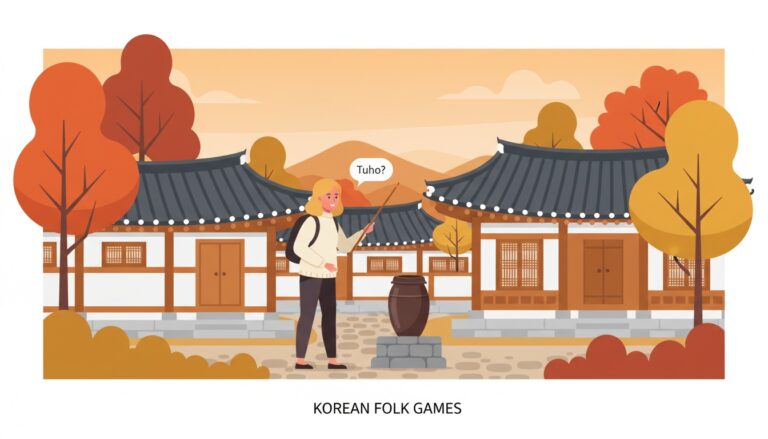
Imagine this: You’ve just arrived at the Korean Folk Village (한국민속촌 – Hanguk Minsokchon). It feels like you’ve time-traveled back to the Joseon Dynasty. You see people throwing arrows into a jar (Tuho) or jumping on a seesaw (Neolttwigi). It looks incredibly fun, and you want to join in!
But then, you freeze. 🥶
You want to ask, “Can I try?” or “How do you play?” but the only phrase coming to mind is “Hello” (안녕하세요). You end up just watching from the sidelines because you’re afraid of being rude.
Don’t worry! As a tutor, I’ve seen so many students miss out on these fun cultural experiences because they lacked just three simple sentences. Today, we are going to fix that. By the end of this post, you’ll be ready to play like a local!
Phase 2: Deep Dive (Core Expressions)
Here are the top 3 phrases you need to survive (and have fun) at the Folk Village.
1. 이거 한번 해 봐도 돼요? (Can I try this once?)
- Pronunciation: [I-geo han-beon hae bwa-do dwae-yo?]
- Sound hint: “Hae” sounds like hair, “Dwae” sounds like dwell.
- Meaning:
- Literal: Can I do this once?
- Real Nuance: This is the magic key to participation. Whether it’s making rice cakes or trying on a mask, this politely asks for permission.
- Editor’s Insight: The grammar
~아/어 봐도 돼요?(Can I try doing…?) is a lifesaver. It shows you are curious but respectful. - Situation Check: ✅ Casual (with
yo) / ✅ Polite enough for strangers.
2. 어떻게 하는 거예요? (How do you do it?)
- Pronunciation: [Eo-tteo-ke ha-neun geo-ye-yo?]
- Sound hint: “Eo” sounds like the u in bus.
- Meaning:
- Literal: How is the doing of this?
- Real Nuance: “I have no idea what the rules are, please teach me.”
- Editor’s Insight: Traditional games have tricky rules. Use this while looking slightly confused, and Koreans will rush to help you kindly!
- Situation Check: ✅ Standard Polite.
3. 와, 진짜 어렵다! (Wow, it’s really hard!)
- Pronunciation: [Wa, jin-jja eo-ryeop-da!]
- Meaning:
- Literal: Wow, really hard!
- Real Nuance: This is a great “reaction” phrase. Even if you fail at the game, saying this makes the situation funny and natural instead of awkward.
- Editor’s Insight: You can mutter this to yourself. It makes you sound like a native speaker who is just frustrated with the game, not the language!
- Situation Check: ✅ Self-talk (Casual) / To others (add
~요at the end:어려워요).
Phase 3: Textbook vs. Real Life
Textbooks often teach you to speak like a news anchor. Let’s learn how to speak like a visitor having fun.
| Textbook Korean (Too Formal) | Real Life Korean (Natural) |
|---|---|
| 이 놀이의 규칙을 설명해 주시겠습니까? (Could you explain the rules of this game?) |
이거 어떻게 해요? (How do you do this?) |
| 저도 참여하고 싶습니다. (I would like to participate too.) |
저도 해 봐도 돼요? (Can I try too?) |
| 매우 흥미롭군요. (It is very interesting.) |
와, 이거 재밌다! (Wow, this is fun!) |
Bottom Note: At an A2 level, simple is better.
이거(This) is your best friend when pointing at games!
Phase 4: Cultural Context & Manners
🤫 The Art of “Nunchi” (Eye-measure)
In a Folk Village, lines for games aren’t always clear. If you see kids playing Tuho (arrow throwing):
1. Don’t just grab an arrow.
2. Use Nunchi. Wait for a pause, make eye contact with the person in charge or the current player, and then ask, “이거 해 봐도 돼요?”
👞 Shoes Off!
Many experiences in the Folk Village take place inside traditional houses (Hanok) or on wooden platforms (Maru). If you see shoes lined up outside, take yours off before stepping up. No exceptions!
Phase 5: Roleplay Scenario
Setting: Alex is at the Folk Village and sees people throwing arrows into a jar (Tuho).
Characters:
* Alex: Tourist (A2 Level)
* Staff: Dressed in Hanbok (Traditional clothes)
(Alex walks up to the staff holding the arrows)
Alex: 안녕하세요! 이거… 이거 해 봐도 돼요?
(Hello! This… Can I try this?)
Staff: 네, 물론이죠! 여기 서서 던지세요.
(Yes, of course! Stand here and throw.)
Alex: (Looks confused) 음… 어떻게 하는 거예요?
(Um… How do you do it?)
Staff: (Demonstrates) 팔을 쭉 뻗어서 던지면 돼요.
(Stretch your arm out and throw.)
Alex: (Throws and fails completely) 으악! 와, 진짜 어렵다!
(Argh! Wow, it’s really hard!)
Staff: (Laughing) 괜찮아요. 다시 해 보세요!
(It’s okay. Try again!)
Phase 6: 10-Second Shadowing
Let’s practice the most useful phrase. Read this aloud three times. Watch the pause marks (/)!
“Excuse me, can I try this once?”
저기요, / 이거 / 한번 / 해 봐도 돼요?
[Jeo-gi-yo, / i-geo / han-beon / hae bwa-do dwae-yo?]
💡 Tip: Raise your intonation slightly at the end (돼요?↗) to sound polite and asking.
Phase 7: FAQ & Troubleshooting
Q: The staff are dressed as servants or commoners. Can I use Banmal (casual language)?
A: NO! ❌ Even if they are acting as “servants,” they are staff members and strangers to you. Always use polite language (ends in ~yo or ~nida). Using casual language can be considered very rude.
Q: What if I don’t understand their explanation?
A: Just use your body language! Watch them demonstrate and say “아~” (Ah~) while nodding. It’s the universal sound of understanding in Korea.
Phase 8: Wrap-up
📝 One-Liner Summary:
To play traditional games, ask “해 봐도 돼요?” (Can I try?) and react with “어렵다!” (It’s hard!) to break the ice.
🏃 Action Mission:
Find a YouTube video of people playing “Tuho” (Korean arrow throwing). Imagine you are holding the arrow and say, “어떻게 하는 거예요?” out loud!
💬 Comment below:
Which Korean traditional game do you want to try most? Tuho? Or maybe Kite flying? Let me know!
Phase 9: Pop Quiz
1. You want to ask permission to play a game. What do you say?
A) 이거 주세요. (Give me this.)
B) 이거 해 봐도 돼요? (Can I try this?)
C) 이거 안 해요. (I don’t do this.)
2. How do you ask “How do you do it?”
A) 왜 해요? (Why do you do it?)
B) 언제 해요? (When do you do it?)
C) 어떻게 하는 거예요? (How do you do it?)
3. True or False: You can speak casually (Banmal) to staff because they are wearing old-fashioned clothes.
A) True
B) False
(Answers: 1-B, 2-C, 3-B)
Frequently Asked Questions (FAQ)
Q: What does "이거 한번 해 봐도 돼요? (Can I try this once?)" mean in Korean and how do you pronounce it?
A: In Korean, "이거 한번 해 봐도 돼요? (Can I try this once?)" is pronounced [I-geo han-beon hae bwa-do dwae-yo?] and means: a key conversational Korean expression covered in this lesson.
Q: What does "어떻게 하는 거예요? (How do you do it?)" mean in Korean and how do you pronounce it?
A: In Korean, "어떻게 하는 거예요? (How do you do it?)" is pronounced [Eo-tteo-ke ha-neun geo-ye-yo?] and means: a key conversational Korean expression covered in this lesson.
Q: What does "와, 진짜 어렵다! (Wow, it’s really hard!)" mean in Korean and how do you pronounce it?
A: In Korean, "와, 진짜 어렵다! (Wow, it’s really hard!)" is pronounced [Wa, jin-jja eo-ryeop-da!] and means: Literal: Wow, really hard!







