

Phase 1: Introduction
안녕하세요! Hello! This is your editor from Daily Hangul.
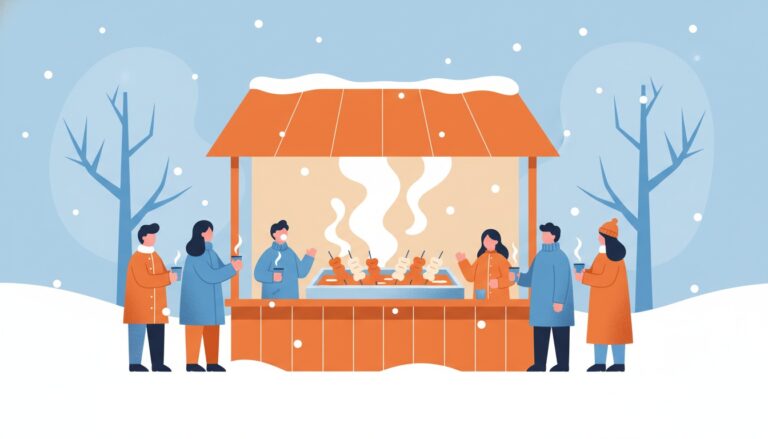
Imagine this: You are walking down a street in Seoul. It is -10°C (14°F), and the wind is biting your face. Suddenly, you see a glowing tent with steam rising into the cold air. It smells savory, fishy, and incredibly warm. You see people standing around eating skewers and sipping hot soup from paper cups.
This is the holy grail of Korean winter snacks: Eomuk (어묵), or Fish Cake.
But here is the panic moment. You want that warm soup desperately. But you don’t know if it’s free. You don’t know how to ask for it. Do you just take a cup? Do you have to pay first?
I have seen so many students stand awkwardly outside the tent, too scared to enter, eventually walking away shivering. Don’t be that person! Today, I will teach you the exact survival phrases to enjoy this delicious snack like a true local “Inssa” (Insider).
Phase 2: Deep Dive (Core Expressions)
Here are the 3 phrases you need to survive at an Eomuk stand.
1. 이거 얼마예요? (How much is this?)
- Pronunciation: [I-geo eol-ma-ye-yo?]
- Sound Analogy: E-go (like Lego) + All-ma (like All my friends) + Yey-yo.
- Meaning: How much is this?
- Editor’s Insight: Even if the price is written down, asking this is a great icebreaker. It shows the vendor (usually called Sajangnim or Imo) that you are ready to buy.
- Situation: Essential for A1 beginners. Use it everywhere, not just for food!
2. 어묵 주세요. (Please give me fish cake.)
- Pronunciation: [Eo-muk ju-se-yo]
- Sound Analogy: Uh-mook (rhymes with Book) + Ju-se-yo.
- Meaning: Please give me Eomuk.
- Editor’s Insight: You can point at the skewer you want. Often, there are two types: straight bars and twisted ones. They usually taste the same, but the texture is different!
- Situation: Polite and standard.
3. 국물 좀 주세요. (Please give me some broth.)
- Pronunciation: [Gung-mul jom ju-se-yo]
- Sound Analogy: Gung-mool (The ‘k’ sound changes to an ‘ng’ sound—this makes you sound very natural!) + Jom + Ju-se-yo.
- Meaning: Please give me some soup/broth.
- Editor’s Insight: This is the magic sentence. The broth is the soul of this snack. The word “Jom” (a little) softens the request, making you sound polite and not demanding.
- Situation: Use this when you are holding your empty paper cup.
Phase 3: Textbook vs. Real Life
Textbooks teach you perfect grammar, but on the street, speed and efficiency matter more.
| Textbook Korean (Too Formal) | Real Street Korean (Natural) |
|---|---|
| 어묵 국물을 주시겠습니까? (Could you please give me fish cake broth?) |
국물 좀 주세요. (Broth, please.) |
| 이것은 무엇입니까? (What is this?) |
이거 뭐예요? (What’s this?) |
| 안녕히 계세요. (Goodbye – staying person) |
많이 파세요! (Sell a lot! / Have a good business!) |
Editor’s Note: “많이 파세요” (Man-i pa-se-yo) is a beautiful phrase to say when leaving. It wishes the vendor good fortune. They will love you for saying this!
Phase 4: Cultural Context & Manners
At an Eomuk stand, there is an invisible flow of Nunchi (eye measure/sensing the atmosphere).
- The Soy Sauce Rule: NEVER dip your half-eaten skewer back into the communal soy sauce pot. This is a huge taboo. Use the brush provided to paint the sauce on your skewer, or pour sauce onto a small plate.
- Self-Service Soup: In many places, you will see a sign that says “물은 셀프” (Water is self-service). Often, the soup is also self-service. If you see a ladle and a stack of paper cups, you can just serve yourself! You don’t even need to ask.
- Payment: You usually eat first and pay later (Post-pay). Count how many sticks you ate and tell the owner at the end.
Phase 5: Real Scenario Roleplay
Setting: A street stall in Hongdae. It’s snowy.
Characters: Alex (Tourist, hungry) vs. Imo (Vendor, friendly auntie).
(Alex walks up to the stall and smells the soup.)
- Alex: 안녕하세요! 이거 얼마예요?
- (An-nyeong-ha-se-yo! I-geo eol-ma-ye-yo?)
- Hello! How much is this?
- Imo: 하나에 천 원이야.
- (Ha-na-e cheon-won-i-ya.)
- It’s 1,000 won for one.
- Alex: 두 개 주세요.
- (Du gae ju-se-yo.)
- Two, please.
(Alex eats the fish cake. It’s hot!)
- Alex: (Holding out a paper cup) 사장님, 국물 좀 주세요.
- (Sa-jang-nim, gung-mul jom ju-se-yo.)
- Boss, please give me some broth.
- Imo: 여기 있어. 뜨거우니까 조심해.
- (Yeo-gi i-sseo. Tteu-geo-u-ni-kka jo-sim-hae.)
- Here you go. Be careful, it’s hot.
Phase 6: 10-Second Shadowing Drill
Let’s practice the most important phrase to get that warm soup. Read this aloud 3 times!
“Boss, please give me a little broth.”
사장님, / 국물 좀 / 주세요.
[Sa-jang-nim, / Gung-mul jom / Ju-se-yo]
- Tip: Put a slight stress on “Gung” and “Jom”.
Phase 7: FAQ & Troubleshooting
Q: Can I just drink the broth without buying anything?
A: Generally, no. It’s polite to buy at least one skewer (usually 1,000 ~ 1,500 KRW) before drinking the free soup.
Q: Is it ‘Odeng’ or ‘Eomuk’?
A: Good question! Odeng (오뎅) comes from Japanese, while Eomuk (어묵) is the native Korean word. Both are understood perfectly, but ‘Eomuk’ is considered the correct standard language. However, many signs still say ‘Odeng’.
Phase 8: Wrap-up
- One-Liner Summary: To enjoy Korean winter street food, just ask “Eol-ma-ye-yo?” (Price) and “Gung-mul jom ju-se-yo” (Soup).
- Action Mission: Next time you pass a street stall, don’t just walk by. Buy one stick, and try saying “Gung-mul jom ju-se-yo.” The warmth will surprise you!
Are you team ‘Spicy Eomuk’ (Red) or ‘Mild Eomuk’ (White)? Let me know in the comments!
Phase 9: Pop Quiz
1. How do you say “Please give me broth”?
A) Odeng ju-se-yo
B) Gung-mul jom ju-se-yo
C) Mul ju-se-yo
2. Which action is rude at a street stall?
A) Drinking soup from a paper cup.
B) Asking the price first.
C) Dipping your eaten food back into the shared soy sauce.
3. What is the polite way to say “Sell a lot” when leaving?
A) An-nyeong
B) Man-i pa-se-yo
C) Gamsa-hap-nida
(Answers: 1-B, 2-C, 3-B)
Frequently Asked Questions (FAQ)
Q: What does "이거 얼마예요? (How much is this?)" mean in Korean and how do you pronounce it?
A: In Korean, "이거 얼마예요? (How much is this?)" is pronounced [I-geo eol-ma-ye-yo?] and means: a key conversational Korean expression covered in this lesson.
Q: What does "어묵 주세요. (Please give me fish cake.)" mean in Korean and how do you pronounce it?
A: In Korean, "어묵 주세요. (Please give me fish cake.)" is pronounced [Eo-muk ju-se-yo] and means: a key conversational Korean expression covered in this lesson.
Q: What does "국물 좀 주세요. (Please give me some broth.)" mean in Korean and how do you pronounce it?
A: In Korean, "국물 좀 주세요. (Please give me some broth.)" is pronounced [Gung-mul jom ju-se-yo] and means: a key conversational Korean expression covered in this lesson.







