Phase 1: Introduction (공감)
Hello, Daily Hangul family! It’s your Head Editor here.
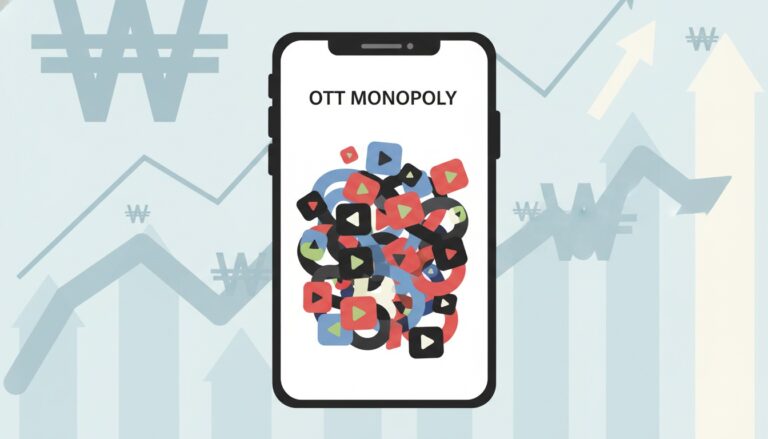
Imagine this scenario: You are sitting in a trendy cafe in Seongsu-dong with your Korean colleagues. The conversation shifts from weekend plans to the sudden price hike of a popular OTT platform (like Netflix or YouTube Premium). Everyone is heating up, using words like “monopoly” and “market disturbance.”
You want to jump in. You want to say, “Honestly, the market is too saturated, and consumers are paying the price for this cutthroat competition.”
But all you can muster is, “비싸요 (It’s expensive).”
Frustrating, right? At the C2 (Advanced) level, your goal isn’t just to communicate needs, but to express opinions on social issues with nuance and sophistication. Today, we are diving deep into the vocabulary of Media & Journalism, specifically focusing on the OTT war. By the end of this post, you’ll be debating market economics like a Korean news anchor.
Phase 2: Deep Dive (핵심 표현 심층 분석)
Here are three high-level expressions frequent in Korean news editorials and intellectual debates.
1. 독과점 (Dog-gwa-jeom)
- Pronunciation: [Dok-kwa-jeom] Think of ‘Dock’ + ‘Kwa’ (like ‘Qua’ in Quality) + ‘Jum’ (jump without the p).
- Meaning: Monopoly and Oligopoly
- Editor’s Insight: This is a compound of 독점 (Monopoly – ruling alone) and 과점 (Oligopoly – ruling by a few). In Korea, where a few conglomerates (Chaebols) often dominate markets, this word is politically charged. It carries a negative nuance of unfair market control.
- Situation Check: 👔 Formal/Debate. (Too heavy for simple small talk about snacks.)
2. 출혈 경쟁 (Chul-hyeol gyeong-jaeng)
- Pronunciation: [Chul-hyeol gyeong-jaeng] ‘Chul’ sounds like ‘Chill’ but with lips rounded. ‘Hyeol’ implies blood.
- Meaning: Cutthroat competition (Literally: “Bleeding competition”)
- Editor’s Insight: This vividly describes a situation where companies lower prices or spend excessively on marketing to the point of suffering losses (‘bleeding’) just to kill off competitors. It’s a very dramatic yet common business term.
- Situation Check: 👔 Formal & ☕ Intellectual Casual.
3. 볼모로 잡다 (Bol-mo-ro jap-da)
- Pronunciation: [Bol-mo-ro jap-da]
- Meaning: To hold hostage
- Editor’s Insight: While originally military/historical, in media contexts, it’s used metaphorically. For example: “The platform is holding the subscribers hostage with exclusive content.” It implies the consumer has no choice but to pay up because they are trapped.
- Situation Check: 👔 News/Op-Ed & ☕ Passionate Complaint.
Phase 3: Textbook vs. Real Life (교과서 vs 진짜 한국어)
At the C2 level, “Real Life” means knowing the buzzwords used in internet communities and industry insider talks.
| Textbook / News Formal | Real Life / Trendy (Buzzwords) |
|---|---|
| 구독료가 인상되었다 (Subscription fees have increased) | 스트림플레이션이 왔다 (Streamflation has arrived) |
| 시장을 지배하다 (Dominate the market) | 다 해 먹는다 (They eat/take everything – cynical nuance) |
| 중복 가입자 (Duplicate subscribers) | 메뚜기족 (Grasshopper tribe – People who hop between services using free trials) |
💡 Editor’s Note: Use “다 해 먹는다” carefully. It implies strong criticism of greed. If you say this about a major company during a discussion, you sound like a local who truly understands the frustration of the common people.
Phase 4: Cultural Context & Manners (문화적 맥락)
The Concept of “Yeoron” (여론 – Public Opinion)
In Western cultures, business is often just business. But in Korea, when a company abuses its 독과점 status, it often faces a backlash called 여론의 뭇매 (The scourge of public opinion).
Koreans differ from many other consumers in their collective action. If an OTT platform raises prices without improving service, you will see organized boycotts or petitions posted on online portals.
Manner Tip: When discussing this, avoid sounding dismissive of the price hikes (e.g., “It’s just a few dollars more”). To many Koreans, this is a matter of fairness (공정성) regarding corporate responsibility. Show empathy for the ‘bleeding competition’ impacting the consumer’s wallet.
Phase 5: Real Scenario Roleplay (실전 시나리오)
Setting: Two friends discussing whether to cancel a subscription over coffee.
- Min-ji (Korean): Another price hike notification.
- Alex (You): An analytical approach.
Dialogue:
민지: 와, 또 가격 올린대. 이 정도면 배짱 장사 아니야?
(Wa, tto ga-gyeok ollin-dae. I jeong-do-myeon bae-jjang jang-sa a-ni-ya?)
(Wow, they’re raising the price again. At this point, isn’t this just arrogant business practice?)
Alex: 솔직히 독과점 구조가 문제야. 대안이 없으니까 소비자를 볼모로 잡고 가격을 올리는 거지.
(Sol-jik-hi **dok-gwa-jeom gu-jo-ga mun-je-ya. Dae-an-i eop-seu-ni-kka so-bi-ja-reul bol-mo-ro jap-go ga-gyeok-eul ol-li-neun geo-ji.)**
(Honestly, the monopoly structure is the problem. Since there are no alternatives, they hold consumers hostage and raise prices.)
민지: 맞아. 예전엔 경쟁하느라 싸게 주더니, 이제 다 잡았다 이거지.
(Ma-ja. Ye-jeon-en gyeong-jaeng-ha-neu-ra ssa-ge ju-deo-ni, i-je da ja-bat-da i-geo-ji.)
(Right. They offered it cheap during the competition, but now they think they’ve captured everyone.)
Alex: 결국 그 출혈 경쟁의 비용을 이제 우리가 떠안는 셈이야.
(Gyeol-guk geu **chul-hyeol gyeong-jaeng-ui bi-yong-eul i-je u-ri-ga tteo-an-neun sem-i-ya.)**
(In the end, it’s like we are now shouldering the cost of that cutthroat competition.)
Phase 6: 10-Second Shadowing (10초 섀도잉)
Let’s practice the rhythm of a logical argument. Focus on the pauses / to sound authoritative.
“소비자들은 / 거대 기업들의 출혈 경쟁에 / 피로감을 느끼고 있습니다.”
(So-bi-ja-deul-eun / geo-dae gi-eop-deul-ui chul-hyeol gyeong-jaeng-e / pi-ro-gam-eul neu-kki-go it-seum-ni-da.)
Meaning: Consumers are feeling fatigue from the cutthroat competition of giant corporations.
Acting Tip: Lower your pitch slightly at “느끼고 있습니다” to sound like a serious analyst.
Phase 7: FAQ & Troubleshooting
Q: Can I use ‘출혈 경쟁’ in daily life, like for sports?
A: Not really. It sounds too serious. For sports, strictly use 치열한 경쟁 (fierce competition). ‘출혈’ implies financial loss or damage, so keep it for business or economics.
Q: Is ‘독과점’ a formal legal term?
A: Yes, but it’s widely used in common conversation whenever people complain about lack of choices (like delivery apps or taxi apps).
Phase 8: Wrap-up
One-Liner Summary:
When complaining about OTT prices, blame the 독과점 (Monopoly) and the aftermath of 출혈 경쟁 (Bleeding competition).
Your Mission:
Next time you see a news article about Netflix or YouTube prices in Korea, look for the word ‘인상’ (Increase) or ‘반발’ (Backlash) in the headline. Try to comment: “이건 전형적인 독과점의 폐해네 (This is a typical evil of monopoly).”
Question for you:
Do you think OTT services in your country are also in a state of 독과점? Let me know in the comments!
Phase 9: Quiz
- Which word best describes a market dominated by a few large companies?
- A) 자유 시장 (Free Market)
- B) 독과점 (Monopoly/Oligopoly)
- C) 재래시장 (Traditional Market)
- If a company lowers prices drastically to kill competitors, suffering losses, this is called:
- A) 출혈 경쟁 (Bleeding Competition)
- B) 선의의 경쟁 (Friendly Competition)
- C) 벼락치기 (Cramming)
- (Fill in the blank) “The platform is holding users ______ with exclusive dramas.”
- A) 친구로 (As friends)
- B) 볼모로 (As hostages)
- C) 손님으로 (As guests)
Click to see answers
1. B, 2. A, 3. B
Frequently Asked Questions (FAQ)
Q: What does "독과점 (Dog-gwa-jeom)" mean in Korean and how do you pronounce it?
A: In Korean, "독과점 (Dog-gwa-jeom)" is pronounced [Dok-kwa-jeom] and means: Monopoly and Oligopoly
Q: What does "출혈 경쟁 (Chul-hyeol gyeong-jaeng)" mean in Korean and how do you pronounce it?
A: In Korean, "출혈 경쟁 (Chul-hyeol gyeong-jaeng)" is pronounced [Chul-hyeol gyeong-jaeng] and means: Cutthroat competition (Literally: "Bleeding competition")
Q: What does "볼모로 잡다 (Bol-mo-ro jap-da)" mean in Korean and how do you pronounce it?
A: In Korean, "볼모로 잡다 (Bol-mo-ro jap-da)" is pronounced [Bol-mo-ro jap-da] and means: To hold hostage