

Phase 1: Introduction
Hello! This is your editor at Daily Hangul.
So, you’ve mastered ordering coffee in Hongdae and asking for directions in Gangnam. Now, you’re ready for the deep end of Korean culture: Daehak-ro (대학로), the Broadway of Seoul.
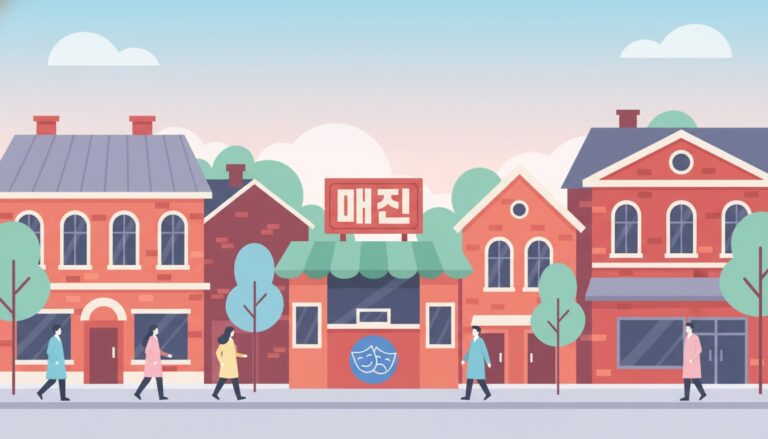
Imagine this: You are standing in front of a tiny red-brick building near Hyehwa Station. You want to see a trendy Sogeukjang (Small Theater) play. But unlike big cinemas like CGV, there’s no kiosk machine, and the staff is shouting something about “Seonchaksun.”
One of my long-time students, Mark from Canada, actually walked away from a box office because he thought the show was sold out when the staff said, “No assigned seats.” He missed a great comedy show because he didn’t know the local system!
Don’t worry. Today, I will teach you the B2-level expressions you need to navigate Korea’s performing arts scene like a true Hyehwa-in (Hyehwa local).
Phase 2: Deep Dive into Key Expressions
Here are the 3 critical terms you’ll hear in the ticket line and lobby. These aren’t in beginner textbooks!
1. 선착순 (Seonchaksun)
- Pronunciation: [Seon-chak-sun] Sounds like “Son” + “Chak” (like chalk) + “Soon”
- Meaning: First come, first served
- Editor’s Insight: This is the golden rule of small theaters. Often, you buy a ticket, but your specific seat number is assigned in the order you arrive at the ticket booth, not when you booked online.
- Situation Check: Used in formal notices but common in everyday speech.
- Ex: “좌석 배정은 선착순입니다.” (Seat assignment is first come, first served.)
2. 현장 예매 / 현장 구매 (Hyeonjang Yemae / Hyeonjang Gumae)
- Pronunciation: [Hyeon-jang-ye-mae] “Hyeon” implies “On-site” or “The actual scene”
- Meaning: On-site ticket purchase
- Editor’s Insight: Many small plays reserve a percentage of tickets for people who just walk up. If an app says “Sold Out,” don’t give up! Ask if Hyeonjang Yemae is possible.
- Situation Check: Very useful when talking to staff.
3. 커튼콜 (Keoteunkol)
- Pronunciation: [Keo-teun-kol] Just like the English “Curtain Call” but with a Korean accent
- Meaning: Curtain Call
- Editor’s Insight: Why learn a Konglish word? Because of strict photography rules. In Korea, taking photos during a play is a huge taboo. However, during the Keoteunkol (when actors bow at the end), it is usually allowed.
- Situation Check: Casual & Formal.
Phase 3: Textbook vs. Real Life
Textbooks are polite, but sometimes too stiff for the energetic vibe of a theater district.
| Textbook Korean (A bit stiff) | Real Korean (Natural & Smart) | Context |
|---|---|---|
| 표를 살 수 있습니까? (Can I buy a ticket?) |
현장 구매 남은 거 있어요? (Do you have any on-site tickets left?) |
Asking at the booth |
| 사진을 찍어도 됩니까? (May I take a photo?) |
커튼콜 때는 찍어도 되나요? (Is it okay to shoot during the curtain call?) |
Checking camera rules |
| 자리가 어디입니까? (Where is the seat?) |
자유석인가요, 지정석인가요? (Is it free seating or assigned seating?) |
Checking seat type |
- Editor’s Note: At B2 level, try using specific nouns like 자유석 (Free seating) instead of asking vague questions.
Phase 4: Cultural Context & Manners
1. The “Small Theater” Intimacy
In a Sogeukjang, the stage is incredibly close. If you sit in the front row, an actor might talk to you or ask you to hold a prop!
* Nunchi Tip: If an actor makes eye contact, don’t look away or check your phone. Smile and nod. If you shy away, it breaks the energy (Gi) of the performance.
2. No Re-entry Policy
Unlike movie theaters, if you leave a small theater to use the restroom, you cannot re-enter. The doors are right next to the stage, and opening them ruins the lighting and sound.
* Manner: Go to the bathroom 10 minutes before the show starts. No exceptions!
Phase 5: Roleplay Script
Setting: At the ticket booth of a small theater in Daehak-ro 30 minutes before the show.
Characters: Alex (Foreign Student), Staff (Theater Employee)
Alex: (Approaching the window) 안녕하세요. 혹시 3시 공연 현장 구매 가능한가요?
(Hello. Is on-site purchase available for the 3 PM show?)
[An-nyeong-ha-se-yo. Hok-si 3-si gong-yeon hyeon-jang-gu-mae ga-neung-han-ga-yo?]
Staff: 네, 가능합니다. 그런데 좌석은 선착순 배정이라 뒷줄만 남았어요. 괜찮으세요?
(Yes, it is. But seats are assigned on a first-come, first-served basis, so only the back rows are left. Is that okay?)
[Ne, ga-neung-ham-ni-da. Geu-reon-de jwa-seok-eun seon-chak-sun bae-jeong-i-ra dwit-jul-man na-ma-sseo-yo. Gwaen-chan-eu-se-yo?]
Alex: (Nodding) 네, 괜찮아요. 아, 그리고 커튼콜 촬영은 되나요?
(Yes, that’s fine. Oh, and is filming allowed during the curtain call?)
[Ne, gwaen-chan-a-yo. Ah, geu-ri-go keo-teun-kol chwal-yeong-eun doe-na-yo?]
Staff: 네, 커튼콜 때는 자유롭게 찍으셔도 됩니다.
(Yes, you can take photos freely during the curtain call.)
[Ne, keo-teun-kol ttae-neun ja-yu-rop-ge jji-geu-syeo-do doem-ni-da.]
Phase 6: 10-Second Shadowing Drill
Let’s practice the sentence you will hear the most. Read this aloud with the pauses!
“Please note that re-entry is strictly prohibited once the performance begins.”
공연 시작 후에는 / 입장이 / 절대 불가합니다.
[Gong-yeon si-jak hu-e-neun / ip-jang-i / jeol-dae bul-ga-ham-ni-da.]
- Focus: Emphasize “절대 (Jeol-dae)” to show you understand the strictness.
Phase 7: FAQ & Troubleshooting
- Q: Can I drink water inside?
- A: Usually, yes. Bottled water (생수) is okay, but coffee or sugary drinks are a big NO in small theaters because of the potential for spills and noise.
- Q: Is it rude to laugh loudly?
- A: Absolutely not! In Korean theater culture, loud reactions (Li-ek-shon / Reaction) are considered a compliment to the actors. Laugh, clap, and gasp freely!
Phase 8: Wrap-up & Action Item
Summary:
Today we learned that Seonchaksun dictates your seat, Hyeonjang Yemae can save you when online tickets are gone, and Keoteunkol is your only chance for Instagram photos.
Your Mission:
Go to a ticket booth in Daehak-ro this weekend (even if you don’t buy a ticket) and look for a sign that says “선착순” or “매진 (Sold Out).” Take a picture of the sign and tag us!
Question:
Have you ever watched a play in a language you didn’t fully understand? How was it? Let me know in the comments!
Phase 9: Quiz
1. What does “선착순 (Seonchaksun)” mean?
a) Reserved seating
b) VIP only
c) First come, first served
2. When is it usually okay to take photos in a Korean theater?
a) During the climax
b) During the Curtain Call (커튼콜)
c) Whenever the actor looks at you
3. Which phrase is best to ask for on-site tickets?
a) 표 주세요 (Give me ticket)
b) 현장 구매 가능한가요? (Is on-site purchase available?)
c) 이거 얼마예요? (How much is this?)
(Answers: 1-c, 2-b, 3-b)
Frequently Asked Questions (FAQ)
Q: What does "선착순 (Seonchaksun)" mean in Korean and how do you pronounce it?
A: In Korean, "선착순 (Seonchaksun)" is pronounced [Seon-chak-sun] and means: First come, first served
Q: What does "현장 예매 / 현장 구매 (Hyeonjang Yemae / Hyeonjang Gumae)" mean in Korean and how do you pronounce it?
A: In Korean, "현장 예매 / 현장 구매 (Hyeonjang Yemae / Hyeonjang Gumae)" is pronounced [Hyeon-jang-ye-mae] and means: On-site ticket purchase
Q: What does "커튼콜 (Keoteunkol)" mean in Korean and how do you pronounce it?
A: In Korean, "커튼콜 (Keoteunkol)" is pronounced [Keo-teun-kol] and means: Curtain Call







