

안녕하세요! Hello from Daily Hangul! 👋
I’m your editor at Daily Hangul. Have you ever walked out of your house in Seoul on a sunny morning, only to be completely soaked by a sudden downpour three hours later? Then, your Korean friend looks at you with pity and says, “Didn’t you check the news? They said it would rain today!”
Frustrating, right?
At the B1 (Intermediate) level, the biggest game-changer is moving from simply stating facts (“It is raining”) to reporting information (“The forecast said it will rain”). This is called Indirect Speech, and it is the secret sauce to sounding like a true local.
Today, we are going to master how to quote the weather forecast so you never get caught in the rain (or the awkward silence) again.
1. The “Pass the Mic” Expression: ~대요 (~dae-yo)
In textbooks, you learn long forms. In real life, Koreans love to shorten everything. This is the most common way to report what you heard.
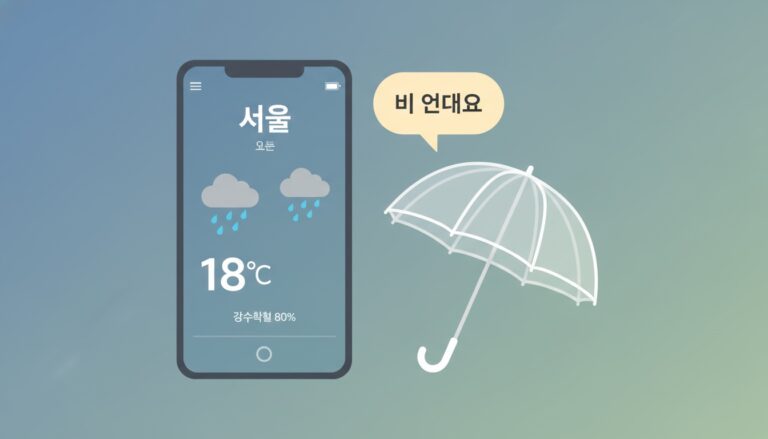
일기예보에서 내일 비가 온대요.
(The weather forecast said it will rain tomorrow.)
- Pronunciation: Il-gi-ye-bo-e-seo nae-il bi-ga on-dae-yo
- (Tip: on-dae-yo sounds a bit like “Own Day, Yo!” with a rising tone at the end.)
- Meaning: “They say it’s raining tomorrow.”
- Grammar Note: This is a contraction of 온다고 해요 (indirect speech).
- Dictionary form: 오다 (to come) + ㄴ다고 해요 = 온대요.
- Editor’s Insight: If you say “내일 비 와요” (It rains tomorrow), it sounds like you are the weatherman predicting it. If you say “내일 비 온대요” (They say it rains), you are citing a source. It’s much safer!
2. The “Future Quote”: ~(으)ㄹ 거라고 했어요
When the forecast predicts something for the future, the grammar shifts slightly.
오후에는 갤 거라고 했어요.
(They said it will clear up in the afternoon.)
- Pronunciation: O-hu-e-neun gael geo-ra-go hae-sseo-yo
- Meaning: “(The forecast) said it is going to clear up.”
- Vocabulary: 개다 (gaeda) = to clear up / stop raining.
- Situation Check: Use this when you are making plans. “Hey, let’s meet at 3 PM, they said it’ll clear up by then.”
3. The “Probability” Talk: 강수 확률 (Precipitation Probability)
Koreans are obsessed with percentages regarding rain.
강수 확률이 90%래요.
(They say the chance of rain is 90%.)
- Pronunciation: Gang-su hwang-nyur-i gu-sip-peo-sen-teu-rae-yo
- Editor’s Insight: Notice we used -래요 instead of -대요 here? That’s because ‘90%’ is a noun.
- Action Verbs + ㄴ대요
- Nouns/Adjectives + (이)래요
⚖️ Textbook vs. Real Life (B1 Level)
Here is how to upgrade your Korean from “Classroom Robot” to “Seoul Insider.”
| Textbook Korean (Standard) | Real Korean (Natural/Casual) |
|---|---|
| 일기예보에서 비가 온다고 하였습니다. (The forecast stated it will rain.) |
일기예보 보니까 비 온대. (Saw the forecast, says it’s raining.) |
| 내일 날씨가 춥다고 들었습니다. (I heard the weather will be cold.) |
내일 완전 춥대! 롱패딩 입어. (They say it’s freezing tomorrow! Wear your long puffer.) |
| 비가 올 것 같아요. (I think it will rain.) |
비 온다던데? (Didn’t they say it’s gonna rain?) |
Editor’s Note: Using “~던데?” (don-de?) at the end adds a nuance of “I recall hearing this… am I right?” It’s a great conversation starter.
🇰🇷 Cultural Context: The “K-Umbrella” Culture
In many Western countries, people might just wear a hoodie and run through light rain. In Korea? Absolutely not.
- Acid Rain Myth: Many Koreans believe that rain contains harmful dust/pollution (acid rain), so getting hit by rain causes hair loss (탈모). Whether scientifically true or not, do not let your Korean friend get wet. Offer to share your umbrella!
- The Convenience Store Umbrella: If the forecast was wrong, don’t panic. Walk into any convenience store (GS25, CU, 7-Eleven) and buy a transparent plastic umbrella (bini-lusan). It’s cheap, iconic, and you’ll see everyone carrying one.
🎭 Roleplay: Making Weekend Plans
- Setting: Friday afternoon at a cafe.
- Characters: Alex (Foreigner) and Minji (Korean).
Minji: 우리 내일 한강 공원 갈까?
(Uri nae-il Han-gang gong-won gal-kka?)
(Shall we go to Han River Park tomorrow?)
Alex: (Checking phone) 음, 글쎄. 일기예보에서 내일 비 온대.
(Eum, geul-sse. Il-gi-ye-bo-e-seo nae-il bi on-dae.)
(Hmm, well. The forecast says it rains tomorrow.)
Minji: 진짜? 아쉽다. 그럼 실내 쇼핑몰 갈래?
(Jin-jja? A-swip-da. Geu-reom sil-lae syo-ping-mol gal-lae?)
(Really? That’s a shame. Then wanna go to an indoor mall?)
Alex: 좋아! 오후에는 바람도 많이 분다고 했어.
(Jo-a! O-hu-e-neun ba-ram-do ma-ni bun-da-go hae-sseo.)
(Good! They also said the wind will blow a lot in the afternoon.)
🗣️ 10-Second Shadowing Drill
Read this out loud. Pay attention to the pause marked by /.
“뉴스에서 그러는데 / 내일 하루 종일 비 온대요.”
(The news says / it’s going to rain all day tomorrow.)
- Romanization: Nyu-seu-e-seo geu-reo-neun-de / nae-il ha-ru jong-il bi on-dae-yo.
- Intonation Tip: Raise your pitch slightly on ‘는데’ and ‘온’ to emphasize the source and the rain.
❓ FAQ: Troubleshooting
Q: Can I use “-대요” to my boss?
A: Yes, but be careful with the ending!
* To friends: “내일 비 온대.” (O)
* To boss: “내일 비 온대요.” (O – Polite)
* To very formal boss/client: “내일 비가 온다고 합니다.” (Best)
Q: What if I didn’t hear it from the news, but from a friend?
A: The grammar is the same! Indirect speech is about reporting any source. “제 친구가 내일 비 온대요” (My friend says it rains tomorrow).
🎁 Wrap-up & Mission
Summary: Use Verb + ㄴ대요 to report weather news like a local without claiming you are a meteorologist.
Your Mission: Open your phone’s weather app right now. Look at tomorrow’s weather. Text a Korean friend (or post in the comments):
“일기예보 봤는데, 내일 [ weather ]대요!”
(I saw the forecast, and they say it will be [ weather ] tomorrow!)
See you in the next lesson! stay dry! ☔️
📝 Quick Quiz
1. How do you shorten “비가 온다고 해요” (They say it rains)?
A) 비가 온래요
B) 비가 온대요
C) 비가 오네요
2. Which phrase is best for citing a source (like the news)?
A) 제 생각에는… (In my opinion…)
B) 일기예보에서… (In the weather forecast…)
C) 제가 봤는데… (I saw it…)
3. True or False: It is culturally common in Korea to worry about “acid rain” (hair loss) and avoid getting wet at all costs.
Click to see answers
1. B (Action verbs use -ㄴ대요)
2. B (Explicitly citing the forecast)
3. True







